

Decluttering Singapore homes well is really about making a small space work harder, whether you live in a compact flat or a larger unit where things have quietly piled up over the years. A good clear-out lifts the mood, frees up storage and makes daily life smoother. This is a general, practical guide to help you get started, work through the process, and pass on what you no longer need responsibly.
You do not need a dramatic overhaul or a spare weekend you will never find. What works best is a clear method, a little momentum, and a plan for where things go once you decide to let them leave.
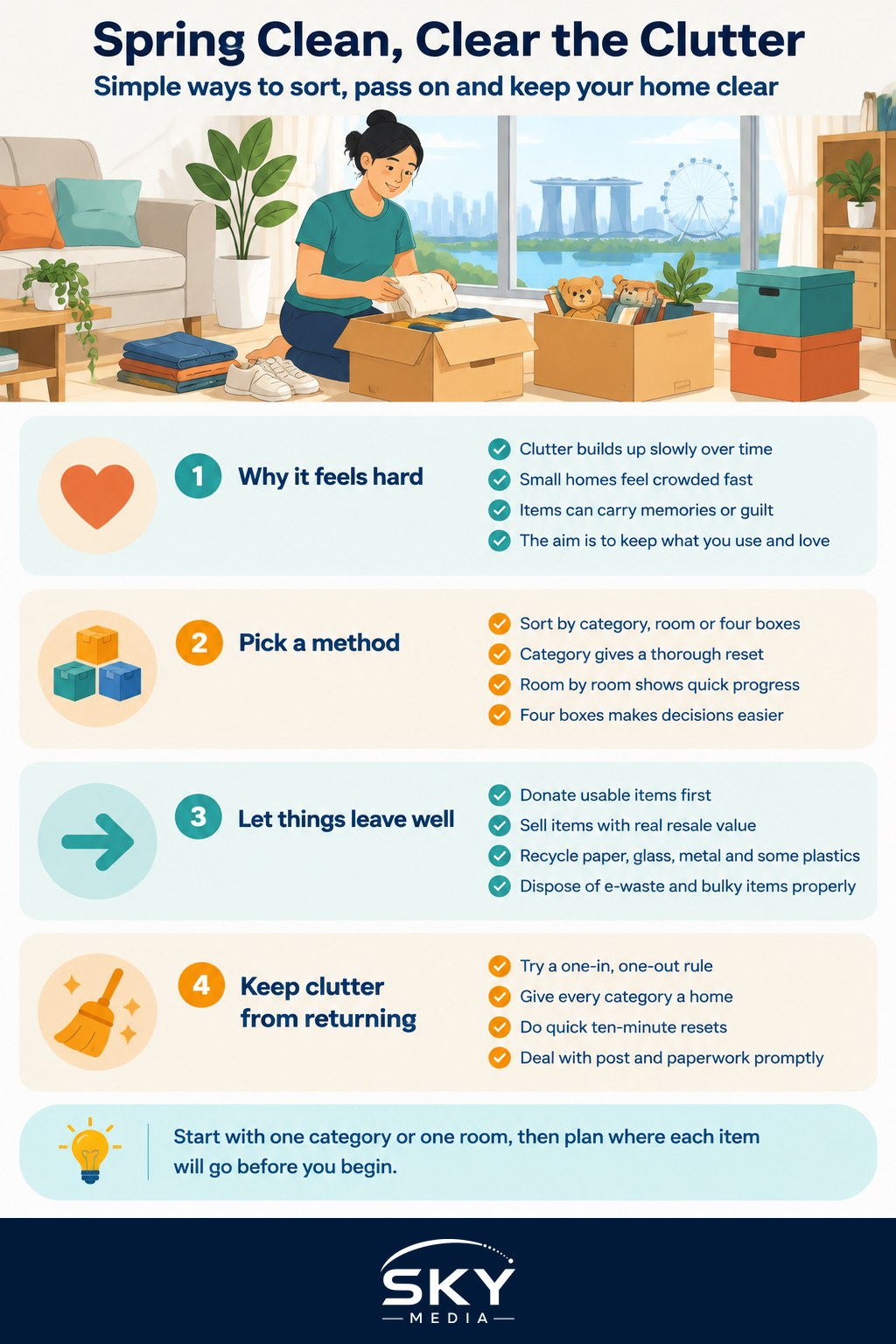
Why Decluttering Feels So Hard
Clutter builds up slowly, so it rarely feels like a decision at any single point. Gifts we feel guilty about, clothes that no longer fit, gadgets kept “just in case”, and paperwork we mean to sort all accumulate until the cupboards are full. In a country where homes are often on the cosier side, this stored-up stuff has an outsized effect, crowding surfaces and making even a tidy home feel cramped.
There is an emotional side too. Many items carry memories or represent money spent, and letting go can feel like waste or loss. Naming this openly makes the process easier. The aim is not to strip your home bare, but to keep what you use and love, and to release the rest so someone else can benefit from it.
Practical Methods That Work
There is no single correct method, so pick the one that suits your temperament and the time you have.
The category method asks you to tackle one type of item at a time, such as all your clothes, then all your books, then paperwork. Gathering everything in a category into one place is confronting in a useful way, because you finally see how much you own. You then keep only what you genuinely use or love.
The room-by-room method suits people who prefer visible progress. You finish one space completely before moving on, which builds momentum and gives you a tidy room to enjoy straight away. This works well in a flat, where a single bedroom or kitchen is a manageable target for an afternoon.
The four-box method is the simplest of all. As you go, sort each item into keep, donate or sell, recycle, and dispose. Labelling four containers before you start removes the endless deliberation, because every object must go into one of them.
Whichever you choose, a few habits help. Work in short sessions so you do not burn out, handle each item once and decide, and be honest about the difference between “I use this” and “I might use this”. A useful test is to ask when you last used something and whether you would buy it again today.
The table below compares the three approaches.
| Method | Best for | The catch |
|---|---|---|
| Category | A thorough, one-off reset | Time-consuming to gather everything |
| Room by room | Visible, motivating progress | Similar items get handled twice |
| Four-box | Quick, low-decision clearing | Boxes need emptying promptly |
Where Things Go Next
The step people skip is deciding what happens to the “leaving” pile, and a bag by the door for weeks quietly undoes your good work. Plan the exit as carefully as the sorting.
For items in good condition, donating is a fine first choice. Various charities and community organisations accept clothing, household goods and sometimes furniture, and some run collection points or drives. Check what a charity actually accepts before you turn up, because unusable donations simply become their problem to dispose of. Places of worship, community clubs and neighbourhood groups sometimes organise giving initiatives too.
Selling suits items with real resale value, such as electronics, branded goods and furniture in good shape. Online marketplaces and community selling platforms are widely used here, and giving-away groups let you pass on items for free to neighbours who will use them. Be realistic on price and honest on condition, and you will clear things faster.
Recycling and proper disposal handle the rest. Paper, certain plastics, glass and metal go into the blue recycling bins found around housing estates, though you should rinse containers and avoid contaminating the bin with food or general rubbish. Electronic waste, or e-waste, should not go into a normal bin, and there are dedicated e-waste collection points and programmes for items such as old phones, batteries and appliances. For bulky items like old furniture, your town council can advise on collection, and reporting a bulky removal through the usual municipal channels keeps corridors and void decks clear. When in doubt about how to dispose of something correctly, check with the National Environment Agency (NEA) or your town council rather than guessing.
Keeping It Clear
A clear-out only lasts if a little of the discipline stays behind afterwards. A few gentle habits keep clutter from creeping back.
Try a one-in, one-out rule, where a new item means an old one leaves. Give every category a home, so tidying becomes returning things rather than finding space. Do a quick ten-minute reset now and then, especially for surfaces that attract clutter such as the dining table and the entrance. Deal with paperwork and post as it arrives rather than letting it stack up. If storage is genuinely tight, consider whether renting a small self-storage unit for seasonal or sentimental items makes sense, but treat it as a considered choice, not a way to avoid decisions.
Decluttering is not a single heroic weekend but a habit you build over time. Start small, choose a method, plan where things go, and let the calm of a clearer home carry you forward. In a compact space, every item you release gives you back something more valuable than the object itself, which is room to breathe.
Explore more
Reducing Waste at Home
Using Self-Storage
Setting Up Your HDB Home
Dealing With Humidity
Frequently Asked Questions
Which decluttering method should I start with in a small flat? The room-by-room method works well in a small flat, since one bedroom or kitchen is a manageable target for an afternoon and gives you a tidy space straight away. If you want a thorough reset instead, try the category method and gather everything of one type first.
How do I decide whether to keep something I might use? Ask when you last used it and whether you would buy it again today. Be honest about the difference between “I use this” and “I might use this”. If you cannot name a likely use, it is probably time to let it go.
What should I do with old electronics and batteries? Do not put e-waste into a normal bin. There are dedicated e-waste collection points and programmes for items such as old phones, batteries and appliances. If you are unsure how to dispose of something correctly, check with the National Environment Agency or your town council.
Can I donate everything that is still in good condition? Mostly, but check what a charity actually accepts before you turn up, because unusable items simply become their problem to dispose of. Clothing, household goods and sometimes furniture are taken by various groups, and some run collection points or drives.
How do I stop clutter coming back after a clear-out? Try a one-in, one-out rule, give every category a home, and do a quick ten-minute reset now and then on surfaces like the dining table. Deal with post as it arrives. Self-storage can help with seasonal items, but should not replace decisions.
Further reading: How to Compare Cleaning Services for a One-Off Deep Clean