

When a parent has a stroke, families often brace for weakness on one side of the body. What can be harder to cope with is losing the ability to talk with them. Aphasia after stroke is a language disorder that can affect speaking, understanding, reading and writing. Your parent is usually still the same person inside, with the same memories and opinions, but the route between thought and words has been damaged.
This guide explains what aphasia is, how speech therapy works in Singapore, and practical things you can do at home every day. It is general information, not medical advice. Your parent’s doctors and speech therapist know their condition and should guide decisions about treatment.
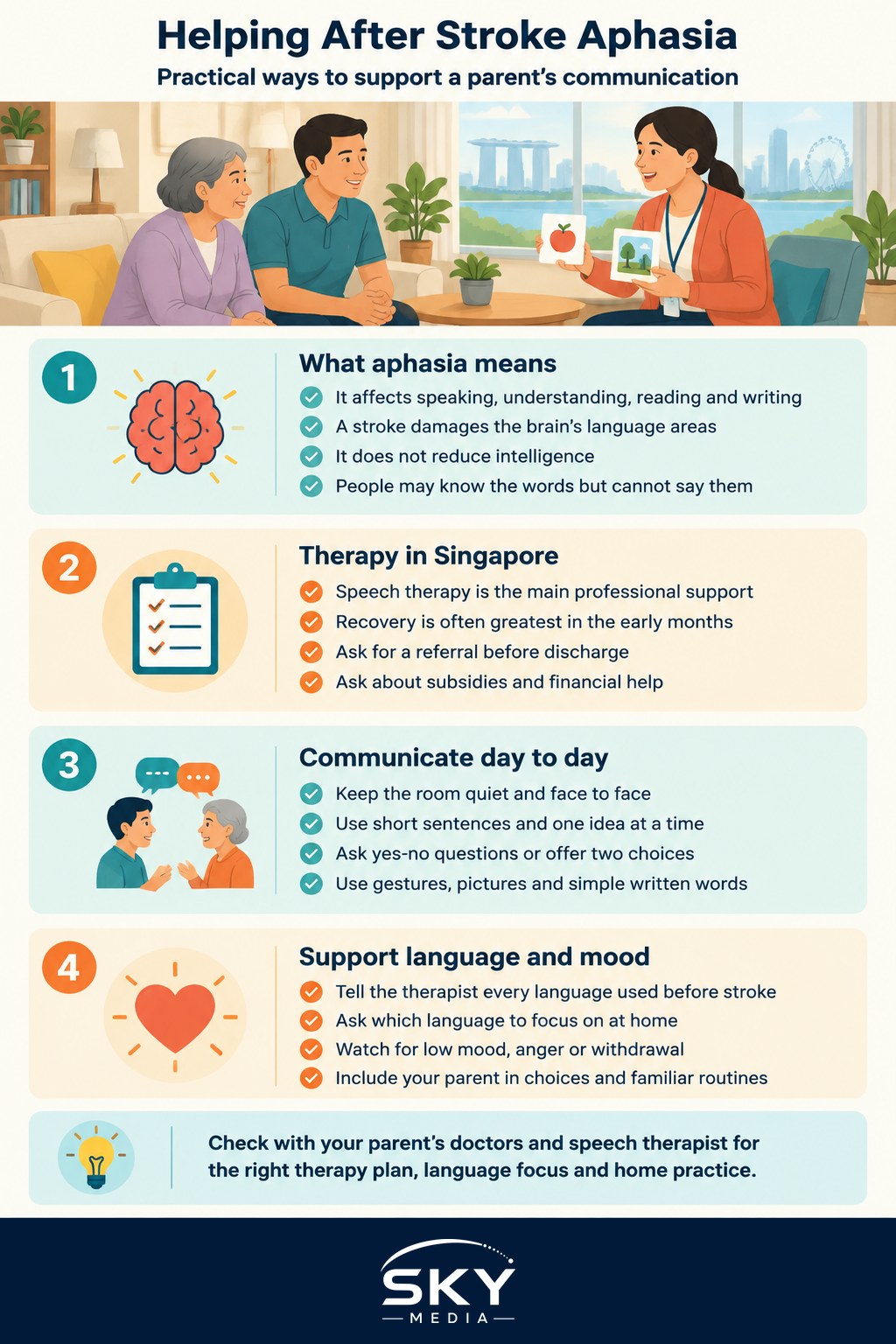
What Aphasia Is, and What It Is Not
Aphasia happens when a stroke damages the parts of the brain that handle language, most often on the left side. It does not reduce intelligence. Many people with aphasia know exactly what they want to say but cannot find or produce the words.
Doctors and therapists often describe a few broad patterns, though every person is different:
- Difficulty producing language. Speech may be slow, effortful and short, with missing words. Understanding is often better than speaking. This is sometimes called expressive or non-fluent aphasia.
- Difficulty understanding language. Speech may flow easily but contain wrong or made-up words, and the person may not realise they are not making sense. This is sometimes called receptive or fluent aphasia.
- Severe difficulty with both. Sometimes called global aphasia, this affects most forms of communication.
Aphasia is different from two other conditions that can follow a stroke and often appear alongside it:
- Dysarthria, where weak or uncoordinated muscles make speech slurred or hard to hear.
- Apraxia of speech, where the brain struggles to plan the mouth movements needed for speech.
A speech therapist will assess which of these are present, because each needs a different approach.
Speech Therapy Options in Singapore
Recovery from aphasia is often greatest in the first months after a stroke, but many people continue to improve slowly for much longer with practice. Speech therapy is the main professional support.
| Setting | What it usually involves | Things to ask |
|---|---|---|
| Acute hospital | Early assessment, swallowing checks, first advice for family | Diagnosis, type of aphasia, referral for follow-up therapy |
| Community hospital or inpatient rehab | Regular therapy sessions while recovering before going home | Therapy frequency, family training, discharge plan |
| Outpatient or day rehabilitation centre | Scheduled sessions after discharge, sometimes in groups | Transport, subsidies, how long sessions continue |
| Home-based or private therapy | Sessions at home or in a clinic, more flexible timing | Therapist’s qualifications, cost, goals and review dates |
Ask the hospital team for a referral before discharge, and ask the medical social worker about subsidies or financial assistance for rehabilitation and caregiving. The Agency for Integrated Care (AIC) is the national body that coordinates community care services and caregiver support, and its website lists rehabilitation and caregiving schemes. Because scheme names, eligibility and amounts change, confirm current details directly with AIC or the hospital.
Ask the therapist for a clear home programme. Daily practice at home, even for short periods, usually matters as much as the sessions themselves.
Everyday Communication Strategies That Help
Small changes in how you talk can make a big difference. Try these consistently, and adapt them to what works for your parent.
Set up the conversation well
– Reduce background noise. Turn off the TV or radio and talk one to one.
– Face your parent, at eye level, and get their attention before you speak.
– Choose a time when they are rested. Fatigue makes aphasia worse.
Keep your language simple, not childish
– Use short sentences with one idea at a time.
– Speak at a slightly slower pace, but in a normal adult tone.
– Avoid sudden topic changes; signal a new topic clearly (“Now, about dinner”).
Make it easier to answer
– Ask yes or no questions (“Do you want tea?”) or offer two choices.
– Give plenty of time. Count silently to ten before helping.
– Do not finish their sentences unless they ask you to.
Use more than words
– Point, gesture and show objects.
– Write key words in large letters, or draw simple pictures.
– Use a communication book or board with photos of family, common needs, food, pain levels and places. Your therapist can help you make one.
– Some families use tablet apps with pictures or recorded phrases. Ask the therapist which tools suit your parent before buying.
Check understanding gently
– Summarise what you think they said and ask if you got it right.
– If you are stuck, say so honestly and try again later. Pretending to understand often causes more frustration.
Aphasia in Multilingual Families
Many Singapore families switch between English, Mandarin, Malay, Tamil and dialects such as Hokkien, Teochew or Cantonese. Aphasia can affect a person’s languages unevenly. Some people recover their first or most-used language better; others do not follow a clear pattern.
- Tell the speech therapist every language your parent used before the stroke, including dialects, and which they used most.
- Ask which language to focus on in home practice, especially if family members speak different languages.
- Grandchildren who do not share your parent’s strongest language can still connect through pictures, music, gestures and shared activities.
Looking After Your Parent’s Mood and Dignity
Losing language is frightening and isolating. Low mood, anger and withdrawal are common after a stroke. Watch for signs such as loss of interest, poor sleep or tearfulness, and raise them with the doctor, because depression after a stroke can be treated.
Ways to protect your parent’s dignity:
- Talk to them, not about them, even when they cannot answer easily.
- Include them in decisions using simple choices.
- Keep familiar routines, hobbies and visits going where possible.
- Singing familiar songs can sometimes be easier than speaking, and is a gentle way to share time.
Our broader guide to stroke prevention and recovery for seniors covers physical recovery, and helping a parent recover at home has tips for setting up the home.
Supporting the Caregiver Too
Caring for someone with aphasia is tiring. You may grieve the conversations you used to have.
- Share the load among siblings and relatives, and agree who handles which appointments.
- Look into caregiver training and support groups. Stroke support organisations and AIC can point you to options.
- Take regular breaks. Respite care services exist for this reason.
- Keep a simple notebook of what works, new words recovered and questions for the therapist.
Progress with aphasia after stroke can be slow and uneven, with good and bad days. Celebrate small gains, keep talking, and lean on the professionals. Even when words are hard, connection is still possible.
Frequently Asked Questions
Can a parent fully recover from aphasia after a stroke? Recovery varies a lot. Some people regain much of their language, while others improve slowly or keep some difficulty. Progress is often greatest in the early months and can continue with practice. The speech therapist can explain what to expect for your parent.
Is aphasia the same as dementia? No. Aphasia is a language problem caused by damage to the language areas of the brain, often after a stroke, and does not by itself mean memory or thinking have declined. A doctor can assess whether other conditions are also present.
Can my parent still make decisions or sign legal documents? Having aphasia does not automatically remove decision-making ability, because many people understand more than they can say. Capacity is assessed for specific decisions, so ask the doctor, and speak to a lawyer about documents such as a Lasting Power of Attorney.
What can I do when my parent gets frustrated or angry about not being able to speak? Stay calm, give them time and avoid correcting or rushing. Use gestures, pictures or yes and no questions to ease the pressure, and take a short break if tension rises. Persistent low mood or anger should be raised with the doctor.
How can I help my parent practise reading and writing at home? Start with short, familiar material, such as names, labels and captions on family photos, and write key words in large print. Let your parent point, copy or choose from options. Ask the speech therapist for exercises that match your parent’s level.
Official sources: HealthHub