
Being invited to a Malay wedding is a warm gesture, and a little preparation lets you enjoy it as a welcomed guest rather than an anxious outsider. Malay wedding etiquette in Singapore is relaxed and generous by nature, yet there are gentle customs worth knowing so you can join in comfortably. This guide is written for a newcomer attending for the first time. It is factual and respectful, and it comes with one honest caveat: customs vary a great deal by family, by community and by how religious the hosts are. Treat what follows as a friendly orientation, and take your cue from your hosts and the other guests on the day.
What a Malay Wedding Looks Like
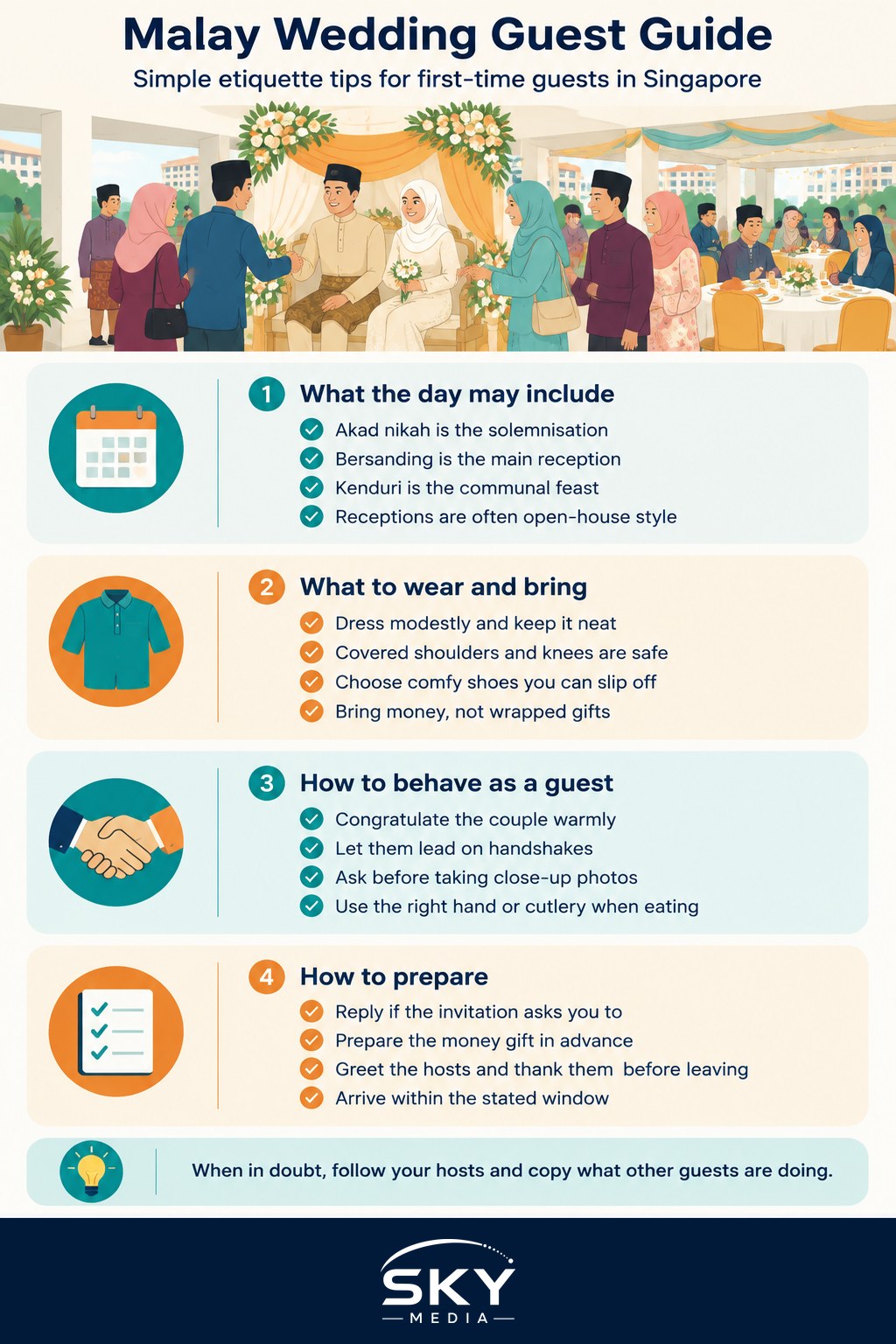
A Malay wedding, often called a kahwin or celebrated through a kenduri (a communal feast), usually unfolds over one or more parts. The religious solemnisation, the akad nikah, is the formal marriage contract and is often a smaller, family-focused moment. The larger celebration many guests attend is the reception, sometimes centred on the bersanding, where the couple sit together on a decorated dais like a “king and queen for a day” while guests come to congratulate them.
In Singapore, many receptions are held at the void deck of an HDB block, a community hall or a hotel. A void-deck celebration is a much-loved tradition, and if you are curious about that space you can read more about what the void deck is used for in Singapore. Receptions are often open-house in spirit: guests arrive across a window of a few hours rather than all at once, greet the family, eat, offer good wishes and leave when ready.
What to Wear and Bring
Dressing respectfully is the simplest way to show care. You do not need traditional Malay dress, though guests are welcome to wear it if they wish.
- Modest and neat is the guiding idea. Covered shoulders and knees are a safe choice for everyone.
- Smart colours are fine. There is no strict rule against any colour, but reading the invitation helps, as some couples suggest a theme.
- Comfortable footwear you can slip off easily is useful, since you may remove shoes when entering a home or a prayer space.
- Modesty matters more at the religious portion than at a casual void-deck reception.
The customary gift is money, not wrapped presents. Malay tradition often uses duit hijau, literally “green money”, given in an envelope or sometimes as part of a decorative token. There is no fixed amount and no obligation to match anyone else. Give what is comfortable and sincere, place it in the provided box or hand it to the family, and do not make a public show of the sum.
Being a Gracious Guest: Do and Do Not
Small courtesies go a long way. The table below offers a gentle guide, remembering that families differ and your hosts’ preferences always come first.
| Situation | A gracious approach | Better to avoid |
|---|---|---|
| Greeting the couple | A warm congratulation, follow their lead on handshakes | Assuming physical contact is welcome across genders |
| The meal | Eat with your right hand or use provided cutlery; it is halal | Bringing outside food or alcohol |
| Photos | Ask before close-ups, especially of the religious rites | Treating the ceremony as a photo opportunity |
| Timing | Arrive within the stated window, stay a comfortable while | Overstaying or rushing off without greeting the hosts |
| Dress | Modest and tidy | Anything revealing, especially at the solemnisation |
A note on greetings: some Muslims prefer not to shake hands with the opposite gender. A friendly nod or a hand placed over the heart is a courteous alternative, and letting the other person offer their hand first avoids any awkwardness. Food served at a Malay wedding is halal, so there is no need to ask about pork or alcohol; simply enjoy the spread, which often includes dishes like nasi minyak or a rich rendang.
Understanding the Customs Without Overthinking Them
You may hear terms that are unfamiliar. A few you might encounter:
- Akad nikah: the solemnisation, the binding religious marriage contract.
- Bersanding: the couple seated in state while guests offer blessings.
- Kompang: hand-held drums that sometimes accompany the couple’s procession.
- Kenduri: the communal feast and gathering.
- Duit hijau: the customary money gift.
You are not expected to know all of this. Malay families in Singapore are used to hosting guests of every background, and genuine warmth counts for far more than perfect terminology. If you are unsure what to do at any moment, watching what other guests do, or quietly asking the friend who invited you, is entirely normal and welcome. Different families blend Malay, religious and personal touches in their own way, so there is no single “correct” script.
How to Prepare and Show Respect
A short checklist for the day:
- Reply to the invitation if it asks you to, so the family can cater.
- Prepare the money gift in an envelope beforehand rather than fumbling on arrival.
- Dress modestly, and keep it especially conservative if you will attend the solemnisation.
- Greet the hosts and the couple early, offer congratulations, and thank the family before you leave.
- Follow the room. If shoes come off, if the right hand is used for eating, if a prayer is being said, simply do as others do.
Attending across cultures is one of the quiet pleasures of life in Singapore, and each community’s celebrations reward a little curiosity. If you would like to learn how neighbouring traditions work, you might also read about attending an Indian wedding as a guest, and about the wider role of self-help groups such as CDAC, MENDAKI and SINDA in community life. Above all, defer to your hosts on any religious specifics, arrive with an open heart, and let the family’s own warmth guide you. That, far more than any rulebook, is the essence of good Malay wedding etiquette.
Related across Sky Media: Wedding Guest Etiquette in Singapore · Malay Wedding Customs in Singapore