

A breakup used to mean you simply stopped seeing someone. Today your ex may still pop up in your Instagram stories, your Telegram chats, your Spotify friend activity and your mutual friends’ group photos. Deciding whether to block ex after breakup is one of the first practical questions people face, and there is no single right answer. This guide walks through no-contact, muting versus blocking, and how to set digital boundaries that help you heal rather than keep you stuck refreshing a profile at 2am.
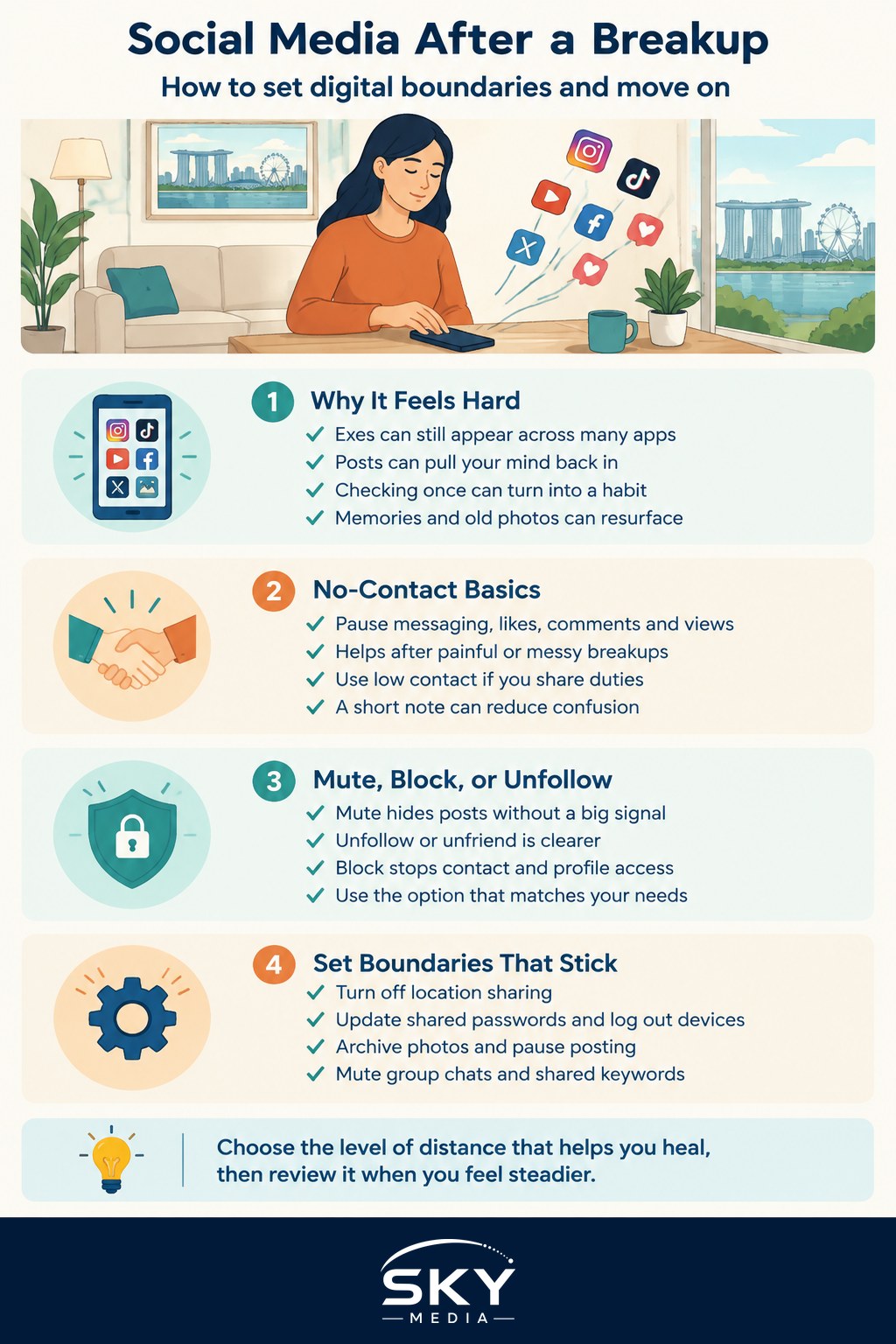
Why Social Media Makes Breakups Harder
Social media is designed to keep you looking. After a breakup, that design works against you. Every time an ex’s post appears, your brain gets pulled back into the relationship, whether it is a holiday photo, a cryptic quote or a new face in the background.
Common traps include:
- Checking “just once”. Looking at their profile, then their friends’ profiles, then their new partner’s profile.
- Reading meaning into everything. A story view, a like or a song share can feel like a coded message, even when it is not.
- Performing for them. Posting to look happy or busy because you know they might see it.
- Old memories resurfacing. “On this day” features and photo albums can ambush you months later.
None of this makes you weak. It is a normal response to losing someone close. The goal is to reduce how often you are triggered so your emotions have space to settle.
The No-Contact Approach, Explained
“No contact” means a period, often a few weeks to a few months, where you deliberately do not message, call, like, comment or view your ex’s content. Many people find it the clearest way to start moving on, because it breaks the habit of checking in.
No contact tends to help most when:
- The breakup was painful, messy or one-sided
- You keep hoping to get back together and it is stopping you from moving forward
- Conversations with your ex keep turning into arguments or confusion
- You notice you feel worse after every interaction
It may need adjusting if you share children, a lease, a pet or a workplace. In those cases, many people use “low contact” instead: communication stays polite, brief and limited to practical matters, ideally in writing on one channel.
No contact is not about punishing the other person. It is a boundary for your own recovery. You do not owe anyone an announcement, though a short, calm message such as “I need some space to move on, so I won’t be in touch for a while” can reduce confusion if you were close.
Mute, Restrict, Unfollow or Block: Which to Choose
Most platforms give you several tools, and each sends a different signal. The table compares the main options in general terms. Exact features and names vary by app and can change, so check each platform’s help pages.
| Option | What it generally does | Does your ex notice? | Best for |
|---|---|---|---|
| Mute | Hides their posts or stories from your feed, you stay connected | Usually not | Amicable splits, shared friend groups |
| Restrict or limit | Limits what they see or how they interact, without fully cutting off | Usually not obvious | Wanting distance without drama |
| Unfollow or unfriend | Removes the connection, they may see you are gone | Often, if they check | A clear signal you are moving on |
| Block | Stops them seeing your profile and contacting you on that app | Often, if they look | Harassment, repeated contact, or a clean break |
Some rough guidance:
- Mute first if you are unsure. It is quiet, reversible and protects you from surprise posts without making a statement.
- Block if you feel unsafe or harassed. Your safety and peace of mind come before anyone’s hurt feelings. You do not need to explain.
- Block if you cannot stop checking. If muting still leaves you visiting their profile, blocking removes the temptation more effectively.
- Remember the other apps. Messaging apps, music apps, fitness trackers, shared photo albums and location sharing can all keep you connected without you realising.
You can always change your mind later. Unblocking or unmuting after you have healed is perfectly fine.
Setting Digital Boundaries That Last
Beyond blocking or muting, a few small changes make a big difference:
- Turn off location sharing. Check every app where you may have shared your location with each other.
- Change shared passwords. If you ever shared streaming, email or device passwords, update them and sign out of other devices. Our guide to securing your social media accounts walks through the settings to check.
- Archive, do not delete, if unsure. Move photos into a hidden or archived folder. You can decide later whether to keep them.
- Turn off memory features. Most photo and social apps let you hide certain people or dates from “memories”.
- Mute keywords or hashtags. If a shared hobby or place keeps bringing them up, mute it for a while.
- Pause posting. You do not need to update the world. Taking a break from posting removes the urge to check who viewed your story.
If someone repeatedly contacts you after you have asked them to stop, or threatens to share private images, take screenshots, report the account to the platform, and seek help. In Singapore, harassment can be reported to the police, and support organisations can guide you. Watch also for strangers or “friends of friends” who suddenly message after a breakup asking for money or sympathy, as scammers sometimes target people going through hard times.
Handling Mutual Friends and Group Chats
In Singapore’s tight social circles, you may share secondary school friends, church groups, company colleagues or a CCA alumni group with your ex. Cutting your ex off entirely can feel awkward when you still see them in the same group chats.
Some practical options:
- Mute the group for a while rather than leaving, so you can return when you are ready.
- Tell one or two close friends what you need, such as “please don’t send me updates about them”.
- Avoid asking friends for information. It keeps you hooked and puts them in an uncomfortable spot.
- Do not ask friends to pick sides. Most people will naturally stay closer to one of you over time.
If you are wondering whether a friendship with your ex is possible later, our article on whether to stay friends with an ex covers the questions to ask. For the bigger picture of how couples manage being online together, see relationships and social media.
Knowing When You Are Ready to Reconnect
Healing is not a straight line. Signs you may be ready to unmute or unblock include:
- Seeing their name no longer sets off a wave of emotion
- You are curious, not desperate, about how they are doing
- You would be fine seeing them with a new partner
- You have built routines, friendships and plans that do not revolve around them
If you are still struggling after several months, or the breakup is affecting your sleep, work or mood, consider speaking to a counsellor or a trusted professional. Reaching out for support is a sign of strength. Whether you mute, block or simply step back, the right choice is the one that protects your peace and helps you move forward.
Further reading: Dating a Friend’s Ex · Untangling Shared Accounts and Photos After a Breakup · Who Keeps the Pet After a Breakup? Deciding Fairly in Singapore