

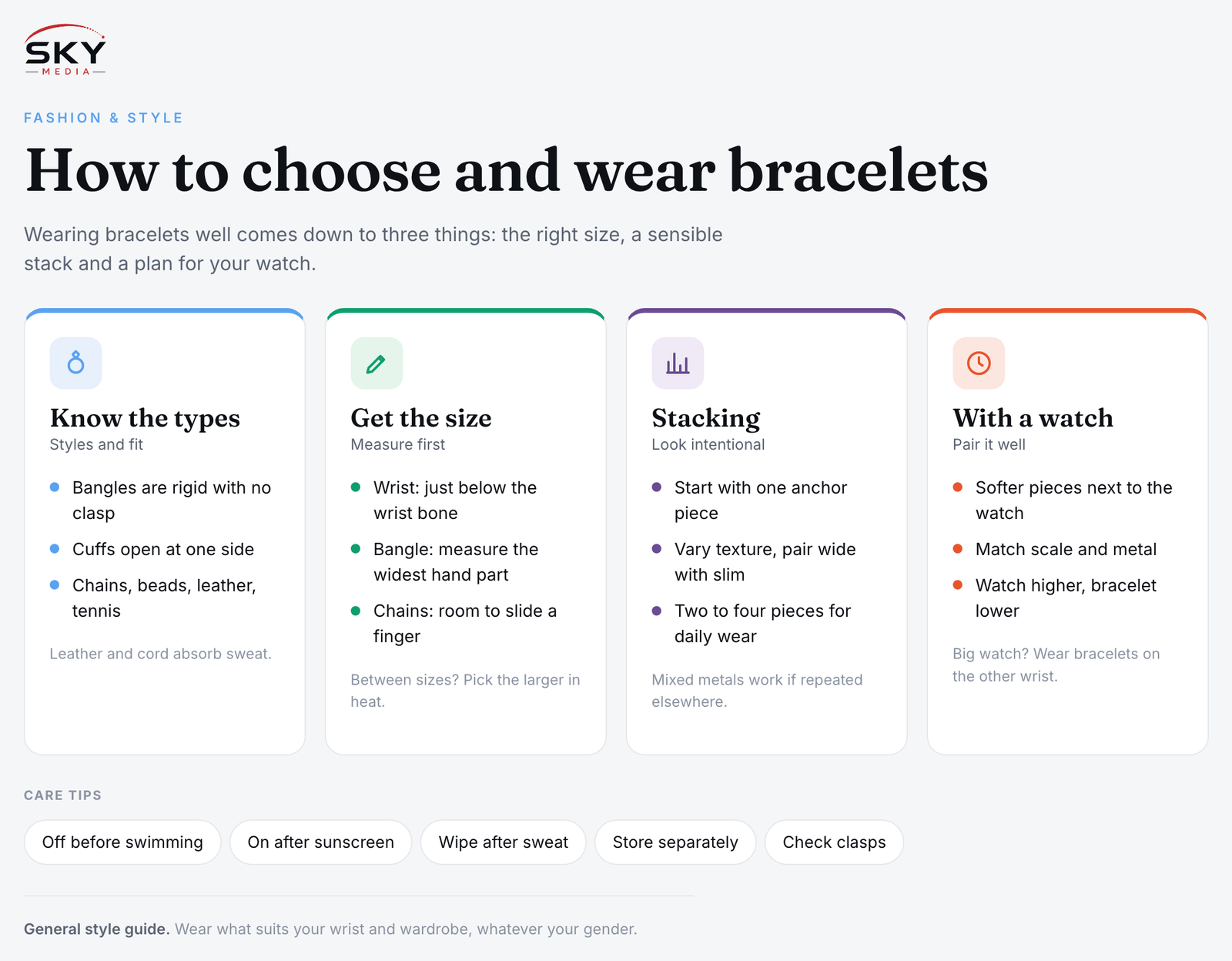
A bracelet is one of the easiest ways to finish an outfit, yet it is also the piece people most often get slightly wrong. Too tight and it pinches in the afternoon heat, too loose and it slides over your hand every time you reach for your phone. Knowing how to wear bracelets well comes down to three things: the right size, a sensible stack, and a plan for how your bracelets sit alongside a watch. This guide covers all three, for men and women, with Singapore’s humid weather in mind.
Bracelet Types and What Each One Suits
Before thinking about sizing, it helps to know what you are working with. Different styles sit on the wrist differently and suit different occasions.
- Bangles are rigid, usually round or oval, and slip over the hand. They have no clasp, so the size has to clear your knuckles while not falling off.
- Cuffs are rigid but open at one side, so you slide them on from the side of the wrist. They are easier to fit and adjust slightly.
- Chain bracelets (curb, cable, rope, figaro) are flexible and closed with a clasp. They are the most common style for both men and women.
- Beaded bracelets use stones, wood or glass on an elastic cord or a knotted string. They are casual, light and easy to stack.
- Leather, cord and fabric bracelets are relaxed and popular with men, but they absorb sweat, so they need more care in a tropical climate.
- Tennis bracelets are slim lines of set stones, usually kept for dressier outfits.
Jade bangles deserve a special mention because they are common gifts in many Chinese Singaporean families. If you are shopping for one, read our guide to buying jade jewellery in Singapore without getting fooled before you pay.
How to Measure Your Wrist and Get the Fit Right
Most fit problems come from guessing. Take a soft tape measure (or a strip of paper and a ruler) and wrap it around your wrist just below the wrist bone, where a bracelet naturally rests. Note the measurement snugly, without pulling tight.
From there, the fit you want depends on the style:
- Chain and beaded bracelets: most people are comfortable with a little room added to the wrist measurement, so you can slide a finger underneath. If you prefer a looser, draped look, add a little more. Many shops and online listings publish their own size chart, so match your wrist measurement to the brand’s chart rather than to a “small, medium, large” label.
- Bangles: you measure the hand, not the wrist. Tuck your thumb towards your little finger as if putting on a bangle, then measure around the widest part of the hand. The inner circumference of the bangle needs to clear that. A jeweller can measure you in person, which is the safest route for an expensive or solid piece that cannot be resized.
- Cuffs: look at the inner length plus the gap. A cuff should sit on the wrist without digging in, and you should be able to gently squeeze softer metals for a closer fit. Avoid repeatedly bending precious metal cuffs, as this weakens them.
A practical Singapore tip: wrists swell slightly in heat and after exercise. If you are between sizes, choose the slightly larger option, especially for anything you plan to wear outdoors.
Stacking Bracelets Without Looking Cluttered
Stacking is where bracelets become personal. A good stack looks intentional rather than piled on. These principles work for most people:
- Start with an anchor piece. Choose one bracelet that stands out, perhaps a bold bangle, a chunky chain or a meaningful beaded piece. Build around it.
- Vary the texture, not everything else. Mixing a smooth bangle, a chain and a beaded strand looks interesting. Mixing five different metals, colours and themes usually looks messy.
- Mind the widths. Pair a wider piece with one or two slim ones. Several thick pieces together can look heavy on a smaller wrist.
- Keep the number sensible. Two to four pieces is a comfortable range for daily wear. More can work for a casual weekend look but tends to clink and catch on things at work.
- Mixing metals is fine if you repeat them. Gold and silver can sit together, especially if the same mix appears elsewhere, such as a two-tone watch, ring or belt buckle.
For men, a simple stack might be a leather or cord bracelet with a slim metal chain or a single beaded strand. For women, a classic start is a fine chain, a slim bangle and one statement piece. There are no rules that divide styles by gender, though; wear what suits your wrist and your wardrobe.
Wearing Bracelets With a Watch
This is the question most people actually have. The table below sets out the common approaches.
| Approach | How it looks | Best for | Watch out for |
|---|---|---|---|
| Bracelets on the other wrist | Clean and balanced | Office wear, expensive watches | Can feel lopsided if one side is very bold |
| One slim bracelet beside the watch | Subtle and polished | Most everyday outfits | Metal rubbing against the watch case |
| A stack beside the watch | Relaxed and expressive | Weekends, casual events | Scratches on crystal and polished cases |
| No bracelet, watch only | Minimal | Formal settings, interviews | Can look plain with very casual outfits |
A few guidelines make the watch-plus-bracelet look work:
- Put the softer pieces nearest the watch. Beaded, leather and fabric bracelets are less likely to scratch a watch case than metal chains or bangles.
- Match the scale. A large sports watch pairs better with a chunkier bracelet, while a slim dress watch suits fine chains. If the watch itself already dominates your wrist, skip the bracelet on that side and wear it on the other.
- Echo the metal or the strap. A steel watch looks natural beside a silver chain, a gold-tone watch beside gold pieces, and a leather strap beside a leather bracelet. Swapping to a strap in a matching colour or material is an easy way to tie the whole look together.
- Wear the watch slightly higher. Letting the watch sit just above the wrist bone and the bracelet just below keeps them from knocking together.
Matching Bracelets to the Occasion
What works on a Saturday at a hawker centre is not always right for a formal event. As a rough guide:
- Work: one or two quiet pieces. Avoid anything that clatters on a keyboard or catches on sleeves.
- Formal events and weddings: a single bangle, a tennis bracelet or a fine chain usually looks best. For dressier dinners, our guide on what to wear to a dinner and dance covers the wider outfit.
- Festive occasions: many families wear gold or jade for celebrations such as Chinese New Year or weddings, and glass or metal bangles are a familiar part of festive dress for some Indian Singaporean families, as our guide on what to wear for Deepavali explains. If you are a guest, follow your host’s lead and keep it respectful.
- Weekends and outdoors: beads, cord and lightweight pieces that cope with sweat are the practical choice.
Caring for Bracelets in Singapore’s Humidity
Heat, sweat and sunscreen take a toll on jewellery. Simple habits help:
- Take bracelets off before swimming, hand-washing large loads of dishes or using cleaning products.
- Put them on after sunscreen, perfume and moisturiser have dried.
- Wipe metal pieces with a soft cloth after a sweaty day, and let leather and cord dry fully before storing.
- Store pieces separately, or in a lined box, so harder metals and stones do not scratch softer ones.
- For valuable or gem-set pieces, ask a reputable jeweller to check clasps and settings periodically.
Get the size right first, keep the stack small, and plan around your watch. With those three in place, choosing bracelets becomes a matter of personal taste rather than trial and error.
Further reading: Gold Chain Styles and How to Choose One