
Many Singapore investors open a brokerage account, buy a few US or Hong Kong shares and never look closely at what happens to the cash in between. Yet the cash side of a brokerage multi currency account quietly decides how much you pay in conversion costs, whether your dividends sit idle for years and how easy it is to bring money home. This guide focuses on that cash handling side: how balances in different currencies behave, when conversion happens, and the habits that stop small leaks from adding up.
It does not cover how to choose a broker. If you are still at that stage, read our guide on choosing a brokerage in Singapore first.
How a Brokerage Multi Currency Account Actually Holds Your Money
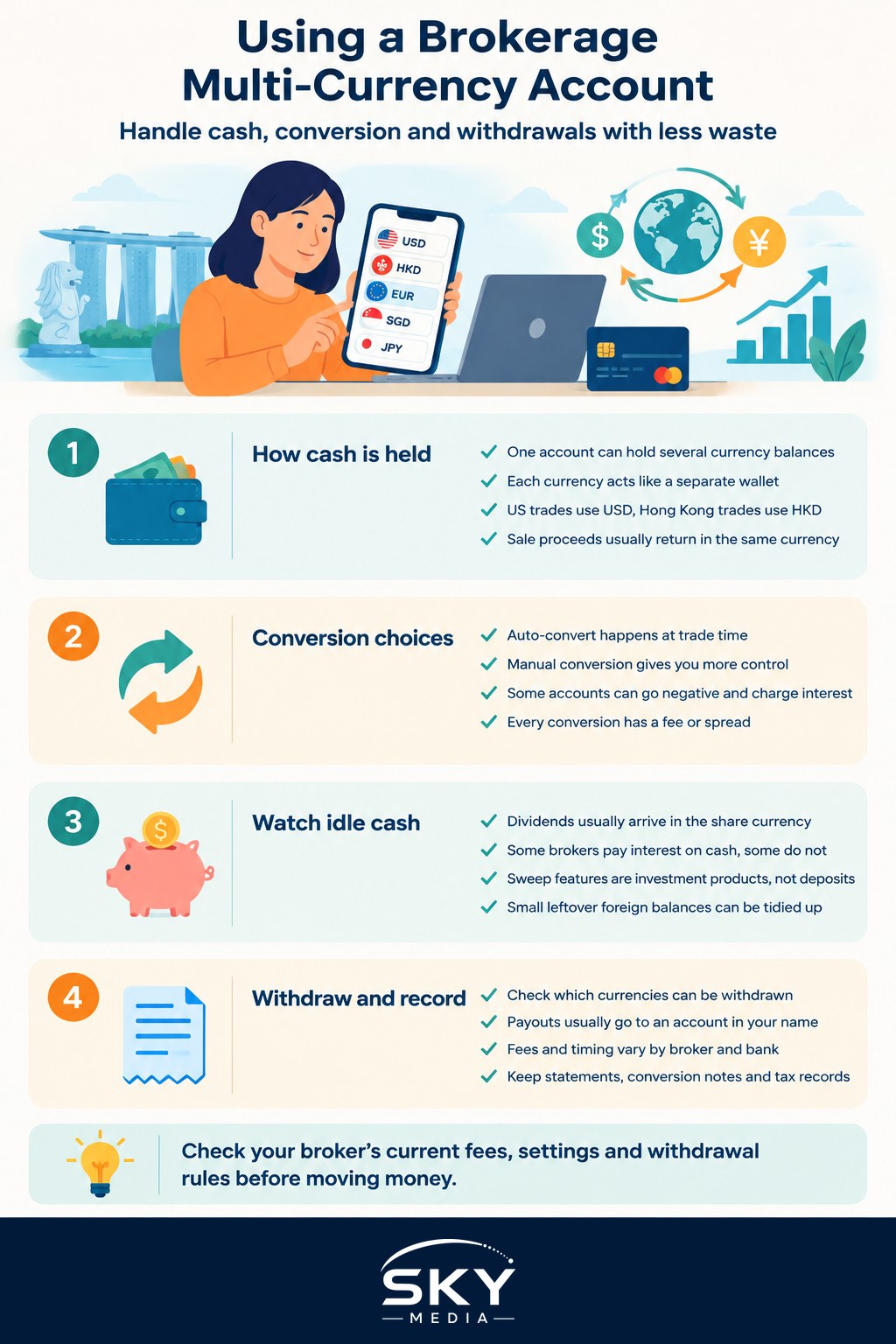
Most modern brokerages let one account hold several cash balances at once, typically Singapore dollars, US dollars and Hong Kong dollars, with some offering more. Each balance is a separate “wallet” inside the same account. When you buy a US-listed share, the broker pays for it from your USD balance. When you sell, the proceeds land back in USD.
The key point is what happens when the right currency is not there. Brokers generally handle this in one of three ways, and the setting is often buried in the app:
- Auto-conversion at trade time. You fund in SGD, place a USD order and the broker converts just enough at its own rate. Convenient, but you pay the conversion spread on every trade.
- Manual conversion only. You must convert SGD to USD yourself before trading. More steps, but you control when and how much.
- Margin or negative balance. Some accounts let a USD balance go negative and charge interest on the shortfall until you top it up or convert. This can happen without you realising, especially in accounts with margin features turned on.
Check which model your broker uses, and look for a setting that controls it. Fee structures and settings vary by broker and change over time, so confirm the current terms in your broker’s fee schedule.
Conversion Choices and Their Trade-Offs
Every currency conversion has a cost, either as an explicit fee, a spread built into the rate, or both. The spread is the difference between the rate you get and the mid-market rate you see on a currency website. Small on any one trade, it compounds if you convert back and forth often.
| Approach | How it works | Best suited to | Main drawback |
|---|---|---|---|
| Auto-convert every trade | Broker converts SGD as each order fills | Occasional small trades | Spread paid on every buy and sell |
| Convert in bulk, then hold | You convert a larger sum once and trade from that balance | Regular investors in one market | Currency exposure while cash sits idle |
| Fund directly in foreign currency | Transfer USD or HKD from a bank or wallet into the broker | Those already holding foreign currency | Bank transfer fees and intermediary charges |
| Keep proceeds in foreign currency | Leave sale proceeds and dividends unconverted | Long-term investors reinvesting in the same market | Easy to forget, may earn little or no interest |
Many people move USD into a broker from a bank foreign currency account or a multi-currency wallet. Our guides on foreign currency accounts and using Wise and multi-currency cards explain those tools. Before doing this, check whether your broker accepts incoming transfers in that currency and from that source, and whether any fees apply on receipt.
Managing Idle Cash, Dividends and Corporate Actions
Idle balances are the most overlooked part of a multi-currency account. Over time you collect small amounts in several currencies from partial sells, dividends and rounding. These can quietly sit there for years.
Things to watch:
- Dividends arrive in the share’s currency. A US share pays USD, a Hong Kong share usually pays HKD. Withholding tax may be deducted before the cash reaches you, depending on the market and your tax status. IRAS and the broker’s tax documents are the places to check how this applies to you.
- Interest on cash varies. Some brokers pay interest on uninvested balances, some pay nothing, and some only on balances above a level. Rates and conditions change, so check the broker’s current terms rather than assuming.
- Sweep or money market features. Some platforms offer to park idle cash in a cash management or money market product. Read what it actually is, because it is an investment product, not a bank deposit, and is generally not covered by the Singapore Deposit Insurance Corporation scheme.
- Small foreign balances. A few dollars of leftover HKD may cost more to convert than it is worth. Decide whether to reinvest, leave it or sweep it up during a periodic tidy-up.
A good habit is a quarterly glance at every currency balance, asking for each: am I going to use this soon, should I convert it, or should it be invested?
Withdrawing Money Back to Singapore
Bringing money home is where people often meet unexpected friction. Typical points to check before you need the money:
- Which currencies can be withdrawn directly. Some brokers only withdraw in SGD, forcing a conversion; others allow USD withdrawals to a USD-capable bank account.
- Where it can go. Most brokers only pay out to a bank account in your own name, to meet anti-money laundering rules.
- Fees and timing. Withdrawal fees, intermediary bank charges and processing times all vary. Do not plan a property down payment or a large bill around a withdrawal you have never tested.
- Settlement. Proceeds from a sale must settle before they can be withdrawn, and settlement periods differ by market.
A small test withdrawal, done when there is no urgency, tells you how the process works and how long it takes.
Record-Keeping for a Multi-Currency Account
Keeping clear records saves trouble later, whether for your own tracking, an IRAS query or a family member who needs to understand your accounts. Keep:
- Monthly or annual statements from the broker, downloaded and stored outside the app.
- A note of the rate and amount for each conversion you make manually.
- Dividend and withholding tax summaries, usually issued yearly.
- A record of transfers in and out, matching your bank statements.
If you use a China-linked platform, the records and currency options may differ from local brokers; see using China-linked brokerages (Futu, Tiger, moomoo) for platform-specific points.
A Simple Routine That Keeps Costs Down
- Turn off auto-conversion if you trade a foreign market regularly, and convert in fewer, larger batches instead.
- Check that margin is off unless you deliberately want it, so a balance cannot slip negative.
- Review idle balances quarterly and decide what each is for.
- Test a withdrawal once, early.
- Download statements at year end.
This is general information, not financial advice. Broker features, fees and tax treatment change, so confirm the current details with your broker and with IRAS, and consider a licensed adviser for decisions specific to your situation.
Further reading: How to Deal With Dormant Bank and Brokerage Accounts