

In Singapore, every car comes with a Certificate of Entitlement (COE), the right to own and use a vehicle, usually valid for ten years. As that period runs down, the car’s paper value falls with it. That is why a car with short COE left, say one to three years, can look surprisingly cheap on used car listings.
The low price can be a genuine bargain or a trap, depending on how you plan to use the car and what you do when the COE expires. This guide explains the maths, the pros and cons, and the end-of-COE decisions you will face. It is general information, not financial advice. Rules and rebates are set by the Land Transport Authority (LTA), so check its website for current details.
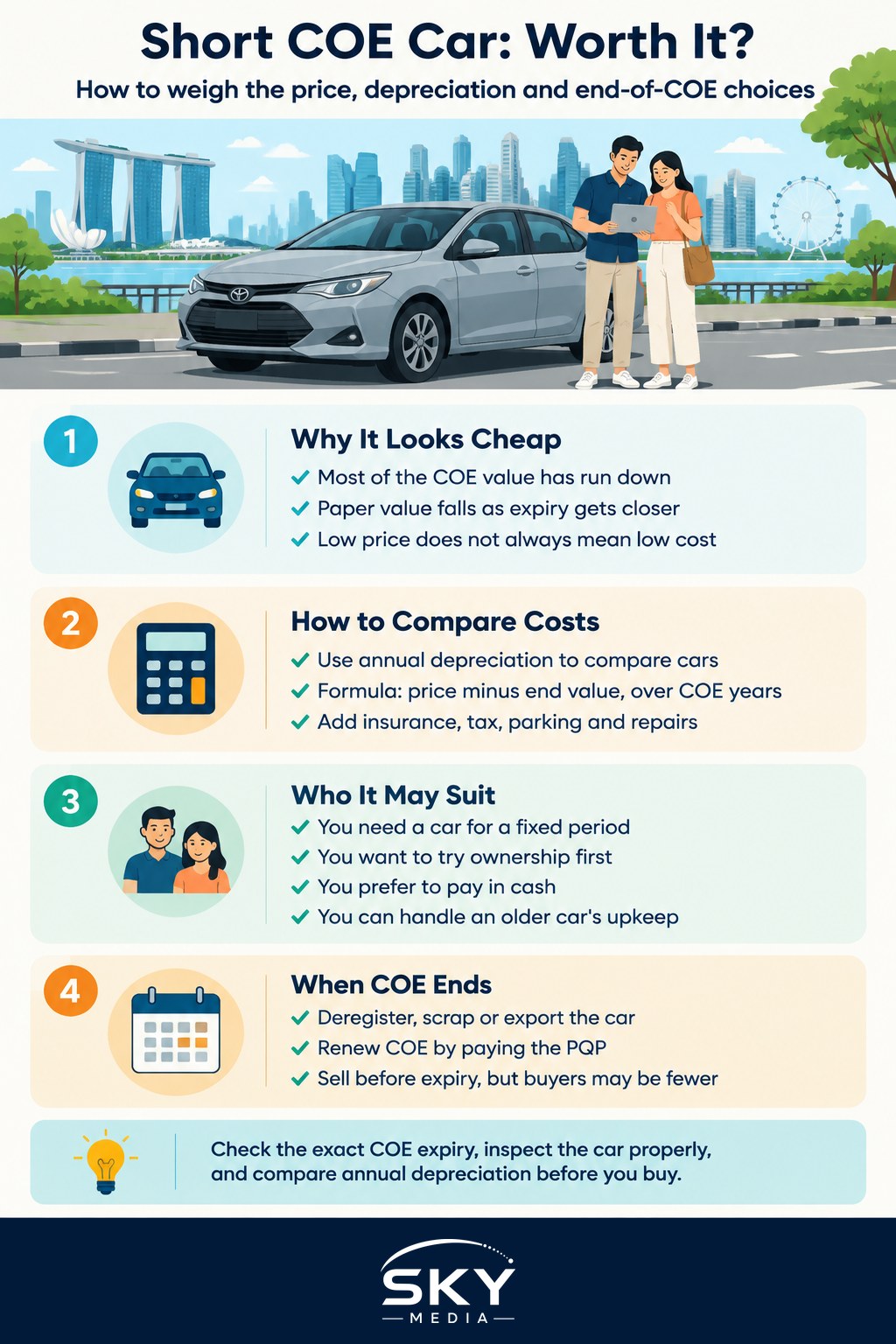
Why Short COE Cars Look So Cheap
When you buy a used car in Singapore, much of what you pay is the remaining value of its COE and registration, not just the metal. As the years pass, that remaining value shrinks steadily. A car with one or two years left has used up most of its COE, so the asking price drops sharply.
That does not automatically mean low cost of ownership. What matters is how much value you lose each year you own the car, known as depreciation.
Doing the Depreciation Maths
The standard way to compare used cars is annual depreciation:
Annual depreciation = (Purchase price minus value you get back at the end) divided by years of COE left
The value you get back at the end depends on what you do when the COE expires (more on that below). If you deregister the car before it turns ten, you may receive rebates, such as a COE rebate for unused COE and a Preferential Additional Registration Fee (PARF) rebate. Cars past their tenth year generally do not get a PARF rebate. Check LTA’s rules, as rebate formulas and caps have changed over time.
Here is a simplified illustration using made-up round numbers, purely to show the method:
- Car A: Paid $40,000, four years of COE left, expect $10,000 back. Annual depreciation: ($40,000 minus $10,000) divided by 4 = $7,500 a year.
- Car B: Paid $15,000, one and a half years left, expect $2,000 back. Annual depreciation: ($15,000 minus $2,000) divided by 1.5 = about $8,700 a year.
The cheaper car costs more per year. Short COE cars often show a higher annual depreciation, though not always. Running the numbers on each listing is the only way to know.
Remember to add the other running costs: insurance, road tax, parking, petrol or charging, servicing and repairs. Older cars tend to cost more to maintain, and road tax rises for cars older than ten years, which matters if you renew.
Pros and Cons at a Glance
| Factor | Short COE car (1 to 3 years left) | Longer COE car (5+ years left) |
|---|---|---|
| Upfront price | Low, easier to pay in cash | Higher, often needs a loan |
| Annual depreciation | Can be higher per year | Often lower per year |
| Commitment | Short, flexible exit | Longer, harder to exit cheaply |
| Financing | Loan tenure limited by remaining COE | More financing options |
| Condition risk | Older car, more wear | Newer, often still under warranty |
| End-of-COE decision | Arrives soon | Years away |
Who a Short COE Car Suits
A car with short COE can make sense if:
- You need a car for a defined period. For example, while children are young, during a temporary posting, or until you relocate.
- You want to test car ownership. It is a lower-risk way to see whether owning a car fits your life before committing to a new one.
- You prefer paying in cash. The lower price may let you avoid a car loan and its interest.
- You plan to time the market. Some buyers drive a short COE car while waiting for COE premiums to soften before buying new. See timing your car purchase with COE for how that thinking works.
It may not suit you if you want a reliable car for many years, cannot absorb a surprise repair bill, or would be stuck if you had to sell suddenly.
What Happens When the COE Expires
As the expiry date approaches, you generally have these choices. Confirm the current options and procedures with LTA.
Deregister the car
You can scrap or export the car and deregister it. If the car is still under ten years old, you may be entitled to rebates. Past ten years, rebates are generally limited. The deregistration process and timings are set by LTA, and missing deadlines can lead to penalties.
Renew the COE
You can renew by paying the Prevailing Quota Premium (PQP), which is based on recent COE prices, for either five or ten more years. Key points:
- A car renewed for five years cannot generally be renewed again, so it must be deregistered at the end.
- Renewing means giving up the PARF rebate.
- Road tax surcharges apply to cars over ten years old.
- Older cars may need more repairs and inspections.
Renewal can be good value if the car is reliable and the PQP is reasonable compared with buying a replacement. Our coverage of COE renewal for existing owners goes into more depth.
Sell before expiry
You can sell to another buyer or dealer, though there is a shrinking pool of buyers as expiry nears.
Checks Before You Buy
- Confirm the exact COE expiry date and registration details through official records, not just the listing.
- Get an independent inspection. Look at engine, gearbox, suspension, aircon and rust.
- Review service records. Gaps can mean neglected maintenance.
- Ask about the loan. Banks typically limit loan tenure to within the remaining COE life, so check repayment amounts.
- Calculate annual depreciation with realistic end-of-life values.
- Price your insurance before committing, as premiums vary with the car’s age and your profile.
Alternatives Worth Comparing
If you need a car only occasionally, car sharing and short-term rental may cost less than any purchase. For a deeper grounding in how premiums are set, read COE explained.
Official sources: OneMotoring
Further reading: Buying a Car During Hungry Ghost Month: Are the Deals Real? · Is a Weekend Car Worth It?