

Signing up for a gym or spa package is easy. Getting out of one can be a different story. Long contracts, auto-renewal clauses, prepaid sessions and persistent sales staff all make it harder to leave than to join. If you want to cancel a gym membership in Singapore, or exit a prepaid spa or beauty package, the key is to understand your contract, put everything in writing, and know where to turn if the business will not cooperate.
This guide focuses on exiting long contracts and handling hard-sell renewals. It is general information, not legal advice. The terms of your own contract matter most, and the Consumers Association of Singapore (CASE) is the best place to check your rights for a specific situation.
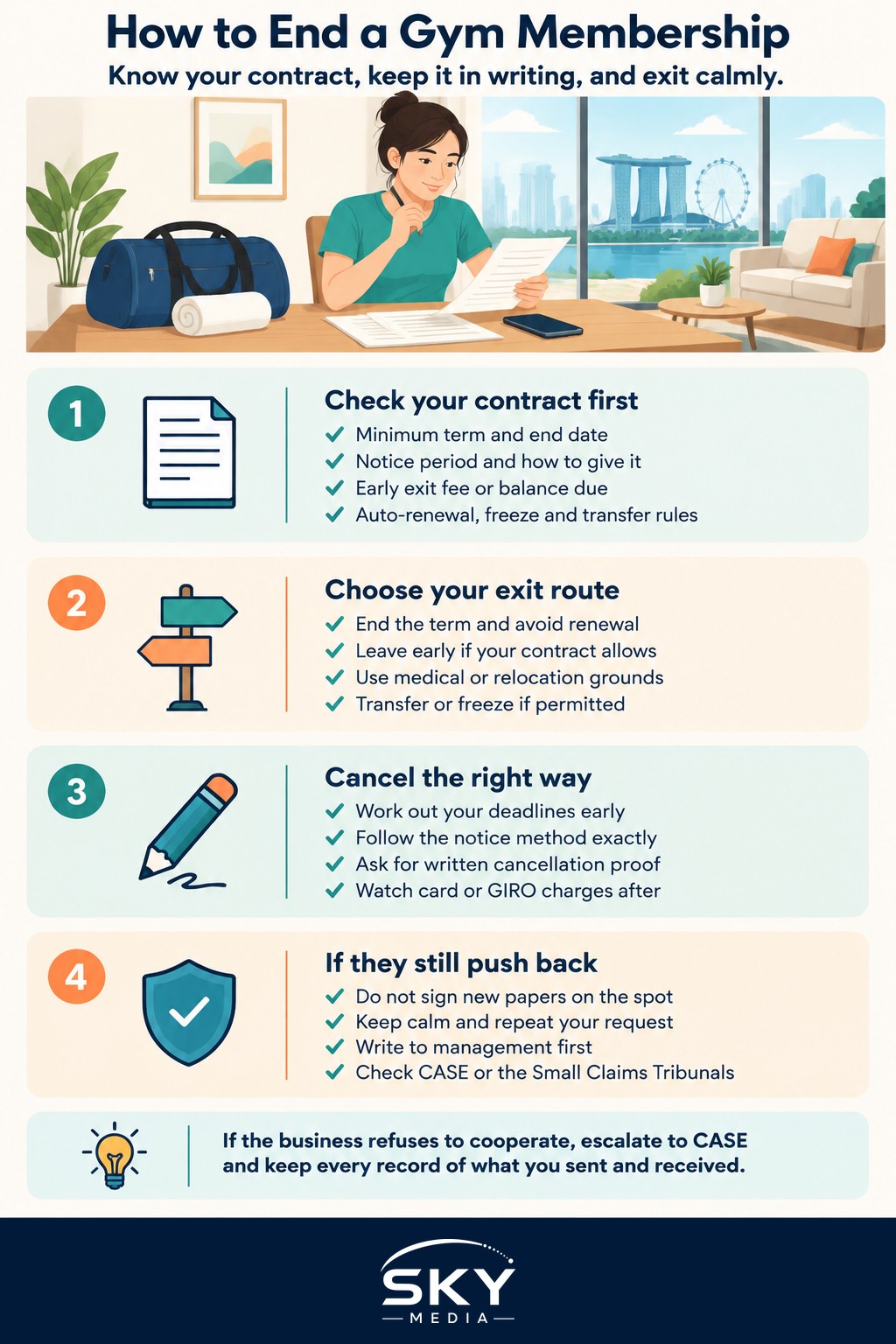
Start With What Your Contract Says
Before contacting the gym or spa, read your contract and any terms you agreed to online. Look for:
- The minimum term, such as 12 or 24 months, and what happens after it ends.
- The notice period you must give to cancel, and how notice must be given (in person, by email, through an app or on a form).
- Early termination terms, including any fee or the requirement to pay the remaining months.
- Auto-renewal clauses, which may roll your membership over unless you cancel by a certain date.
- Freeze or suspension options for medical reasons, pregnancy or relocation.
- Transfer options, which may let you pass the membership to someone else.
- Rules for prepaid packages, including expiry dates and whether unused sessions can be refunded.
If you no longer have a copy, ask the business for one in writing. You are entitled to know what you signed. Our guide on how to read gym contracts before you sign explains common clauses in more detail.
Your Main Exit Options Compared
Depending on your contract and circumstances, you may have several ways out. The table below compares them.
| Option | When it fits | What to watch for |
|---|---|---|
| Cancel at the end of the minimum term | You have completed the committed period | Give notice early enough to stop auto-renewal |
| Early termination with a fee | You need to leave mid-contract | The fee may equal the remaining months; ask for it in writing |
| Medical or relocation exit | You have a doctor’s letter or proof of moving away | Not every contract allows this; check the exact wording |
| Transfer to another person | The contract allows transfers | There may be an admin fee and conditions for the new member |
| Freeze, then cancel | You need a pause now and will exit at term end | A freeze can extend your end date |
If you signed up outside the business premises, such as at a roadshow or through a door-to-door sale, you may have a statutory cooling-off period under Singapore’s consumer protection rules. Check with CASE quickly, since cooling-off periods are short and have specific conditions.
How to Cancel Step by Step
- Calculate your dates. Work out when your minimum term ends and when notice must be given. Mark the deadline in your calendar.
- Give notice in the way the contract requires. If it says email or a form, use that. If it says in person, go in person, but also follow up by email.
- Keep it short and firm. State your name, membership number, that you are cancelling, and the effective date. You do not need to explain your reasons unless you are claiming a medical or relocation exit.
- Ask for written confirmation. Request an email or letter confirming the cancellation date and that no further charges will be made.
- Stop recurring payments safely. Once cancellation is confirmed, check whether the business will stop charges. If charges are on a credit card or GIRO, monitor your statements. Speak to your bank if unauthorised charges continue after a confirmed cancellation.
- Use remaining sessions. For prepaid packages, use what you have paid for before the cancellation date if a refund is not available.
Simply cancelling the card linked to your membership does not end the contract. The business can still pursue amounts owed under the agreement. Our article on what to do before cancelling an old credit card explains why it is better to cancel recurring arrangements first.
Handling Hard-Sell Renewals and Pressure Tactics
Many people who try to cancel find themselves in a meeting that turns into a sales pitch. Some common tactics include last-minute discounts, upgraded packages, claims that the offer expires today, or being told cancellation is not possible in person.
A few ways to stay in control:
- Decide before you go. Write down what you want to achieve: cancel, freeze or transfer.
- Bring a friend if you find it hard to say no.
- Do not sign anything new on the spot. Take documents home to read. A genuine offer will still be there tomorrow.
- Do not hand over your card for a “deposit” or “trial” upgrade.
- Repeat your position calmly. “I am here to cancel. Please confirm in writing.”
- Leave if you feel pressured. Send your cancellation by email instead.
Singapore’s Consumer Protection (Fair Trading) Act lists unfair practices, which can include taking advantage of a consumer who is unable to understand the deal, or using undue pressure or harassment. If you feel you were pressured into a contract or renewal, note what happened and when.
If the Business Will Not Cooperate
If your cancellation is ignored or refused, escalate in steps:
- Write a formal email to the business’s management, summarising your contract, your notice, and what you want, such as cancellation or a refund of unused sessions.
- Contact CASE. CASE can advise on your rights and may help through negotiation or mediation with the business. Check their website for how to file a complaint.
- Consider the Small Claims Tribunals. For money claims within its limits, the Small Claims Tribunals, part of the State Courts, offer a relatively simple route without needing a lawyer. Check the State Courts website for current claim limits and filing steps.
- Prepare for closures. If a gym or spa shuts down suddenly, act quickly. Contact your card issuer about the charges, and check with CASE about any industry measures or claim processes.
Keep records throughout: the contract, receipts, emails, screenshots of app notices, and notes of conversations with names and dates.
Avoiding the Same Problem Next Time
The best way to avoid a messy exit is to choose arrangements that are easy to leave. Prefer monthly or short-term plans, pay-per-class options or smaller prepaid packages. Ask about cancellation, freezing and refunds before you sign, and get the answers in writing. For more ideas on trimming recurring costs, see our guide on how to cut subscription and membership costs. With a clear plan and the right paperwork, ending a membership can be straightforward rather than stressful.
Official sources: CASE (Consumers Association of Singapore)
Further reading: Buying Beauty Packages in Singapore Without Regret