

A listing photo can make almost any flat look appealing. The address tells you much more: how long your commute will be, what kind of property it is, what rules apply, and what the neighbourhood is like at night. Before you sign a tenancy agreement or an option to purchase, it is worth taking time to check a Singapore address properly.
This guide is for newcomers renting their first place and for buyers shortlisting homes. It goes beyond postal basics to the practical checks that help you avoid surprises after the movers leave. Rules on renting and buying change from time to time, so confirm details with the official agencies named below.
Read the Postal Code and District
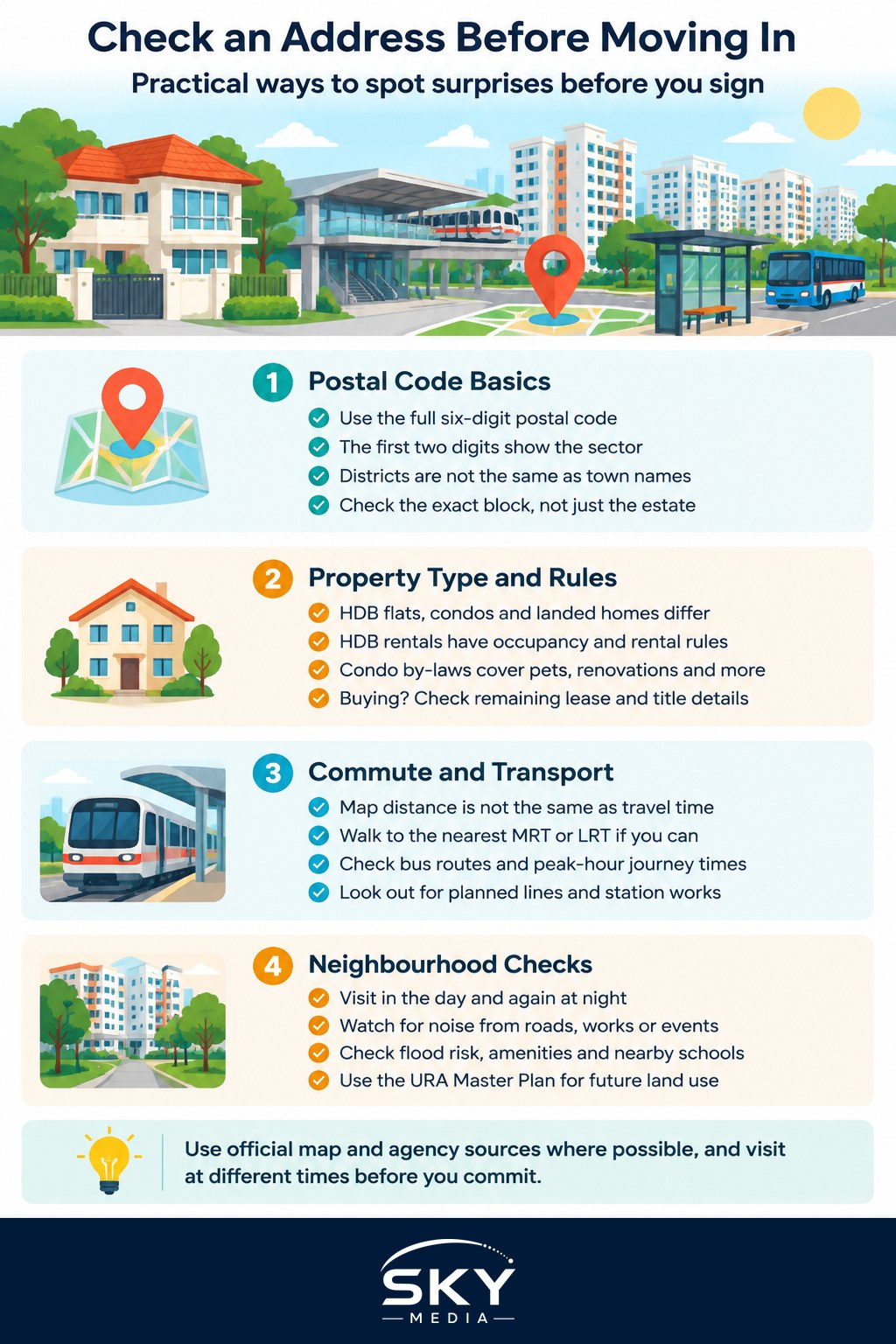
Singapore postal codes have six digits, and every building has its own code. The code is more informative than it looks.
- The first two digits form a postal sector, which tells you roughly where the building is. Several sectors make up one of the older postal districts.
- Property listings often quote districts, written like “D10” or “D15”. These are the traditional postal districts, which are different from planning areas and town names. Two homes in the same district can still be quite far apart.
- Check the exact block and code. In HDB estates, neighbouring blocks may be similar but differ in distance to the MRT station, noise exposure and facilities. Put the full postal code into a map rather than relying on the estate name.
- Use OneMap, the official national map from SLA (the Singapore Land Authority), to see the precise location, nearby amenities and building names. Mainstream map apps are useful too, but OneMap draws on government data.
Confirm the Property Type and Its Rules
The same address can only be one kind of property, and each kind comes with different rules for residents.
- HDB flats are public housing. If you are renting, HDB has rules about who may rent, how many occupants are allowed, and whether the owner is allowed to rent out the whole flat or only rooms. The owner is responsible for meeting HDB requirements, but it is sensible to ask whether the rental is properly registered with HDB.
- Condominiums and executive condominiums are managed by an MCST (Management Corporation Strata Title), which sets by-laws on pets, renovations, moving times and use of facilities. Ask for the house rules before you sign.
- Landed homes such as terraces and bungalows usually have no MCST, so maintenance, security and pest control fall on the owner or tenant as agreed.
- Check the remaining lease if you are buying. Most HDB flats and many private homes are on leasehold land, and remaining lease affects financing and future value. Buyers can confirm title details through SLA and should work with a lawyer.
Test the Commute and Transport Links
Distance on a map is not the same as journey time. Before committing, check how you will actually get around.
- Find the nearest MRT and LRT stations, and walk the route yourself if you can. Note whether the path is sheltered, since rain and heat make a long walk much harder.
- Check bus services at the nearest stops. LTA’s official journey planning tools and common transport apps show routes and arrival times.
- Try the commute at peak hours. A route that takes 25 minutes on a Sunday can take much longer on a weekday morning.
- Look at upcoming transport projects. New MRT lines can transform an area, but construction nearby may bring noise for some time. LTA publishes information on planned lines and stations.
Look at the Neighbourhood, Day and Night
- Visit at different times. A quiet street at noon may be busy near a hawker centre, school or coffee shop in the evening.
- Check for noise sources such as expressways, flight paths, construction sites, bin centres and void decks used for events.
- Look up the URA Master Plan. URA (the Urban Redevelopment Authority) publishes the Master Plan, which shows planned land use around the address. An empty plot next door may be zoned for future development.
- Check flood-prone areas. PUB, Singapore’s national water agency, publishes information on flood-prone areas and drainage works.
- Note daily amenities: supermarkets, clinics, a polyclinic, parks and a hawker centre or food court within easy reach.
- Consider schools if you have children. For Primary 1 registration, distance between home and school can matter for priority. Check the current rules on MOE’s website rather than relying on agent claims.
Address Checks at a Glance
Here is a quick summary of what to check and where to look.
| Check | Why it matters | Where to look |
|---|---|---|
| Postal code and sector | Pinpoints the exact building, not just the estate | OneMap or any map app |
| Property type | Sets rental rules, house rules and maintenance duties | Listing, owner, HDB or MCST |
| Remaining lease | Affects loans and resale value for buyers | SLA title records, with a lawyer |
| Transport links | Determines real commute time | LTA journey tools, a walk at peak hour |
| Future land use | Signals construction or new amenities nearby | URA Master Plan |
| Flood risk | Avoids water problems during heavy rain | PUB information |
Practical Checks on the Day of Viewing
When you view the home in person, check:
- The address on the door and letterbox matches the listing and the tenancy agreement.
- The person showing the flat is authorised, whether the owner or a registered property agent. You can check an agent’s registration on CEA’s public register.
- Mobile signal and internet availability inside the unit.
- Water pressure, air-conditioning, windows and any signs of damp or pests.
- Lift access and loading arrangements, since some older blocks do not stop on every floor.
After You Commit
Once you move in, update your address with the relevant agencies. Singapore citizens, permanent residents and many pass holders need to report address changes, and our guide on changing your address with ICA and agencies explains the process. For the move itself, use our home move-in checklist, and if you are relocating from overseas, planning your move to Singapore with a timeline helps you sequence each step.
Taking an hour to check a Singapore address before you sign can save months of regret. Read the postal code, confirm the property type and its rules, test the commute and visit the neighbourhood at different times. Then you can move in knowing what to expect.
Further reading: How to Prepare for a Condo Move-In in Singapore · How to Register Your Address After Moving to Singapore · What to Check About School Bus Access Before Moving · Using OneMap in Singapore