
The chinese zodiac in Singapore is woven gently through everyday life, from the animal that decorates a shopping centre at Lunar New Year to the casual question of which sign someone was born under. For newcomers from the mainland, much of this will feel familiar, yet you may notice local touches and a lively fortune-telling culture that is worth understanding on its own terms. This guide offers a respectful, light-hearted look at the twelve animals and the traditions of fortune-telling here. It is written as a description of cultural belief and heritage, not as a prediction of your future, and certainly not as advice about your money, health or life choices. Beliefs vary widely, and many people enjoy these traditions purely for their colour and meaning.
The Twelve Animals
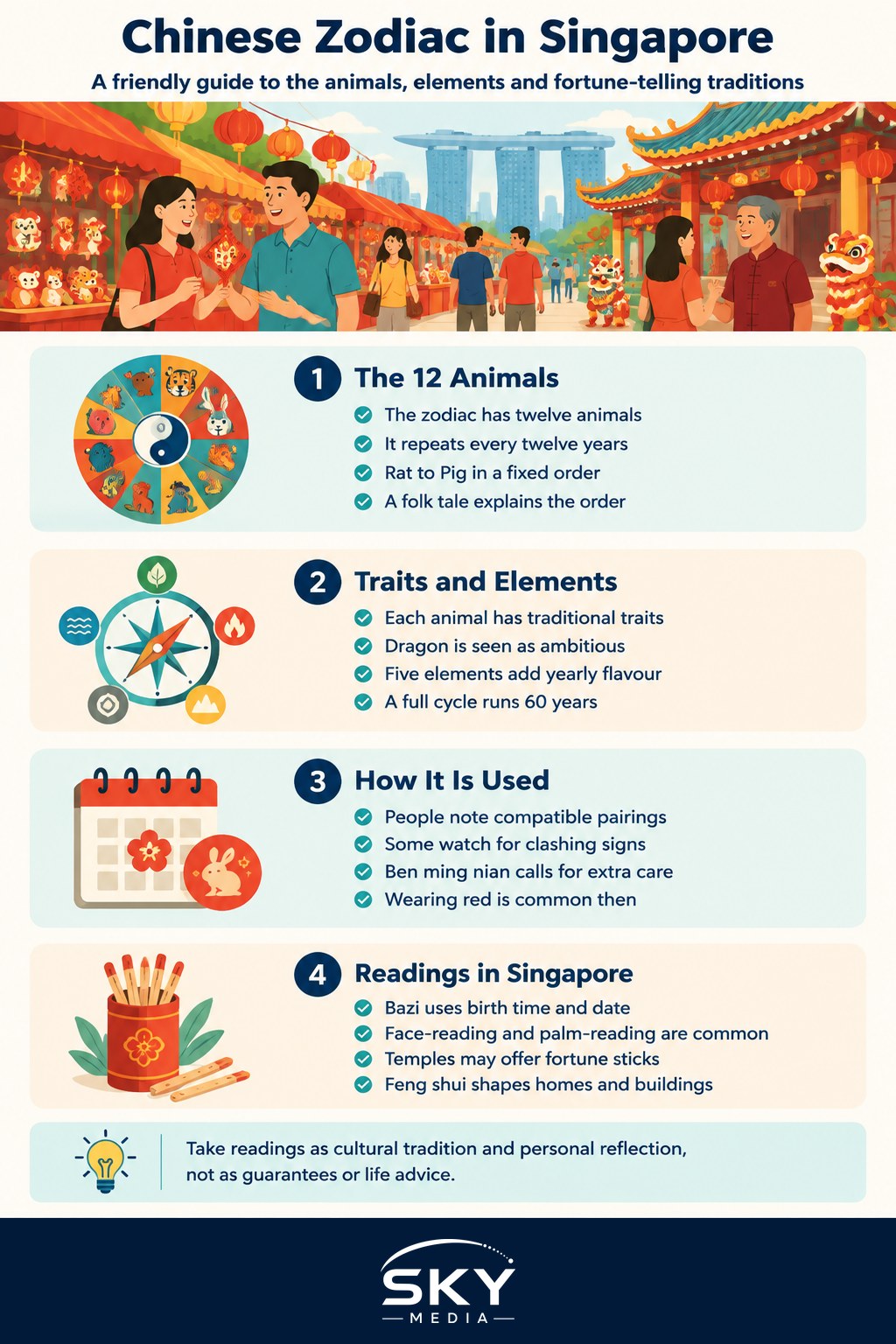
The Chinese zodiac, or sheng xiao, is a cycle of twelve animals, each linked to a year, that repeats every twelve years. In order, they are the Rat, Ox, Tiger, Rabbit, Dragon, Snake, Horse, Goat, Monkey, Rooster, Dog and Pig. According to a much-loved folk tale, the order was set by a great race across a river called by the Jade Emperor, in which the clever Rat rode on the diligent Ox and leapt ahead at the finish, which is why the Rat comes first.
Each animal carries a bundle of traditional associations. People born in the year of the Dragon, the only mythical creature in the set, are often described as ambitious and charismatic, which is why Dragon years tend to see a small rise in births among Chinese communities. Those born under the Ox are spoken of as steady and hardworking, the Tiger as brave, the Rabbit as gentle, and so on. These are cultural characterisations passed down through generations, enjoyed as a fun lens on personality rather than fixed truths about anyone.
Layered onto the animals are the five elements, wood, fire, earth, metal and water, which cycle through the years and are said to give each year its own flavour, such as a Wood Dragon or a Fire Horse. This is why the full cycle actually runs for sixty years before an exact combination repeats.
Newcomers sometimes ask how the zodiac is used day to day. Beyond marking the year, people traditionally note pairings said to be compatible or clashing, and some check whether the coming year is their ben ming nian, the return of their own birth sign, which by custom is thought to call for a little extra care and the wearing of red for good cheer. All of this is folk tradition, enjoyed for its warmth rather than followed as fact, and plenty of people simply like knowing their animal as a piece of family heritage.
The Signs at a Glance
The table below lists the twelve animals with a traditional trait often associated with each, offered simply as cultural lore.
| Animal | Traditional Association |
|---|---|
| Rat | Quick-witted and resourceful |
| Ox | Steady and hardworking |
| Tiger | Brave and confident |
| Rabbit | Gentle and elegant |
| Dragon | Ambitious and charismatic |
| Snake | Wise and thoughtful |
| Horse | Energetic and free-spirited |
| Goat | Kind and creative |
| Monkey | Clever and playful |
| Rooster | Observant and hardworking |
| Dog | Loyal and honest |
| Pig | Generous and easy-going |
Fortune-Telling as a Living Tradition
Beyond the zodiac year, Singapore has a rich culture of Chinese fortune-telling that many people consult for interest, reassurance or tradition, especially around big life moments such as marriage, a new baby or the Lunar New Year. It is important to hold all of this lightly, as a heritage practice that people relate to in very different ways, from firm believers to those who simply enjoy the ritual.
Bazi, meaning the eight characters, is one of the most respected systems. A practitioner takes the year, month, day and hour of a person’s birth and reads them through the framework of the elements and the zodiac to describe personality and life patterns. It is detailed and philosophical, closer to a traditional chart than a simple prediction.
Face-reading, or mian xiang, and palm-reading are also part of the landscape. A face-reader interprets features such as the forehead, eyes and the shape of the face according to long-standing charts, offering a character sketch drawn from tradition. Some people also consult practitioners about auspicious dates or seek a fortune stick reading at temples, where a numbered stick is drawn and matched to a written verse to be interpreted.
Feng shui, the art of arranging space in harmony with the flow of energy, overlaps with this world and shapes everything from home layouts to the design of buildings. Many people here take an interest in it when moving into a new flat, again with a wide range of seriousness.
Where People Go
Fortune-telling in Singapore is easy to encounter without going far. Around the Lunar New Year, temples and Chinese-heritage districts fill with activity, and stalls offering readings appear at festive fairs and bazaars. Certain temples are long associated with fortune stick drawing, and busy neighbourhoods have practitioners of bazi and face-reading who see visitors year-round. Bookshops stock almanacs and zodiac forecasts, and around New Year these little annual guides are popular gifts and reading material.
If you would like to experience a reading out of curiosity, treat it as you would anywhere, with an open but grounded mind. A respectful, thoughtful practitioner will speak in terms of tendencies and traditional wisdom rather than absolute promises.
Enjoying It Respectfully
The zodiac and its wider fortune-telling culture are, at their best, a warm thread connecting people to heritage, family and the turning of the years. Take them as such. They are not a substitute for your own judgement, professional advice, or medical and financial guidance, and no reading can guarantee what lies ahead. Held in that spirit, they add a great deal of colour to life in Singapore, a shared language of animals and elements that lights up the New Year and gives friends a playful way to talk about who they are.
Explore more
Qixi: Chinese Valentine’s Day in Singapore
Mid-Autumn Festival in Singapore
Mooncakes and Zongzi: Singapore vs China
Chinese Tea Culture in Singapore
Frequently Asked Questions
What is ben ming nian and why do people wear red? It is the year when your own birth animal returns, which tradition says calls for a little extra care. Wearing red is a custom meant to bring good cheer. It is folk tradition, not fact, and plenty of people simply enjoy the ritual.
Is it worth paying for a bazi or face-reading in Singapore? It depends on why you are going. Treat it as a cultural experience or conversation, not a prediction, and never as advice about money, health or major decisions. Agree the price beforehand, and be wary of anyone offering absolute promises.
What is a fortune stick reading at a temple? A numbered stick is drawn at a temple and matched to a written verse, which is then interpreted by temple staff or the visitor. It is a tradition of reflection, and the interpretation speaks in general tendencies rather than guarantees.
Do Singaporeans really take the zodiac seriously? Attitudes vary widely, from firm believers to those who just like the colour and shared stories. Many people enjoy it as heritage around Lunar New Year, while others pay it little attention. You are free to take as much or as little from it as you like.
Further reading: Reading Tarot as a Hobby