

Searching for divorce lawyers in Singapore usually happens at one of the hardest moments in life. You are dealing with emotions, children, money and housing all at once, and then you are faced with hundreds of law firms that all seem to say the same thing. This guide focuses on one practical question: how to pick a lawyer who suits your situation, your budget and the way you want the divorce to go.
This is general information, not legal advice. Divorce procedures and court practices can change, so always confirm current requirements with the Family Justice Courts and your own lawyer.
What a Divorce Lawyer Actually Does for You
A family lawyer does more than file papers. Depending on your case, they may:
- Explain whether you meet the basic requirements to file for divorce in Singapore and which ground or fact applies.
- Prepare and file court documents, and keep track of deadlines.
- Advise on the division of matrimonial assets, including the HDB flat, CPF savings and other property.
- Advise on child arrangements, often called custody, care and control, and access.
- Advise on maintenance for a spouse or children.
- Negotiate with your spouse’s lawyer, and represent you at mediation or in court if needed.
If you want a broader picture of the process before choosing anyone, our guide to navigating divorce in Singapore walks through the stages.
Do You Need a Lawyer at All?
It is possible to act for yourself in some family matters, and the Family Justice Courts provide information for people who do so. However, many people engage a lawyer because the financial and parenting decisions involved are long-lasting and hard to undo.
Your situation will usually fall somewhere on this spectrum:
| Situation | What kind of help often fits | Points to discuss with a lawyer |
|---|---|---|
| Both agree on the divorce and all terms | A lawyer for a simpler, uncontested process, sometimes on a package basis | Whether the agreed terms are fair and workable in the long run |
| Agree on divorcing but not on assets or children | A lawyer who is comfortable with negotiation and mediation | Your priorities, and what a realistic outcome might look like |
| Strong disagreement, safety concerns or complex assets | An experienced family litigator, sometimes with a larger team | Protection options, timelines and the likely cost of going to trial |
| Limited income and savings | Legal aid or a community legal clinic first | Whether you qualify for assistance and what it covers |
Even in an amicable split, a short consultation to check the terms can be worthwhile. An agreement that seems simple today may affect your housing and retirement savings for decades.
Where to Find Divorce Lawyers in Singapore
There are several reliable starting points:
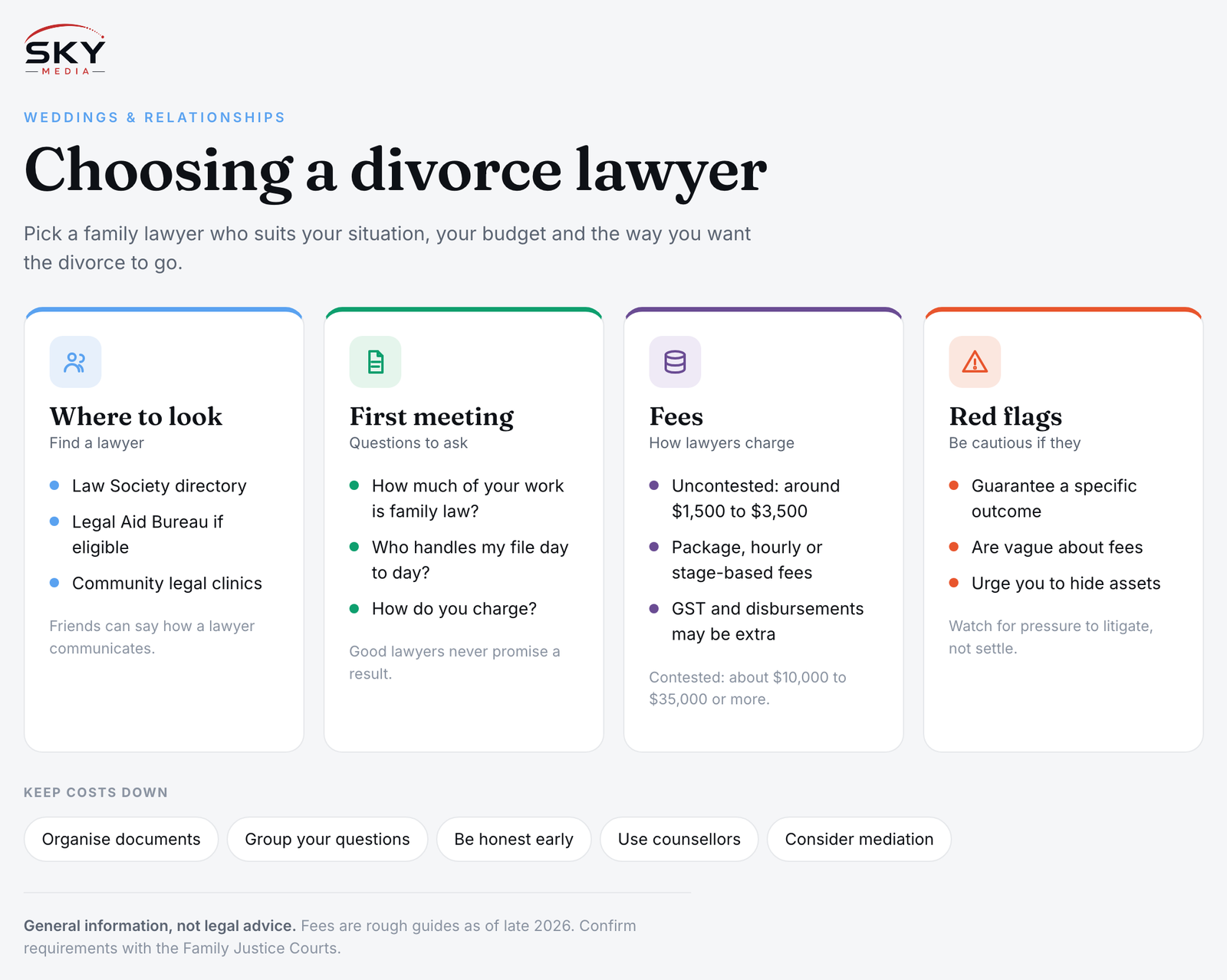
- The Law Society of Singapore. Its public directory lets you search for practising lawyers, and it can tell you whether a person is a qualified lawyer.
- Legal Aid Bureau (LAB). Under the Ministry of Law, LAB provides legal aid in certain civil matters, including divorce, to people who pass its means and merits tests. Check the LAB website for current eligibility.
- Community legal clinics. Volunteer lawyers at various community organisations offer brief, free advice sessions. These are useful for understanding your options before you commit to paying a firm.
- Family support agencies. Divorce support specialist agencies and family service centres can help with emotional support and practical guidance, and may point you to legal resources.
- Personal recommendations. Friends who have been through a divorce can describe how a lawyer communicated, which is often what matters most day to day.
If you are more comfortable discussing sensitive matters in Mandarin, see our guide to Mandarin-speaking lawyers and accountants in Singapore.
Questions to Ask at Your First Meeting
Many firms offer an initial consultation. Some charge for it, others do not, so ask beforehand. Bring a short summary of your marriage, children, property and finances, and use the meeting to assess fit.
Useful questions include:
- How much of your practice is family law?
- Who will handle my file day to day, you or a junior lawyer, and how do I reach them?
- Based on what you know, what are the realistic options for my case?
- How do you feel about mediation and settlement compared with going to court?
- How do you charge, and what is and is not included?
- What could cause costs to rise, and how will you keep me updated?
- Roughly how long do cases like mine take?
Pay attention to how you feel during the conversation. A good divorce lawyer explains things plainly, is honest about weaknesses in your position, and does not promise a particular result.
Understanding How Divorce Lawyers Charge
Fees vary a great deal between firms and cases, so it is not possible to give a single figure. As a rough guide, as of late 2026, legal fees for a simple uncontested divorce are typically around $1,500 to $3,500, often on a package basis, while contested divorces commonly run from about $10,000 to $35,000 and can go well beyond that when assets, businesses or children are fiercely disputed. Quotes vary, and GST and disbursements may be extra. It helps to understand the common structures:
- Fixed or package fees. Often offered for uncontested divorces where both parties agree on everything. Check exactly which stages the package covers.
- Hourly billing. Common for contested matters. You pay for the time spent on calls, emails, drafting and court work.
- Stage-based fees. A fixed amount for each stage, such as filing, mediation and hearings.
- Disbursements. Court filing fees and other out-of-pocket costs are usually charged on top of legal fees.
Ask for the fee arrangement in writing, usually in a warrant to act or engagement letter, before work starts. If anything is unclear, ask again. A reputable lawyer will be happy to explain.
Red Flags to Watch For
Be cautious if a lawyer or firm:
- Guarantees a specific outcome, such as sole care and control or a fixed share of assets.
- Pushes you towards aggressive litigation without discussing settlement or mediation.
- Is vague about fees or reluctant to put terms in writing.
- Rarely responds to messages, or keeps handing you to different staff without explanation.
- Encourages you to hide assets or mislead the court. This can seriously harm your case and has legal consequences.
Mediation, Children and Keeping Costs Down
Singapore’s family justice system places strong emphasis on resolving matters amicably, particularly where children are involved. Couples are commonly expected to attend counselling or mediation at some stage. Since July 2024, a parent with at least one child under 21 must generally complete the Mandatory Co-Parenting Programme (CPP) before filing for divorce, even if both spouses agree on everything. The same reforms added Divorce by Mutual Agreement as a new basis for divorce. The specific requirements depend on your circumstances, so check with the Family Justice Courts and your lawyer.
A lawyer who supports mediation is not necessarily “soft”. Settling sensibly often saves money, reduces stress for children, and gives both parties more control over the outcome. Read more in our guide to mediation for divorcing couples in Singapore.
Ways to keep legal costs manageable:
- Organise documents yourself, such as bank statements, CPF statements and property papers.
- Group your questions into one email instead of many short messages.
- Be honest and complete from the start, so your lawyer does not have to redo work.
- Use counsellors or support agencies for emotional support, rather than your lawyer, whose time is billed.
For help understanding the money side, see dividing finances in a divorce.
Frequently Asked Questions
How do I know if a divorce lawyer in Singapore is qualified?
Check that they hold a current practising certificate through the Law Society of Singapore’s directory, and ask about their family law experience.
Can my spouse and I use the same lawyer?
Generally, each party should have separate legal advice, because a lawyer cannot properly act for both sides when interests may conflict. Ask a lawyer to explain the position for your case.
Can I change lawyers midway?
Yes, you can usually change lawyers, though you may need to settle outstanding fees and allow time for the file to be handed over.
What documents should I bring to my first meeting with a divorce lawyer? Bring a short written summary of your marriage, children, property and finances, plus key papers such as your marriage certificate, HDB or property documents, CPF statements and bank statements. Being organised from the start saves billable time and helps the lawyer give you realistic options.
Can I get free legal advice on divorce in Singapore? Community legal clinics run by volunteer lawyers offer brief, free sessions to help you understand your options. If your income and savings are limited, the Legal Aid Bureau may provide legal aid for divorce, subject to its means and merits tests, so check its website for eligibility.
Should I choose a big law firm or a small practice for my divorce? Size matters less than family law experience and how well the lawyer communicates. Larger teams can suit complex assets or heavily contested cases, while smaller practices may offer more direct contact with the lawyer handling your file. Ask who will actually work on your case.
What does the Mandatory Co-Parenting Programme involve? Since July 2024, a parent with at least one child under 21 must generally complete this programme before filing for divorce, even when both spouses agree. It focuses on helping parents plan for their children’s needs after separation. Check the Family Justice Courts for current details and how to register.
Choosing the right lawyer will not make a divorce painless, but it can make the process clearer, fairer and calmer for everyone involved.