

Buying a home with someone else can make a purchase possible that would be out of reach alone. Two incomes can support a bigger loan, and sharing the downpayment eases the pressure on savings. But choosing a joint home loan borrower is not only a financial decision. In Singapore, the person you borrow with usually becomes a co-owner of the property, and that link can last for decades.
This guide looks at the practical and legal implications of buying with a parent, a sibling or an unmarried partner. It is general information, not financial or legal advice. Rules on loans, stamp duties, CPF use and HDB eligibility change from time to time, so check the current details with your bank, the Monetary Authority of Singapore (MAS), the Inland Revenue Authority of Singapore (IRAS), the CPF Board and HDB, and speak to a lawyer before you commit.
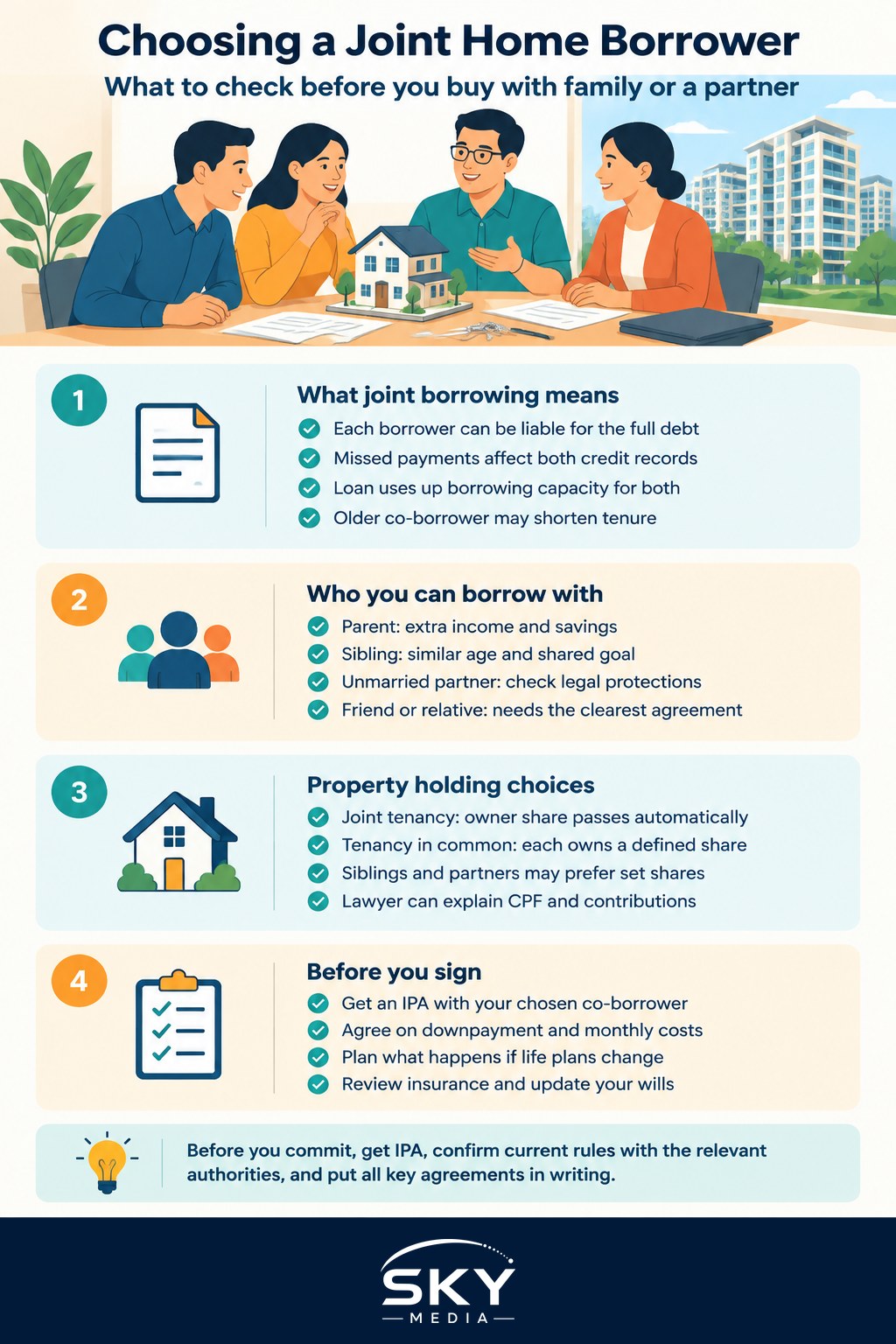
What Being a Joint Borrower Really Means
When two or more people take a home loan together, each is usually jointly and severally liable for the whole debt. In plain terms, the bank can ask any one borrower to repay the full outstanding amount, not just “their half”. If your co-borrower stops paying, you remain responsible.
Some other points to understand early:
- Borrowers and owners usually go together. Banks in Singapore generally expect everyone named on the title to be on the loan, and often the reverse. Ask your bank how it treats your situation.
- Your credit records are linked to the loan. Missed payments can affect each borrower’s credit history with Credit Bureau Singapore.
- The loan counts against both borrowers. A joint mortgage uses up part of each person’s borrowing capacity under the Total Debt Servicing Ratio (TDSR), which can limit future loans. Our explainer on TDSR and MSR covers how these limits work.
- Age affects the loan tenure. For joint loans, banks generally consider the borrowers’ income-weighted average age when working out the maximum tenure. An older co-borrower may shorten the tenure and raise the monthly instalment.
If you are still deciding whether to borrow with someone at all, read applying for a home loan jointly or alone first. This article assumes you have decided to go joint and are now choosing who with.
Comparing Parents, Siblings and Unmarried Partners
Each type of co-borrower brings different strengths and risks. The table below summarises the main issues to think through.
| Co-borrower | Possible advantages | Key issues to check |
|---|---|---|
| Parent | Extra income and savings; family trust; may help a young buyer qualify | Older age can shorten loan tenure; parent’s existing property may trigger higher stamp duty; future inheritance questions |
| Sibling | Similar age, so tenure is less affected; shared goal of owning a home | Life changes such as marriage, moving abroad or wanting to buy separately; agreeing on who lives there |
| Unmarried partner | Shared household and long-term plans | Fewer legal protections than married couples if the relationship ends; HDB eligibility rules; how to divide the home on a breakup |
| Friend or other relative | Pooling resources when family options are limited | Hardest to unwind; needs the clearest written agreement |
Buying With a Parent
Adding a parent is common when a young buyer’s income is not yet enough to qualify for the loan they need. It can work well, but check these points carefully.
- Loan tenure. A parent’s age may reduce the maximum tenure because of the income-weighted average age approach. A shorter tenure means higher monthly instalments.
- Stamp duty. Additional Buyer’s Stamp Duty (ABSD) applies on top of Buyer’s Stamp Duty in certain cases. For a joint purchase, IRAS generally applies the highest ABSD rate among the buyers’ profiles. If your parent already owns a property, buying jointly may mean paying ABSD as a second-property purchase. Check the current rules on the IRAS website before you decide.
- Future flexibility. If your parent remains a co-owner, they may face restrictions or extra costs if they want to buy another property later.
- Inheritance. How you hold the property affects what happens if your parent passes away. This links to the joint tenancy and tenancy in common choice explained below.
For HDB flats, buying with parents falls under specific eligibility schemes. Check the HDB website or the HDB Flat Portal for the current eligibility conditions.
Buying With a Sibling
Siblings of similar age often make practical co-borrowers, and HDB has schemes for certain singles buying together. Again, eligibility depends on the current HDB rules, so confirm them before planning.
The bigger questions are personal. What happens if one of you marries and wants to live with a spouse? What if one sibling wants to sell and the other does not? What if one sibling moves overseas for work? Talk through these scenarios before you sign, and write down what you agree.
Buying With an Unmarried Partner
Couples who are not married can buy private property together, but the legal position is different from that of married couples. If the relationship ends, there is no divorce process to divide matrimonial assets. Instead, the co-owners must agree on a sale or buyout, or one may need to go to court to resolve the dispute.
For HDB flats, unmarried couples face specific eligibility rules. For example, schemes for fiancé and fiancée couples come with conditions about getting married. Check the latest HDB requirements carefully.
Whatever the property type, unmarried partners should strongly consider a written co-ownership agreement prepared with a lawyer.
Joint Tenancy or Tenancy in Common
When you buy jointly, you choose how to hold the property. This choice matters as much as who you borrow with.
- Joint tenancy: all owners own the whole property together. If one owner dies, their interest passes automatically to the surviving owner or owners, regardless of a will. This is the right of survivorship.
- Tenancy in common: each owner holds a defined share, such as 70% and 30%. If one owner dies, their share passes under their will or the intestacy rules, not automatically to the co-owner.
Parents and children sometimes prefer joint tenancy for simplicity, while siblings and unmarried partners who contributed unequally often prefer tenancy in common to reflect their shares. Your lawyer can explain which suits your situation and how CPF use and contributions interact with each option.
Practical Steps Before You Sign
- Get an In-Principle Approval (IPA) with your chosen co-borrower to see how much you can borrow together. See our guide to In-Principle Approval for a home loan.
- Agree on contributions in writing, including downpayment, CPF use, monthly instalments, maintenance, property tax and renovation costs.
- Plan the exit. Decide what happens if someone wants to sell, cannot pay, marries, moves away or passes away.
- Review insurance. Mortgage protection and CPF’s Home Protection Scheme for HDB flats cover risks differently. Check what applies to your purchase.
- Update your wills so they match the way you hold the property.
Choosing a joint home loan borrower is ultimately about trust, timing and clear agreements. The right co-borrower is someone whose finances and plans fit yours, and with whom you can calmly discuss difficult “what if” questions before you buy.
Frequently Asked Questions
Can a joint borrower be removed from a home loan later? It is possible but not automatic. The bank has to agree, and the remaining borrower must usually qualify for the loan alone. If the property is an HDB flat, ownership changes also follow HDB’s rules. Ask your bank and a lawyer early, because this affects how you plan the exit.
Does adding a joint borrower get me a lower interest rate? Not necessarily. The rate depends on the loan package and the bank’s offer, not on the number of borrowers. A joint borrower mainly changes how much you qualify for and how the loan is assessed. Compare packages from several banks for your own case.
What happens to the loan if my co-borrower dies? The debt does not disappear. The surviving borrower normally remains liable, and how the property passes depends on whether you hold it as joint tenants or tenants in common. Insurance and the bank’s terms matter too. A lawyer can explain your position.
Can a foreigner or PR be my joint home loan borrower? Possibly, but their status affects several things. Buyer’s profile can change the stamp duty rate, and for HDB flats the eligibility rules are specific. Check the current rules with IRAS, HDB and your bank before you commit, since each applies its own conditions.
How do we protect ourselves if one borrower cannot pay the instalment? Discuss it before you sign and write down what happens, such as using savings first, a temporary top-up, or selling. Keep an emergency fund and consider suitable insurance. Because each borrower is liable for the whole loan, talk to the bank early if payments are at risk.