

You have decided a certain stock is going to rise, so every positive headline feels like proof and every negative one feels like noise. You are sure your colleague dislikes you, so a short reply on Teams reads as a snub. This is confirmation bias: the tendency to look for, notice, interpret and remember information in a way that supports what you already believe.
Everyone has it. It is not a sign of low intelligence, and clever people can be especially good at building arguments for what they want to be true. The useful question is not “Am I biased?” but “Where is this bias steering me right now, and what can I do about it?” This article goes deep on this one bias, with everyday examples and practical habits to catch it in action.
What Confirmation Bias Actually Is
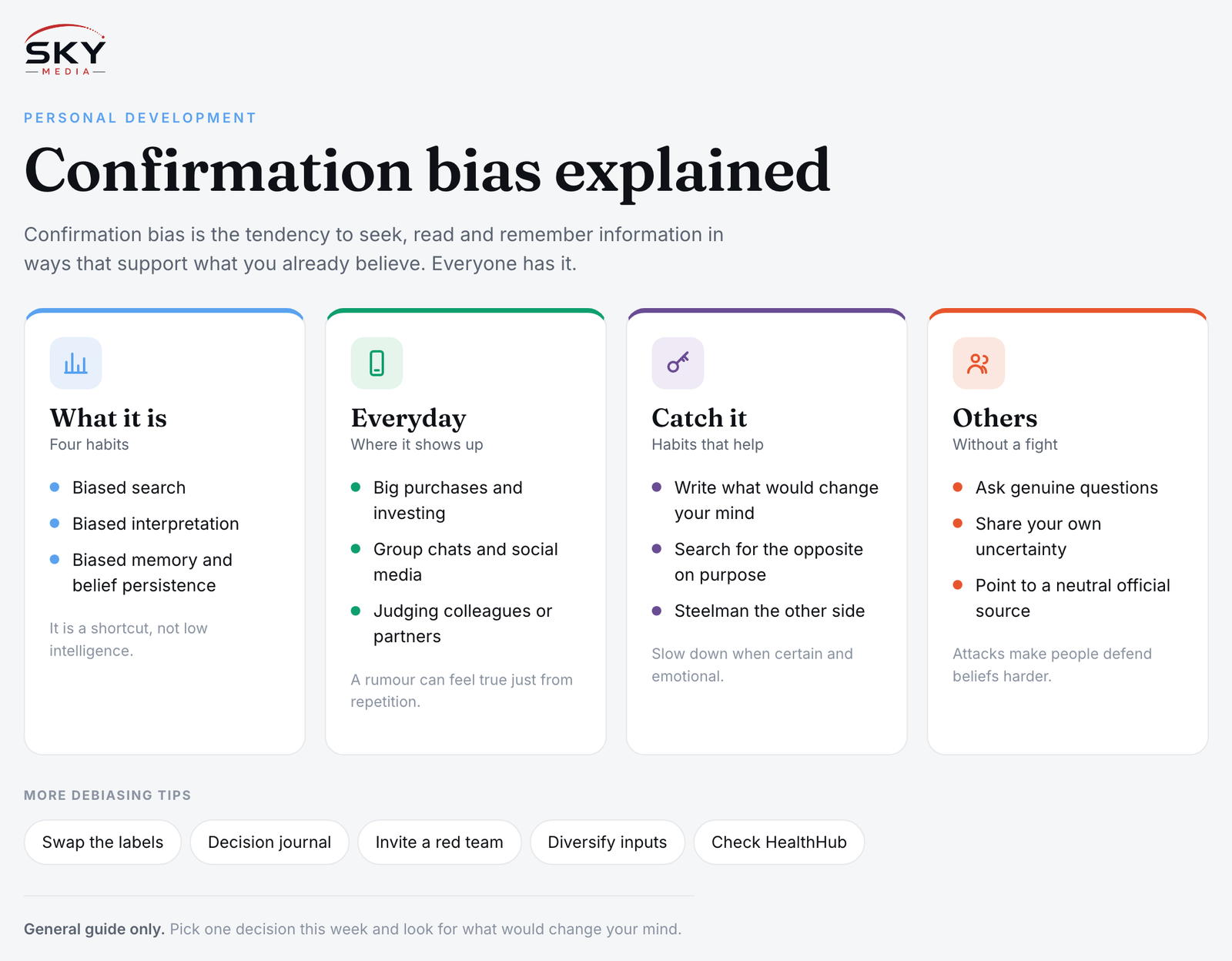
Psychologists usually describe confirmation bias as several related habits working together, rather than a single mistake:
- Biased search. We look for evidence in places likely to agree with us. If you suspect a diet works, you search “benefits of X diet”, not “X diet doesn’t work”.
- Biased interpretation. Given the same ambiguous facts, we read them in our favour. A mixed review becomes “basically positive” if we already like the product.
- Biased memory. We recall the hits and forget the misses. The one time a hunch paid off sticks; the five times it did not fade.
- Belief persistence. Even when the original reason for a belief is shown to be wrong, the belief often stays.
It helps to see why the brain does this. Checking every belief from scratch would be exhausting, so the mind uses shortcuts. Holding on to existing views saves effort, protects our self-image and keeps us consistent with people we identify with. Those are understandable goals. The trouble comes when the shortcut overrides the evidence on decisions that matter.
Everyday Examples You Will Recognise
Confirmation bias is easiest to understand in situations from ordinary life.
Property and big purchases. After falling for a particular flat or car, buyers often start reading listings and forum posts that praise it, while waving away comments about noise, maintenance costs or resale. The decision was emotional; the research comes afterwards to justify it.
Investing. Someone who has bought a share may follow only the analysts and online groups that are bullish on it. Losses get explained as “temporary”, gains as proof of skill.
Group chats and social media. Algorithms show you more of what you engage with. Combine that with friends and family who already share your views, and a chat group can become an echo chamber where a rumour feels confirmed simply because many people repeated it.
Health claims. If you believe a remedy helped, you remember the days you felt better after taking it and forget the days you would have felt better anyway. Always check health information with a doctor or an official source such as HealthHub rather than relying on testimonials.
Workplace judgements. A first impression of a new hire, good or bad, can colour how a manager reads every later piece of work. Strong performers get the benefit of the doubt; others get scrutiny.
Relationships. If you have already decided a partner “never listens”, you will notice every missed detail and overlook the moments they did pay attention.
How Confirmation Bias Shows Up vs What Helps
| Situation | What the bias tells you | A better question to ask |
|---|---|---|
| Researching a purchase | “Look how many good reviews there are” | “What do the most detailed negative reviews say?” |
| Reading news on a topic you care about | “This source finally tells the truth” | “How would a careful critic describe this same event?” |
| Judging a colleague | “Typical, they always do this” | “What would I conclude if someone I liked did the same?” |
| Holding an investment | “The dip is just temporary” | “What evidence would make me sell, and have I seen it?” |
| A forwarded message in a group chat | “Everyone is sharing it, so it must be true” | “Where did this originate, and has an official source confirmed it?” |
Habits That Help You Catch Yourself
You cannot switch confirmation bias off, but you can build routines that make it easier to spot. These work best when used on decisions with real consequences, not every passing thought.
1. Write down what would change your mind. Before you research a decision, note the specific evidence that would make you choose differently. If you later find that evidence and still do not budge, that is a signal worth paying attention to.
2. Search for the opposite on purpose. Add words like “problems”, “criticism”, “risks” or “does not work” to your search. Read at least one well-argued piece that disagrees with you all the way through.
3. Steelman the other side. Try to describe the opposing view so well that someone who holds it would agree with your summary. If you can only describe a weak, silly version, you probably have not understood it yet.
4. Swap the labels. Ask how you would judge the same evidence if it pointed the other way, or if it came from a person or group you dislike. Inconsistency here is confirmation bias in plain sight.
5. Keep a decision journal. For important choices, record what you decided, why, and what you expected to happen. Reviewing it months later shows where your predictions were honest and where you were telling yourself a story.
6. Slow down when you feel certain and emotional. Strong feelings of being right, especially paired with anger or excitement, are when the bias is strongest. A short pause before sharing, buying or replying can help.
7. Invite a “red team”. Ask a trusted friend or colleague to argue against your plan. Make it clear you want real pushback, not reassurance, and thank them for it.
8. Diversify your inputs. Follow a few thoughtful sources that reach different conclusions from yours. This is not about agreeing with them; it is about seeing the evidence you would otherwise miss.
Spotting It in Other People Without Starting a Fight
Once you learn about confirmation bias, it is tempting to point it out in everyone else. That rarely changes minds, because people defend beliefs harder when they feel attacked.
More constructive approaches include:
- Asking genuine questions: “What made you confident about this?” or “What would change your view?”
- Sharing your own uncertainty first, which makes it safer for the other person to admit theirs.
- Focusing on a shared goal, such as protecting an elderly parent from a scam, rather than on who is right.
- Pointing to a neutral source, such as an official government website, instead of your favourite commentator.
Why It Matters Now
Information arrives faster and in greater volume than ever, and much of it is selected to keep you engaged rather than informed. AI tools and recommendation systems can quietly reinforce what you already think. Our guide to understanding AI ethics and bias explains how bias can be built into the systems we use, which makes your own checking habits even more valuable.
Catching confirmation bias is ultimately a skill of independent thinking: testing ideas instead of collecting support for them. If you want to strengthen that wider skill, read how to think for yourself. It also makes you harder to manipulate, which is useful protection when a scammer tells you exactly what you hope to hear, a pattern discussed in protecting yourself from identity theft.
Start small. Pick one decision this week, write down what would change your mind, and go looking for it. Doing that regularly will not make you bias-free, but it will make you noticeably better at seeing the world as it is rather than as you expect it to be.
Further reading: Circle of Competence: Knowing the Edges of What You Know