

For a small business, getting people and goods from one place to another is a real operating cost, and in Singapore, owning a vehicle is expensive by design. The right answer depends on what you move, how often and how far. This guide to business transport in Singapore compares the main options for SMEs: buying a company car or van, leasing, short-term rental, car sharing, corporate ride-hailing accounts and outsourced delivery.
It is general information, not financial or tax advice. Vehicle rules, COE prices and tax treatment change, so check current details with LTA (the Land Transport Authority), IRAS (the Inland Revenue Authority of Singapore) and your accountant before committing.
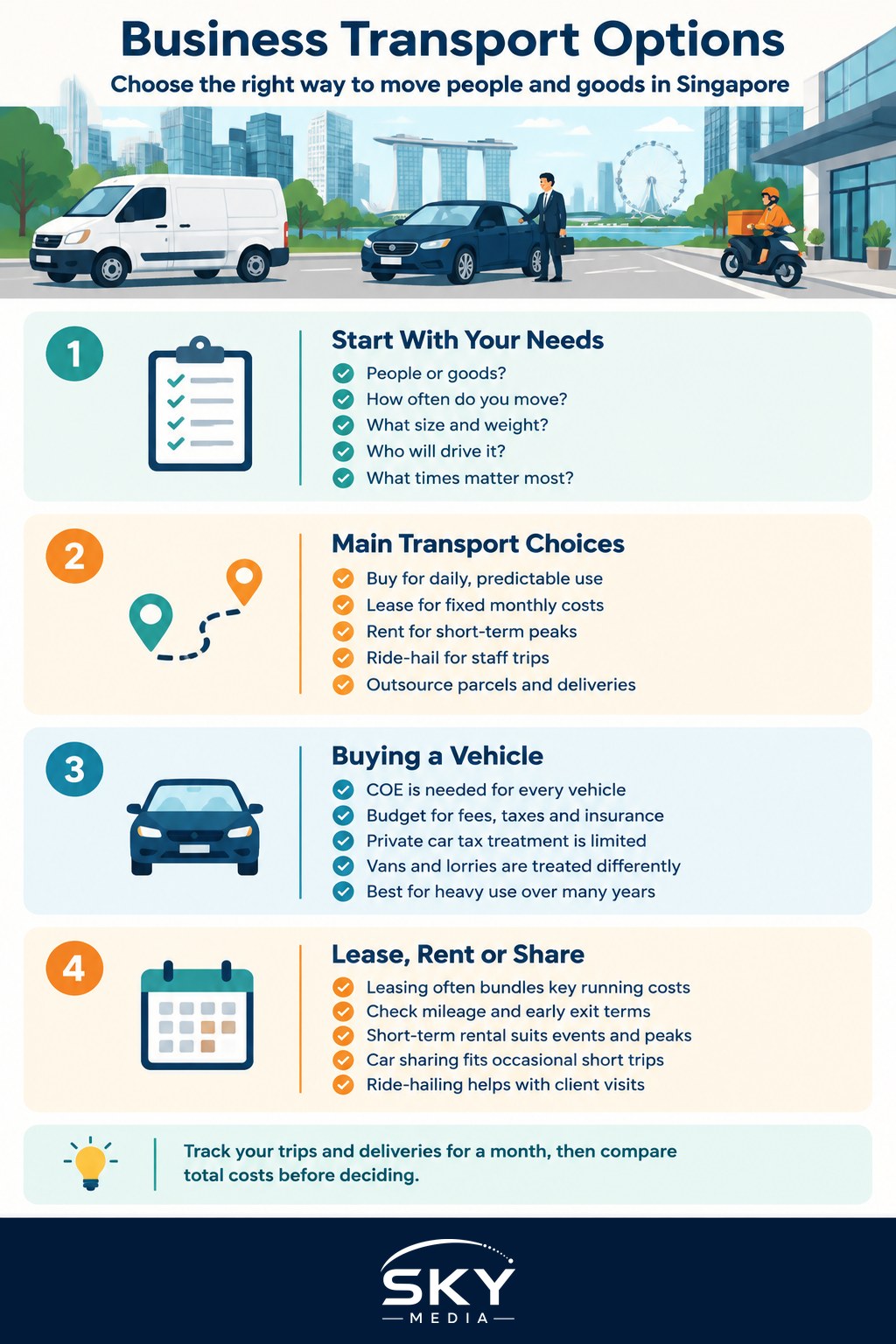
Start With What You Actually Need to Move
Before comparing options, write down your real transport pattern for a typical month:
- People or goods? Visiting clients is a very different need from delivering stock.
- How often? Daily trips justify a dedicated vehicle more than occasional ones.
- What size and weight? Documents and laptops fit in any car; furniture or catering equipment needs a van.
- Who drives? Owners, staff or a third party. Drivers must hold the right licence class for the vehicle.
- When? Early-morning deliveries or late-night events may rule out some options.
Many SMEs end up with a mix: ride-hailing for client meetings, rental for the occasional event and a courier for parcels. Trying to cover everything with one owned vehicle is often the most expensive route.
Comparing the Main Options
| Option | Best suited for | Cost pattern | Main watch-outs |
|---|---|---|---|
| Buying a company car or van | Daily, predictable use over several years | High upfront cost, COE and depreciation | Capital tied up; resale depends on COE timing |
| Long-term leasing | Regular use without large upfront spend | Fixed monthly fee, often bundling insurance and servicing | Contract length, mileage caps, early termination terms |
| Short-term rental | Peaks, events, trial periods | Pay per day or week | Availability at busy periods; insurance excess |
| Car sharing by the hour | Occasional short trips | Pay per use | Booking availability; not for heavy goods |
| Corporate ride-hailing or taxi account | Staff travel and client visits | Pay per trip, central billing | Costs add up with frequent long trips |
| Outsourced courier or logistics | Parcels and regular deliveries | Per delivery or contract | Less control over timing and handling |
Buying a Company Car or Commercial Vehicle
Every vehicle registered in Singapore needs a Certificate of Entitlement (COE), which gives the right to use it for a set period. Cars and goods vehicles bid in different COE categories, and prices move with each bidding exercise. On top of the purchase price, budget for registration fees and taxes set by LTA, road tax, insurance, servicing and parking.
Private cars and tax. IRAS generally does not allow businesses to deduct the costs of private passenger cars, with limited exceptions. If an employee also uses a company car for personal purposes, that private use may count as a taxable benefit. Speak to your accountant before buying a car through the business, because the tax picture is often less attractive than owners expect.
Vans and lorries. Goods vehicles such as vans and small lorries are treated differently for tax and fall under the goods vehicle COE category. Check:
- Which driving licence class is needed for the vehicle’s weight
- Parking rules for commercial vehicles in HDB and URA car parks
- Any LTA schemes for cleaner commercial vehicles if you are considering electric or low-emission models
Buying makes the most sense when the vehicle will be used heavily every working day for years, and when you have cash flow to spare without starving the rest of the business.
Leasing: Predictable Costs Without the Upfront Hit
Leasing lets you use a car or van for a fixed term, often one to several years, for a monthly fee. Many lease packages bundle insurance, road tax and servicing, which simplifies budgeting.
What to check in a lease contract:
- Mileage limits and the charge for exceeding them
- Who pays for repairs after accidents and normal wear
- Replacement vehicle terms while yours is being serviced
- Early termination fees if your business needs change
- Named drivers and whether all staff are covered
Leasing suits businesses that need a vehicle reliably but want to keep capital free for hiring, stock or marketing. If you are weighing leasing against other outsourced services, our guide to outsourcing for small business in Singapore covers the wider buy-versus-outsource thinking.
Rental, Car Sharing and Ride-Hailing Accounts
Short-term rental works well for seasonal peaks, roadshows, moving offices or testing whether a van is worth committing to. Book early for festive periods and check the insurance excess.
Car sharing platforms let staff book a car by the hour from nearby car parks. They are handy for occasional client visits and avoid the fixed costs of ownership entirely. Some offer business accounts with consolidated billing.
Corporate ride-hailing and taxi accounts are often the most practical choice for staff travel. Benefits include:
- No parking, maintenance or insurance to manage
- Central billing and trip records for expense claims
- Spending controls by employee or cost centre
Set a clear travel policy: when staff should use public transport, when a ride is allowed and whether late-night trips are covered. Public transport remains the cheapest option for many routes, and a transport allowance can be simpler than reimbursing every trip.
Delivery and Logistics for Goods
If your main need is moving products, compare doing it yourself with using couriers or logistics partners:
- Same-day courier services suit urgent, irregular deliveries.
- Scheduled logistics contracts suit regular volumes and may include warehousing.
- Your own van with a driver suits frequent local deliveries where timing and customer contact matter.
Track cost per delivery for a few months. It is the easiest way to see whether an owned van is worth it compared with paying per job.
Greener Choices and Planning Ahead
Singapore is moving towards cleaner vehicles, and newer commercial vehicle purchases are increasingly expected to be electric or low emission. Check current LTA incentives and charging availability near your premises before buying. Lower-emission choices also support wider sustainability goals, which our article on green practices for small businesses explores further.
Review your setup once a year. As the business grows, a pattern of rentals and ride-hailing might justify a lease, or a fleet might be cut back when work goes digital. Our guide to scaling a small business can help you plan these decisions alongside hiring and premises.
A Quick Decision Checklist
- Log every work trip and delivery for a month.
- Separate people movement from goods movement.
- Price at least three options for each, including all running costs.
- Ask your accountant how each option is treated for tax.
- Pick the most flexible option that meets your needs, and review it yearly.
There is no single best answer for business transport in Singapore. Matching the option to your actual usage keeps costs under control and frees up cash for the work that grows your business.
Official sources: Land Transport Authority (LTA)