
Getting a frail parent to a clinic can be an ordeal. There is the wheelchair, the lift, the taxi, the waiting room and the journey home, and for some seniors it is simply not possible any more. A doctor house call for elderly Singapore residents who are housebound can take much of that strain away, bringing a consultation, a medication review and routine checks into the living room.
This guide explains what home medical services are, how fees are usually structured, what can and cannot be done at home, and when a house call is the right choice. It is general information, not medical advice. In an emergency, call 995.
What a Doctor House Call Is, and What It Is Not
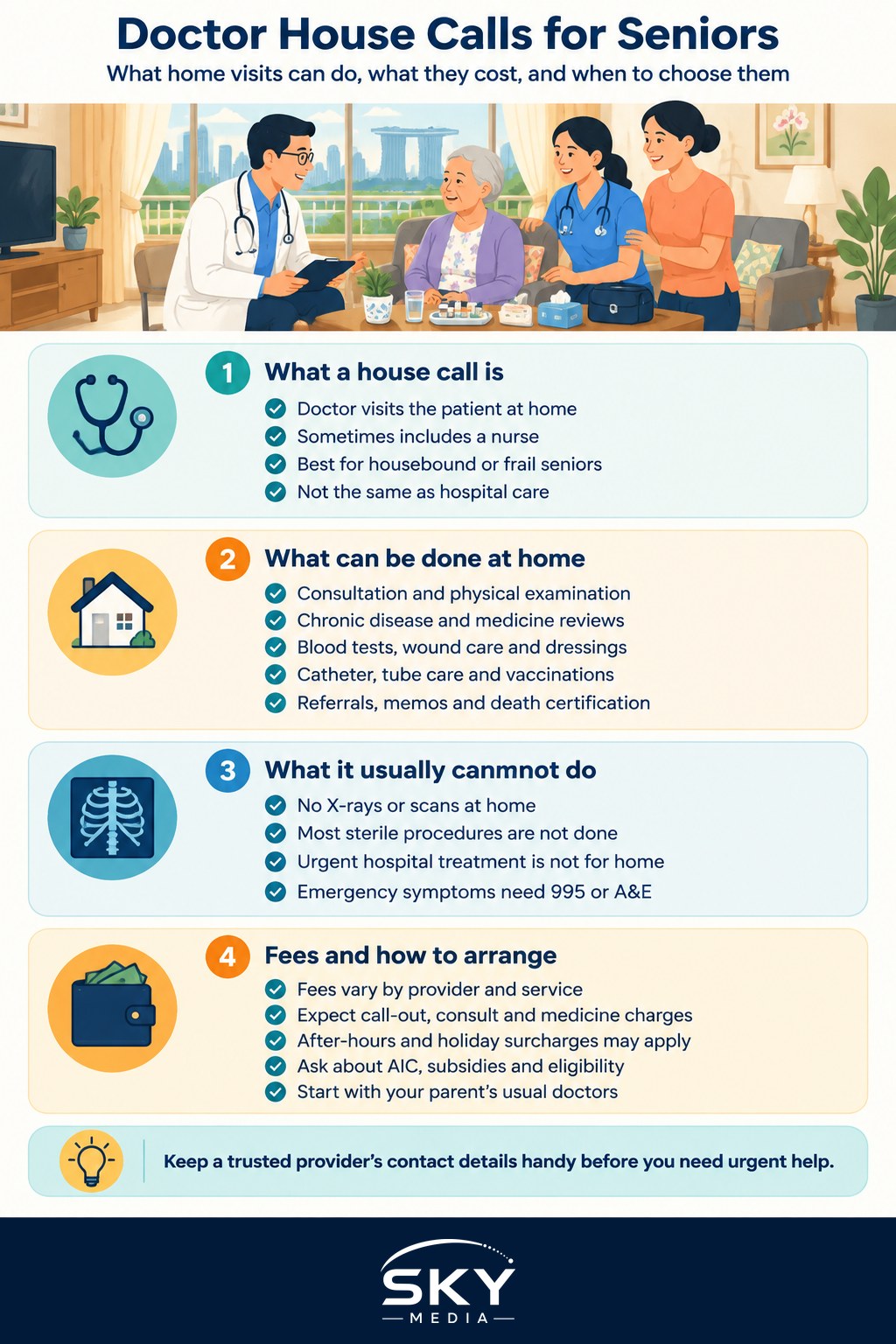
A house call is a visit by a doctor, and sometimes a nurse, to see a patient at home. It is typically used for seniors who are bedbound, have limited mobility, have advanced dementia or find travel distressing.
Providers fall into a few broad groups:
- Private house call doctors and GP clinics that offer home visits, sometimes after clinic hours.
- Home medical and home nursing services run by community care organisations, some of which are supported by the Agency for Integrated Care (AIC), the national body that coordinates long-term and community care.
- Home palliative care teams for seniors with serious, life-limiting illness, focused on comfort and symptom control.
A house call is different from Mobile Inpatient Care@Home, a hospital-level programme where eligible patients receive inpatient-type care at home under a hospital’s management. A house call is closer to a GP or family doctor visit: assessment, routine management and follow-up, not acute hospital treatment.
What Can Be Done at Home
A house call can cover a surprising amount of routine care. Depending on the provider and the senior’s condition, a home visit may include:
- Consultation and examination for a new problem such as a cough, fever, rash or reduced appetite.
- Chronic disease reviews, for example for high blood pressure, diabetes or heart conditions, including adjusting medication where appropriate.
- Medication review, which is especially useful for seniors on several medicines. Our guide on taking blood thinners safely as a senior shows why regular reviews matter.
- Blood tests, with samples taken at home and sent to a laboratory.
- Wound care, pressure sore checks and dressing changes, often by a nurse.
- Tube and catheter care, such as changing urinary catheters or feeding tubes, usually by trained nurses.
- Vaccinations, where the provider offers them.
- Referrals and memos for specialists, therapy or equipment.
- Certification of death at home, for families caring for a loved one at the end of life, which is an important service to arrange in advance with the care team.
What usually cannot be done at home includes imaging such as X-rays and scans, most procedures that need a sterile theatre, and anything requiring urgent hospital treatment.
Typical Fees and How They Are Structured
Fees vary widely between providers, so ask for a written quote. Rather than a single price, expect several components:
- A visit or call-out fee, which may depend on distance and timing.
- The consultation fee.
- Medication, charged separately.
- Tests and procedures, such as blood tests or dressing changes.
- After-hours, weekend or public holiday surcharges, which can add significantly to the bill.
Private house calls generally cost more than a clinic visit because of the doctor’s travel time. Subsidised home medical and home nursing services through community care providers may be available to eligible Singapore citizens and permanent residents, usually through a referral and a means test. Check the AIC website or ask your parent’s hospital or polyclinic care team about current eligibility and subsidies. Ask too whether MediSave, insurance or other schemes can be used for a particular service, as this depends on the provider and the type of care.
| Situation | House call | Clinic or polyclinic visit | Emergency (995 or A&E) |
|---|---|---|---|
| Senior is bedbound or travel is very distressing | Good fit | Hard to manage | Only if urgent |
| Routine chronic disease review | Good fit, especially if mobility is poor | Good fit if the senior can travel | Not appropriate |
| Mild new symptoms such as a cold or rash | Suitable | Suitable | Not appropriate |
| Chest pain, stroke signs, severe breathlessness | Not appropriate | Not appropriate | Call 995 immediately |
| Needs X-ray or scan | Doctor can refer | Can arrange imaging | Only if urgent |
When to Choose a House Call
A house call makes most sense when:
- Travel itself is the problem. Your parent is bedbound, cannot manage stairs or a wheelchair transfer, or becomes very agitated outside the home.
- The visit is routine or non-urgent. For example, a chronic disease review, a medication check or monitoring a slow-healing wound.
- The caregiver is stretched. If organising a clinic trip means taking leave and arranging help, a home visit can be more practical.
- Comfort matters most. For seniors with advanced illness, being seen at home may be kinder and less tiring.
A house call is not the right choice when symptoms suggest an emergency. Sudden weakness on one side, slurred speech, chest pain, severe breathlessness, heavy bleeding, a serious fall or sudden confusion need 995 or the emergency department, not a booked visit. Our guides on constipation red flags in seniors and similar topics explain warning signs that should not wait.
How to Arrange a House Call Well
- Start with your parent’s existing doctors. Their family doctor, polyclinic team or hospital specialist may provide or recommend a home service and can share records. If your parent does not yet have a regular GP, our guide to choosing a family doctor helps.
- Ask about subsidised options. A hospital medical social worker or AIC can explain community home care and how referral works.
- Check the provider. Confirm the doctor is registered with the Singapore Medical Council and that the service is licensed by MOH.
- Prepare for the visit. Have a list of medicines, recent discharge summaries, test results and a short note of symptoms ready. Make sure there is light and space near the bed.
- Clarify follow-up. Ask how to reach the team between visits, what to do after hours, and how prescriptions and test results will be delivered.
- Combine with remote check-ins. Some providers offer video consultations for follow-ups. If your parent needs help with this, see our guide on video calls for seniors.
A Practical Option Worth Planning Ahead
Doctor house calls will not replace every hospital or clinic visit, but for a housebound senior they can make regular care safer, calmer and far easier on the family. The best time to find a provider is before you urgently need one. Speak to your parent’s care team, check AIC for current community care options, and keep the provider’s contact details somewhere the whole family can find them.
Official sources: HealthHub
Further reading: End-of-Life Conversations With Your Doctor in Singapore