

Few sleep changes stir as much mixed feeling as dropping the nap Singapore parents quietly rely on for a daily breather. That midday snooze is precious, both for your child’s rest and for your own moment of calm. So when your toddler starts fighting it, lying awake, or napping happily but then refusing bedtime, it is natural to feel a little wobbly. The truth is that letting go of the daytime nap is a normal milestone, and with a gentle approach you can ease through it without losing everyone’s sanity. This is general information rather than a strict schedule, because there is no single right timeline.
When Do Naps Usually Fade
Children give up daytime naps at very different ages, and that spread is completely normal. Many little ones hold on to a nap until somewhere between three and five years old, while others let go earlier or later. Rather than fixing on an age, it helps to watch the signs your own child is showing.
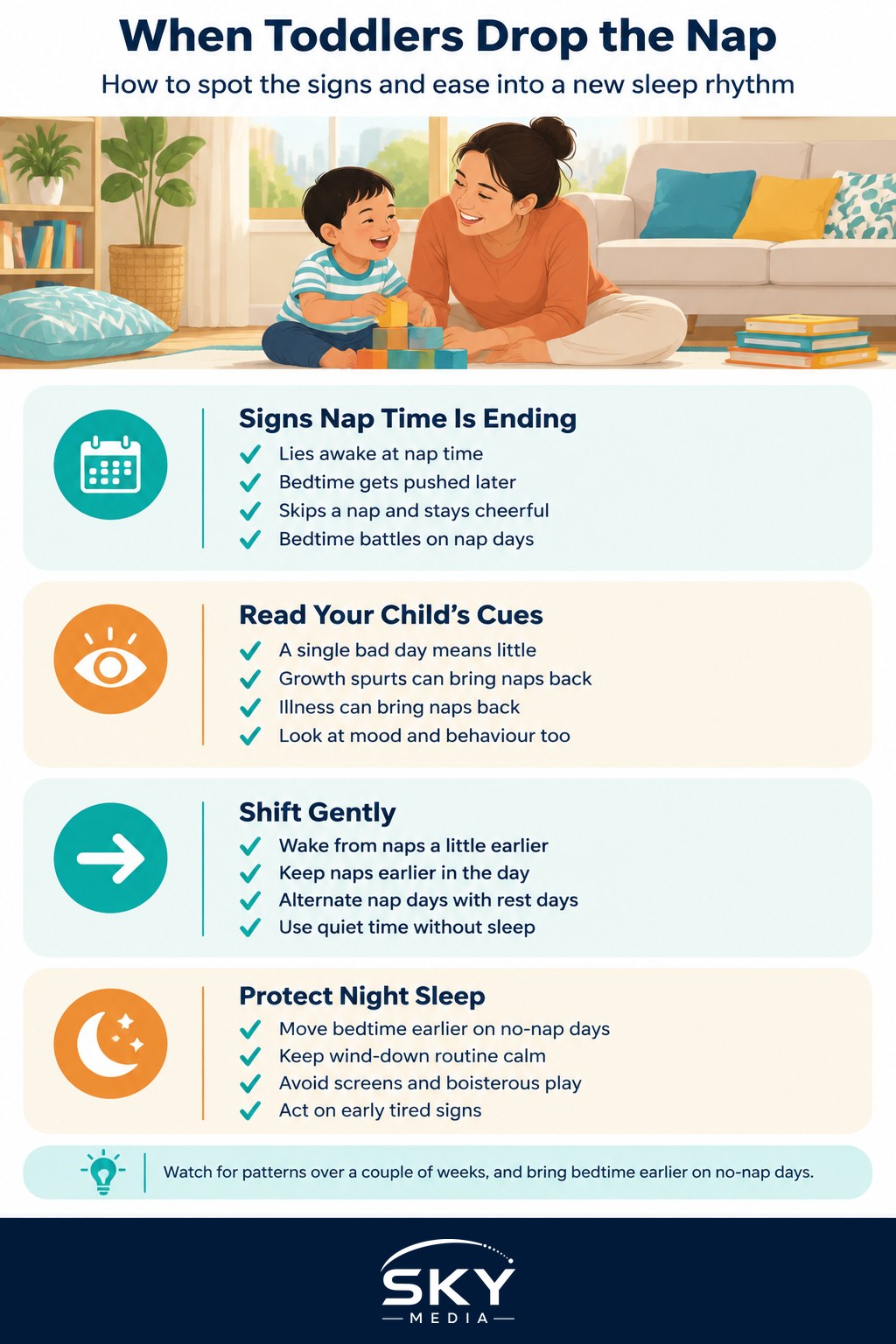
Common clues that a nap may be on its way out:
- Your child lies awake for a long time at nap time but is not upset.
- Napping now pushes bedtime much later or makes settling at night hard.
- She skips the odd nap yet stays cheerful and copes well until bedtime.
- Bedtime battles appear on nap days but melt away on the days she misses one.
One or two of these on a single day means little on its own. Look instead for a pattern over a couple of weeks. If your toddler regularly manages without a nap and is still pleasant company by dinner, that is a stronger signal than a one off refusal after an exciting morning out.
Reading Your Own Child
Every child is different, and the same child can vary from week to week. A big growth spurt, a bout of illness, or a busy season of playdates and outings can all bring the need for a nap roaring back, even after weeks without one. Try to stay flexible rather than declaring naps gone forever after a single good day.
It also helps to separate two things that often get muddled. A child who no longer needs a nap is one thing, but a child who is simply too wound up to settle is another. If your toddler seems overtired, cranky and clumsy by late afternoon, she probably still needs some daytime rest, even if the nap itself has grown shorter. Watching her mood and behaviour, not just whether she falls asleep, will guide you well.
A Gentle Way to Transition
The kindest transitions are gradual. Rather than cutting the nap out overnight, most families find it smoother to shift slowly, capping the nap, moving it earlier, or swapping some days for a rest without sleep. Here is one gentle way to picture the shift.
| Stage | What it looks like | Why it helps |
|---|---|---|
| Shorten | Gently wake after a shorter nap | Protects night time sleep |
| Cap the time | Keep naps earlier in the day | Leaves enough awake time before bed |
| Alternate | Some days nap, some days rest | Eases the body into the change |
| Quiet time | Calm rest without sleep | Keeps a restorative pause in the day |
Introducing a quiet time is often the secret to a happy transition. Even when the nap goes, keeping a calm slot in the early afternoon gives your child, and you, a chance to recharge. Set her up with books, soft toys or gentle music in her room or a cosy corner, and let her rest without any pressure to sleep. Some days she may drift off anyway, and that is perfectly fine.
Protecting Night Time Sleep
The biggest worry when a nap disappears is that your child will become overtired and sleep worse, not better, at night. The simple fix is to bring bedtime forward. As the daytime nap shrinks or vanishes, an earlier bedtime cushions the extra tiredness and helps your child settle more easily rather than tipping into that wired, wide awake state.
A few steady habits make all the difference:
- Move bedtime earlier, sometimes noticeably so, on no nap days.
- Keep your wind down routine calm and predictable.
- Wind down screens and boisterous play well before bed.
- Watch for early tired signs and act on them before the meltdown.
Consistency here matters more than perfection. A slightly earlier, well protected bedtime does far more good than trying to reinstate a nap that your child has genuinely outgrown.
Handling the Rough Patches
The in between phase can be the trickiest, when your child is not quite napping but not quite ready to sail through the whole day either. Late afternoon crankiness is common during this stretch, and it is not a sign you are doing anything wrong. It simply reflects a body adjusting to a new rhythm.
On tricky days, lean on gentle tools. A slightly earlier tea, a calm cuddle and a story, or a quiet walk in the cooler part of the day can carry a tired toddler over the hump. If she is truly struggling, there is no harm in offering a short rest, even if you thought the nap was gone. Flexibility is a strength, not a step backwards.
Try to protect your own patience too. Overtired toddlers can be hard work, and it is easy to snap when you are also missing that midday breather. Lowering expectations for those weeks, planning gentler afternoons and asking family or a helper to share the load can make the whole process feel far more manageable.
Trusting the Process
Dropping the daytime nap is a normal part of growing up, and there really is no single right way or age to do it. Some children glide through in days, while others zigzag for months, napping one week and skipping the next. Both journeys are perfectly healthy.
Follow your child’s cues, keep bedtime flexible, and hold on to a restful quiet time even after the nap itself has gone. With patience and a gentle hand, you will find a new rhythm that keeps your little one well rested and reasonably cheerful, and that gives you a moment to catch your breath too.