

When an older person develops a severe disability, the cost of daily care can add up quickly. Many Singaporeans have CareShield Life or ElderShield, which pay monthly cash payouts if they become severely disabled. But some seniors are not covered by either scheme, or receive only limited support. ElderFund Singapore was set up to help those people. This guide explains what ElderFund is for, who it is meant to help, how it relates to other schemes, and how families can apply.
This is general information, not financial or medical advice. The Ministry of Health (MOH) and the Agency for Integrated Care (AIC) set the current eligibility criteria and payout amounts, and these are reviewed from time to time. Always check the latest details with them.
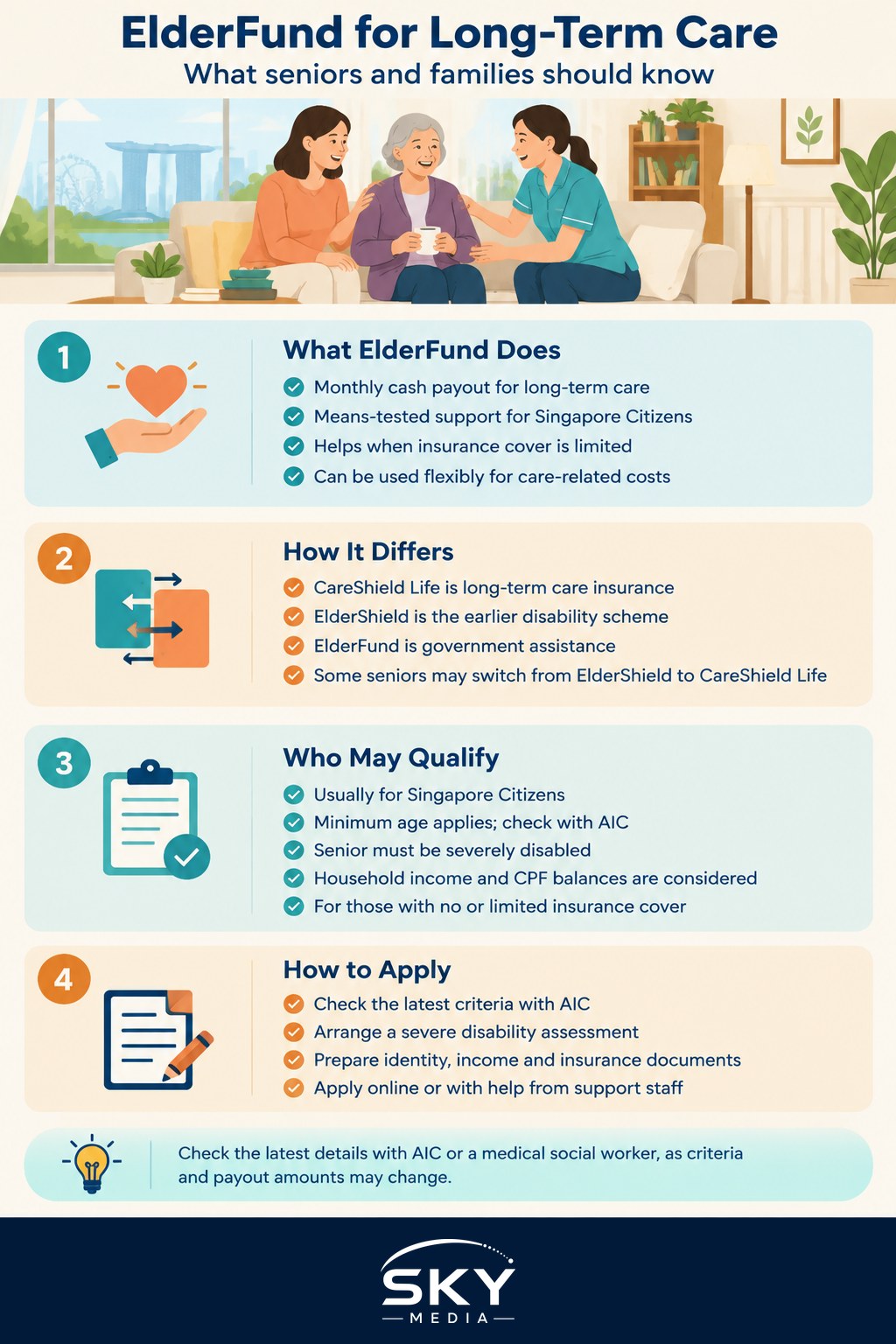
What ElderFund Is and Why It Exists
ElderFund is a means-tested financial assistance scheme for Singapore Citizens with severe disability who need help with long-term care costs. It is designed as a safety net for people who cannot rely on Singapore’s long-term care insurance schemes, often because they were not eligible to join, or joined only under older terms.
The scheme provides a monthly cash payout. Families can use it flexibly towards care-related costs, such as paying a caregiver, home care services, day care, consumables or other expenses connected with looking after the senior.
ElderFund sits alongside, not in place of, other forms of support. If you are still working out the overall picture of care options, our guide to long-term care options in Singapore walks through nursing homes, home care and day centres.
How ElderFund Compares With CareShield Life and ElderShield
The three schemes are often confused. In simple terms, two are insurance and one is assistance.
| Scheme | What it is | Who it mainly covers | How support is decided |
|---|---|---|---|
| CareShield Life | National long-term care insurance with lifelong monthly payouts | Singapore Citizens and Permanent Residents in the eligible birth cohorts, with some older residents able to join | Payouts if you meet the severe disability criteria; premiums paid through MediSave or cash |
| ElderShield | The earlier severe disability insurance scheme | People who joined before CareShield Life was introduced | Payouts for a fixed period if severely disabled, depending on the plan |
| ElderFund | Means-tested government assistance | Singapore Citizens with severe disability who lack, or have limited, insurance cover | Means test plus severe disability assessment; reviewed periodically |
Some ElderShield policyholders can switch to CareShield Life. If a senior has neither policy, or has a pre-existing disability that kept them out of the insurance schemes, ElderFund is often the scheme to look at.
Who May Qualify for ElderFund Singapore
The exact criteria are set by MOH and may change, so treat the following as a broad guide.
- Citizenship. ElderFund is generally for Singapore Citizens.
- Age. There is a minimum age requirement. Check the current figure with AIC.
- Severe disability. The person usually needs to be assessed as severely disabled. In Singapore this is commonly defined as being unable to perform at least three of six Activities of Daily Living (ADLs) without help. The six ADLs are washing, dressing, feeding, toileting, walking or moving around, and transferring (for example, from bed to chair).
- Means testing. The family’s household income and the senior’s assets, including CPF balances, are considered. Lower-income households are prioritised.
- Insurance status. ElderFund is aimed at those not eligible for CareShield Life or ElderShield payouts, or whose payouts fall below certain levels.
Do not assume a senior will or will not qualify based on what a relative or friend received. Every application is assessed on its own facts.
How the Severe Disability Assessment Works
Most applications need a disability assessment carried out by an MOH-accredited severe disability assessor. These are usually doctors or allied health professionals who have been trained and approved for this purpose.
The assessor looks at how the senior manages the six ADLs in daily life. Families can help by:
- Keeping notes on what the senior can and cannot do independently over a few weeks.
- Gathering medical reports from doctors, hospitals or polyclinics on relevant conditions, such as stroke, dementia or advanced mobility problems.
- Being honest and specific. Describe what happens on a typical day, not a good day or a bad day.
There may be a fee for the assessment. Ask the assessor or AIC about costs and whether any subsidy applies. This assessment does not replace medical advice. If the senior’s condition changes, speak to their doctor first.
How to Apply Through AIC
The Agency for Integrated Care administers ElderFund applications. The general steps are:
- Check the latest criteria on AIC’s website or by calling the AIC hotline.
- Arrange the severe disability assessment with an accredited assessor.
- Prepare documents, such as identity documents, household income details and any information on existing insurance.
- Submit the application online or with help from a medical social worker, hospital or community care provider.
- Wait for the outcome, which will state whether the application is approved and the payout amount.
If the senior lacks mental capacity, a family member may need legal authority to act for them, such as a Lasting Power of Attorney (LPA) donee or a court-appointed deputy. The Office of the Public Guardian explains these options.
Other Help to Consider Alongside ElderFund
ElderFund is one piece of the support picture. Families caring for a severely disabled senior often combine it with other schemes. Depending on eligibility, these may include:
- Home Caregiving Grant, a monthly grant to support caregivers of people who need permanent help with several ADLs.
- Subsidies for home care, day care and nursing homes, which are means-tested and arranged through AIC or care providers.
- MediFund, an endowment fund that helps needy patients with medical bills they cannot afford.
- Silver Support Scheme, a quarterly payment for lower-income seniors, based on lifetime wages and household circumstances.
- Caregiver training grants to help family members and helpers learn safe care techniques.
Medical social workers in hospitals and community care teams can help you map out what is available. They know how the schemes fit together.
Practical Tips for Families
- Start early. Gathering documents and arranging assessments takes time.
- Keep copies of every form, letter and receipt.
- Review the senior’s insurance policies so you know exactly what is and is not covered.
- Re-check eligibility if circumstances change, such as a drop in household income.
- Look after yourself as a caregiver. Respite care and support groups exist for good reason.
For the latest ElderFund details, visit the AIC website or speak to a medical social worker. MOH announces updates to long-term care schemes from time to time, so treat any figures you hear second-hand with caution.
Frequently Asked Questions
What are the six activities of daily living used to assess disability? They are washing, dressing, feeding, toileting, walking or moving around, and transferring, such as from bed to chair. Severe disability is commonly defined as being unable to perform at least three of the six without help. An accredited assessor does the assessment.
Who can apply on behalf of a senior who lacks mental capacity? A family member may need legal authority to act, such as a Lasting Power of Attorney donee or a court-appointed deputy. The Office of the Public Guardian explains these options. Ask AIC or a medical social worker about documents needed.
What can ElderFund money be spent on? It is a monthly cash payout that families can use flexibly towards care-related costs, such as paying a caregiver, home care services, day care, consumables or other expenses connected with looking after the senior.
How should a family prepare for the disability assessment? Keep notes on what the senior can and cannot do independently over a few weeks, and gather medical reports on relevant conditions such as stroke or dementia. Be honest and specific about a typical day. Ask AIC about assessment fees and any subsidy.
Where can caregivers get help besides ElderFund? Depending on eligibility, there are the Home Caregiving Grant, means-tested subsidies for home care, day care and nursing homes, MediFund and the Silver Support Scheme. Medical social workers in hospitals and community care teams can help map out what is available.
Official sources: Agency for Integrated Care
Further reading: MediSave Care Explained: Using MediSave for Long-Term Care Costs