

Singapore is one of the world’s busiest air hubs, so a career in aviation here can be steady, varied and genuinely global in outlook. The catch is that most people picture only two jobs when they think of aviation: pilot and cabin crew. In reality the industry runs on a large, interconnected workforce covering engineering, operations, ground services, air traffic, safety, planning and commercial roles. This guide gives you an honest map of the field, the pathways in, and how to work out whether it suits you, without inventing figures or overselling it.
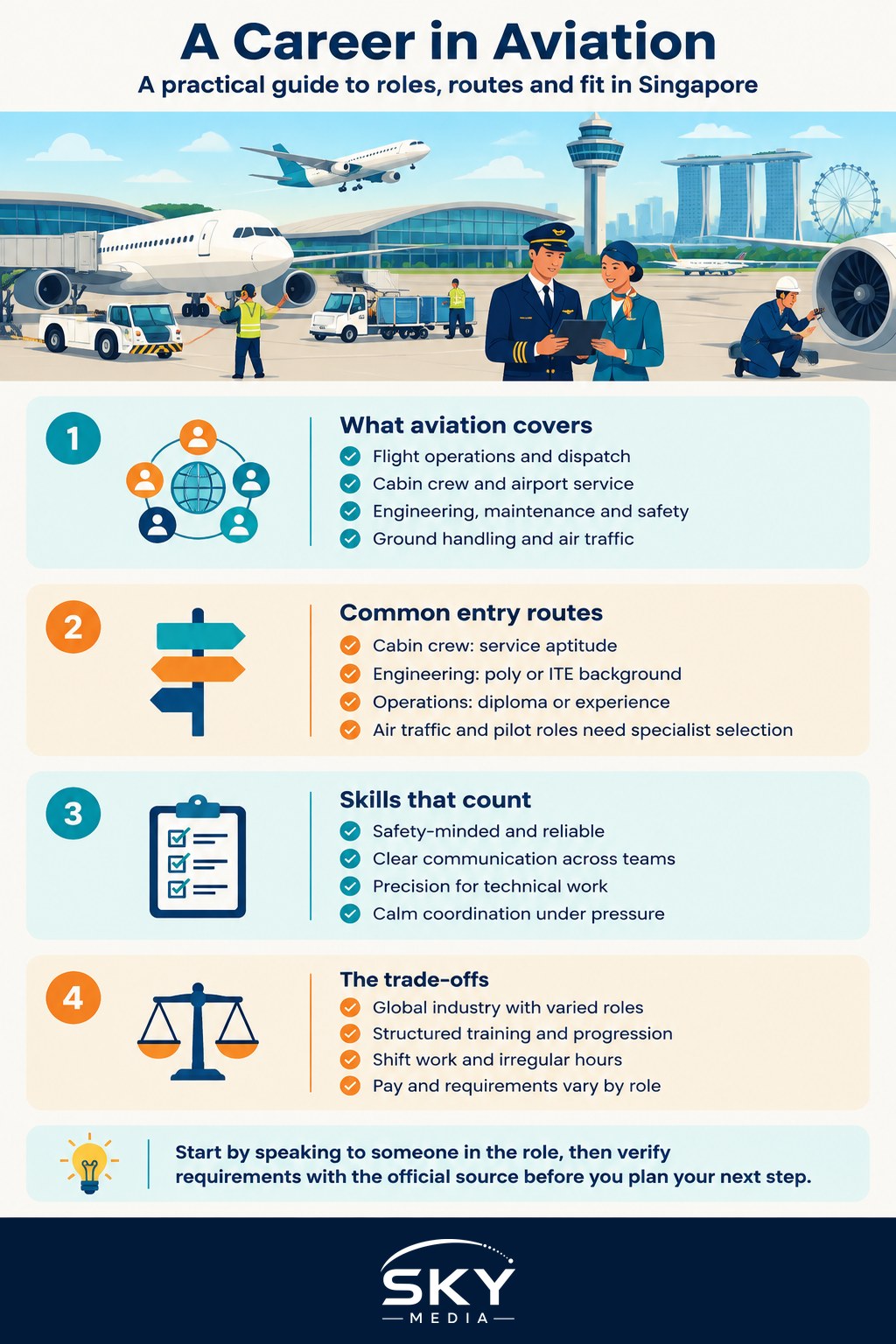
The Many Sides of Aviation Work
Every flight depends on dozens of roles working together, most of which passengers never see. Understanding this breadth is the first step, because it opens up options you may not have considered.
- Flight operations: pilots and flight dispatchers who plan and fly routes.
- Cabin and customer service: cabin crew and airport service staff who look after passengers.
- Engineering and maintenance: licensed aircraft engineers and technicians who keep aircraft airworthy.
- Ground handling and operations: teams that turn a flight around, from baggage and cargo to ramp coordination.
- Air traffic and safety: controllers and safety specialists who keep the airspace orderly.
- Commercial and support: scheduling, revenue, cargo, airport planning, security and corporate functions.
Because the sector is so wide, people with very different strengths can find a place in it. Someone who loves hands-on problem solving might thrive in engineering, while someone who enjoys coordinating moving parts under pressure might suit operations or air traffic work.
Comparing a Few Common Entry Routes
There is no single door into aviation. The right route depends on the role, your starting point and how much study you want to do. The table below compares a few common paths at a high level. Treat entry requirements as indicative only, because they are set by employers, training schools and the relevant authorities, and they change.
| Path | Typical starting point | Suits people who | Where to verify |
|---|---|---|---|
| Cabin crew | Post-secondary, service aptitude | Enjoy people and travel | Airline careers pages |
| Aircraft engineering | Poly or ITE technical diploma | Like hands-on technical work | Training schools, CAAS |
| Airport operations | Diploma or relevant experience | Coordinate and stay calm | Airport and handler pages |
| Air traffic control | Selection and specialist training | Focus intensely, decide fast | The relevant authority |
| Pilot | Cadet scheme or self-sponsored | Commit to demanding training | Airlines, flight schools |
For technical and operations roles, a polytechnic or ITE background is a well-trodden starting point, and many engineers and specialists build on that with on-the-job training and licensing. If you are weighing your options after poly or ITE, our guide on career paths after polytechnic or ITE can help you think it through.
Skills and Qualities That Matter
Across almost every aviation role, a few qualities show up again and again. Safety-mindedness comes first, because the industry is built on procedures, checks and a culture of speaking up when something looks wrong. Reliability and punctuality matter enormously when a single late link can delay a whole operation. Clear communication, often across cultures and time zones, keeps teams coordinated.
Beyond those shared basics, different lanes reward different strengths:
- Technical roles value precision, methodical thinking and comfort with manuals and diagnostics.
- Service roles value patience, warmth and grace under pressure with tired or anxious passengers.
- Operations and control roles value situational awareness and the ability to prioritise quickly.
- Commercial roles value numeracy, planning and stakeholder management.
Many of these skills transfer from adjacent fields. If you have worked in hospitality and tourism, your service instincts carry over to customer-facing aviation roles. If you come from logistics and supply chain, the coordination mindset maps neatly onto ground operations and cargo. And an engineering background is a natural feeder into aircraft maintenance.
Shift work is a defining feature of much of the industry, since airports run around the clock. Factor in how rotating shifts and the commute across the island would fit your life before you commit.
The Honest Pros and Cons
Aviation offers real rewards, but it asks for real trade-offs too. Knowing both helps you choose well.
What people enjoy:
- A genuinely global industry with structured training and clear progression in many roles.
- Variety and teamwork, with a shared sense of purpose around getting people and cargo where they need to be.
- Skills and licences that are recognised well beyond one employer.
- For customer-facing roles, travel and exposure to people from all over the world.
What people find hard:
- Irregular hours, shift work and time away from home, especially for flying roles.
- Demanding training and, for some paths, competitive selection with no guaranteed outcome.
- Sensitivity to global shocks; the industry can slow sharply when travel drops, which affects hiring.
- Physical and medical requirements for certain roles, set by the authorities and employers.
Pay varies widely by role, employer and seniority, and it changes over time, so look up current figures from official and industry sources rather than relying on hearsay. Do not assume that one visible role sets the pay for the whole sector.
How to Test the Fit and Take a First Step
Before committing to a long training path, it is worth checking the fit cheaply and honestly.
- Talk to people already in the role. A short chat with a working engineer, controller or crew member will tell you more about the daily reality than any brochure.
- Match your life to the hours. If rotating shifts, weekends and public holidays would strain your commitments, factor that in now.
- Check the real requirements early. Medical, age, education and selection criteria are set by employers, training schools and the relevant authorities, so verify them at the source before you plan around them.
- Build relevant experience. Service, technical or coordination experience in adjacent fields strengthens an application, and internships give you a real feel for the environment.
If you are coming out of national service and weighing your options, the discipline and teamwork you built there transfer well; our guide on transitioning from national service to work can help you plan the move. For funded courses to build specific skills, check SkillsFuture and MySkillsFuture, and confirm current eligibility and details, since these change.
A career in aviation can be a rewarding, long-term path if you go in clear-eyed about the hours, the training and the cycles of the industry. Start by narrowing down which lane suits your strengths, verify the entry requirements with the official bodies, and take one concrete step, whether that is an open house, an internship or a conversation with someone doing the job. For any question about contracts, terms or fair treatment, read your own contract and refer to the Ministry of Manpower (MOM) and TAFEP, or seek professional advice for disputes.
Frequently Asked Questions
Do I need perfect eyesight to work in aviation? Not for every role. Pilots and some operational roles have strict medical and vision standards set by the authorities and employers, while many engineering, ground and commercial jobs have different requirements. Check the specific role’s criteria at the source.
Can women and mid-career switchers build a career in aviation? Yes. Aviation employs people of all backgrounds across many roles, and skills from hospitality, logistics or engineering often transfer. Entry criteria vary by role, so check the requirements and consider internships or short courses to bridge gaps.
How long does it take to train as an aircraft engineer? It depends on the route and licence level, and no single timeline applies. Many start with a polytechnic or ITE technical qualification and then build experience and licensing on the job. Ask training schools and CAAS for the current pathway.
What is the difference between working for an airline and an airport? Airlines operate the flights and employ crew, pilots, engineers and commercial staff, while airport companies and handlers run terminals, ground services and operations. The work culture, shifts and career paths differ, so look at each employer’s careers page.
How secure is a career in aviation? The sector can be stable and well-structured, but it reacts sharply to global shocks that reduce travel. Hiring may slow during downturns. Building transferable skills and licences recognised beyond one employer helps you stay resilient.
Further reading: How to Become a Cabin Crew Member in Singapore