

A life in the arts can be one of the most meaningful ways to work, turning creativity, craft, and imagination into something that moves other people. It is also a field full of myths, from the idea that you must be a starving artist to the assumption that talent alone decides who makes it. If you are exploring an arts career in Singapore, it helps to see the sector clearly: how broad it is, what skills sustain a working life in it, and the realistic pathways available. This guide offers an honest, encouraging look, so you can decide how the arts might fit into your future.
How wide the arts sector really is
When people picture an arts career, they often think only of performers or painters. In reality, the creative sector is far larger, and many of its roles are steady and behind the scenes.
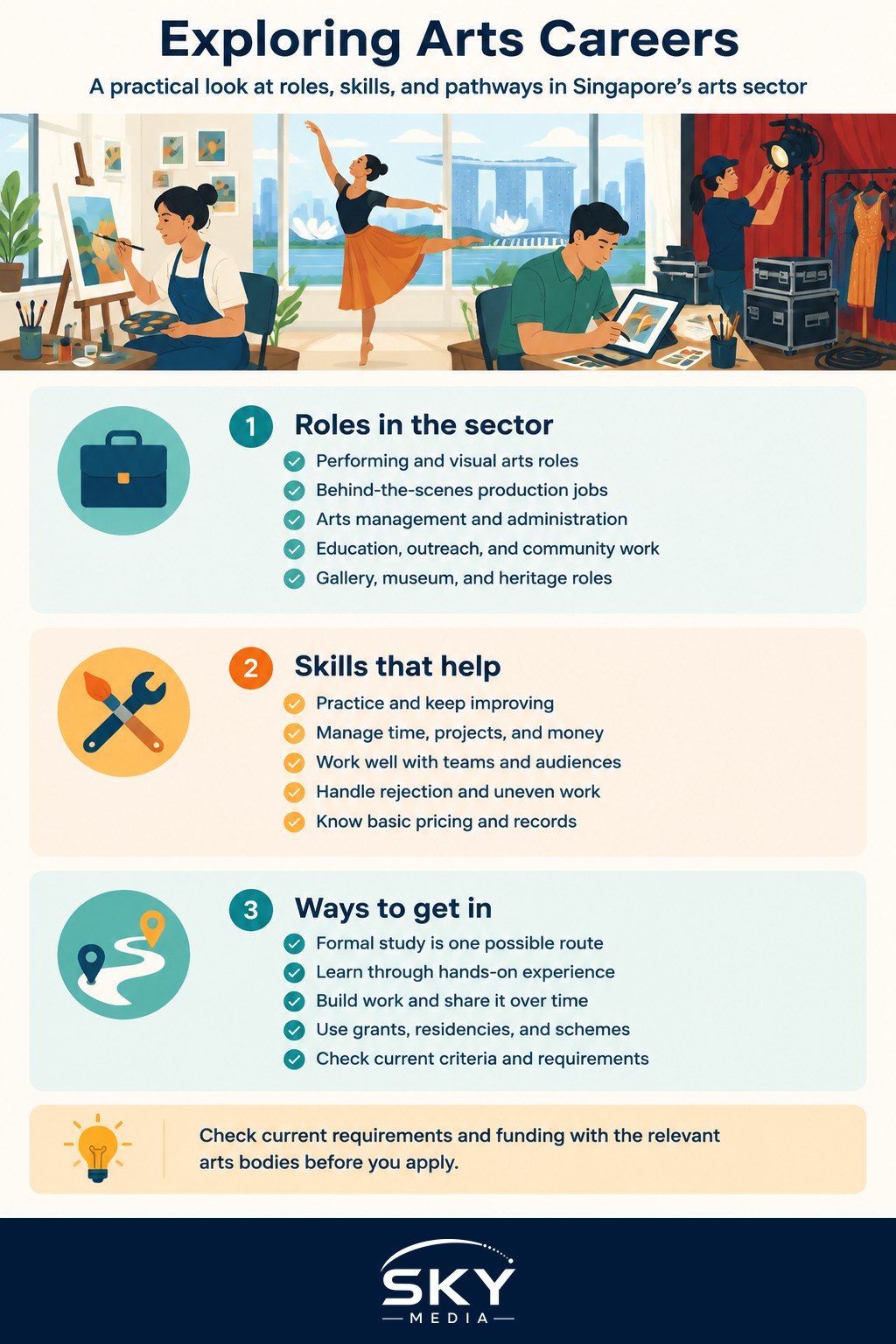
- Creative and performing practitioners: visual artists, musicians, dancers, actors, writers, and designers.
- Production and technical roles: stage management, lighting, sound, set and costume, and audiovisual work.
- Arts management and administration: producers, programmers, marketing, fundraising, and operations at companies and venues.
- Education and community work: teaching artists, workshop facilitators, and outreach roles.
- Curatorial, gallery, museum, and heritage roles, along with arts writing and criticism.
This breadth matters, because it means there are many ways to build a life around the arts, not all of which depend on being a full-time performer or maker. Many people combine several of these, teaching, creating, and doing project work in parallel. If that appeals to you, our guide on building a portfolio career explains how people structure that kind of working life so it holds together.
Skills and realities that sustain a creative career
Talent and craft matter, but they are rarely enough on their own. The people who sustain long careers in the arts tend to pair their artistic ability with a set of practical skills.
- Discipline and craft: the willingness to practise, revise, and keep improving over years.
- Self-management: managing your own time, projects, and finances, especially if you freelance.
- Communication and collaboration: most creative work involves teams, clients, and audiences.
- Resilience: handling rejection and uneven work is part of the territory, so protecting your wellbeing matters.
- Basic business sense: pricing your work, writing proposals, and keeping records.
It is worth being honest about the realities too. Income in the arts can be irregular, particularly early on, and many practitioners piece together several sources of work. That is not a sign of failure; it is often how the sector operates. Building a strong body of work you can show is central to opportunities, so our guide on building a work portfolio is a good companion. Because so much of the arts runs on relationships and reputation, learning to connect naturally helps enormously, and networking without being awkward offers a gentler, more genuine approach than cold self-promotion.
Pathways in and where to check what you need
There is no single route into the arts, and formal study is one option among several.
- Formal training: diplomas and degrees in fine arts, music, theatre, design, or arts management give structure and networks, though they are not the only way in.
- Apprenticeship and hands-on experience: assisting established practitioners, joining productions, or volunteering with companies and festivals.
- Self-directed practice: building a body of work, sharing it, and finding an audience over time.
- Support and development: Singapore has arts councils, grants, residencies, and development schemes, and SkillsFuture may support some accredited courses.
Because criteria, funding schemes, and any registration or licensing requirements for specific roles change over time, treat this article as a starting point rather than the final word. Check the current requirements, grant criteria, and application details with the relevant arts bodies, funding agencies, and institutions before you rely on them, and look at how working artists in your discipline have actually built their paths. MyCareersFuture and reputable industry channels can show you what arts organisations are currently hiring for.
A career in the arts asks for courage and patience, but it also offers the chance to do work that genuinely matters to you and to others. Start where you are, keep making and sharing your work, build real relationships, and give yourself time to grow. Whatever shape your arts career eventually takes, the steady combination of craft, resilience, and openness to opportunity will serve you well.
Frequently Asked Questions
Can I make a living from the arts in Singapore? Many practitioners do, often by combining several sources of work such as teaching, commissions and project work. Income can be irregular early on, so build savings and a body of work. Talk to artists in your discipline.
Do I need an arts degree to work in the arts? Not necessarily. Formal training gives structure and networks, but apprenticeships, volunteering and self-directed practice are also routes in. Look at how working artists in your discipline actually built their paths.
Are there grants or schemes to support artists in Singapore? Arts councils, grants, residencies and development schemes exist in Singapore, but criteria and deadlines change. Check current details with the relevant arts bodies and funding agencies before planning around any scheme.
What non-performing jobs exist in the arts? Arts management, production and technical work, curating, museum and gallery roles, education, marketing, fundraising and arts writing all offer steadier, behind-the-scenes options. Many people combine several of them to build a sustainable working life.
How do I deal with parents who worry that an arts career is risky? Show them a realistic plan: the range of roles, how you will build a portfolio, a financial cushion and a fallback skill. Introducing them to working practitioners helps. Their concern usually comes from care.