

There is something special about watching a film and then hearing the director, actor or writer talk about how it was made, just a few metres from your seat. If you are new to the city, a film screening Q&A in Singapore is one of the easiest ways to dip into the local arts scene, meet people who love cinema, and see a different side of the films you watch.
This guide is for first timers. It covers how these sessions work, where to find them, how to book, and the unwritten etiquette that helps everyone enjoy the discussion.
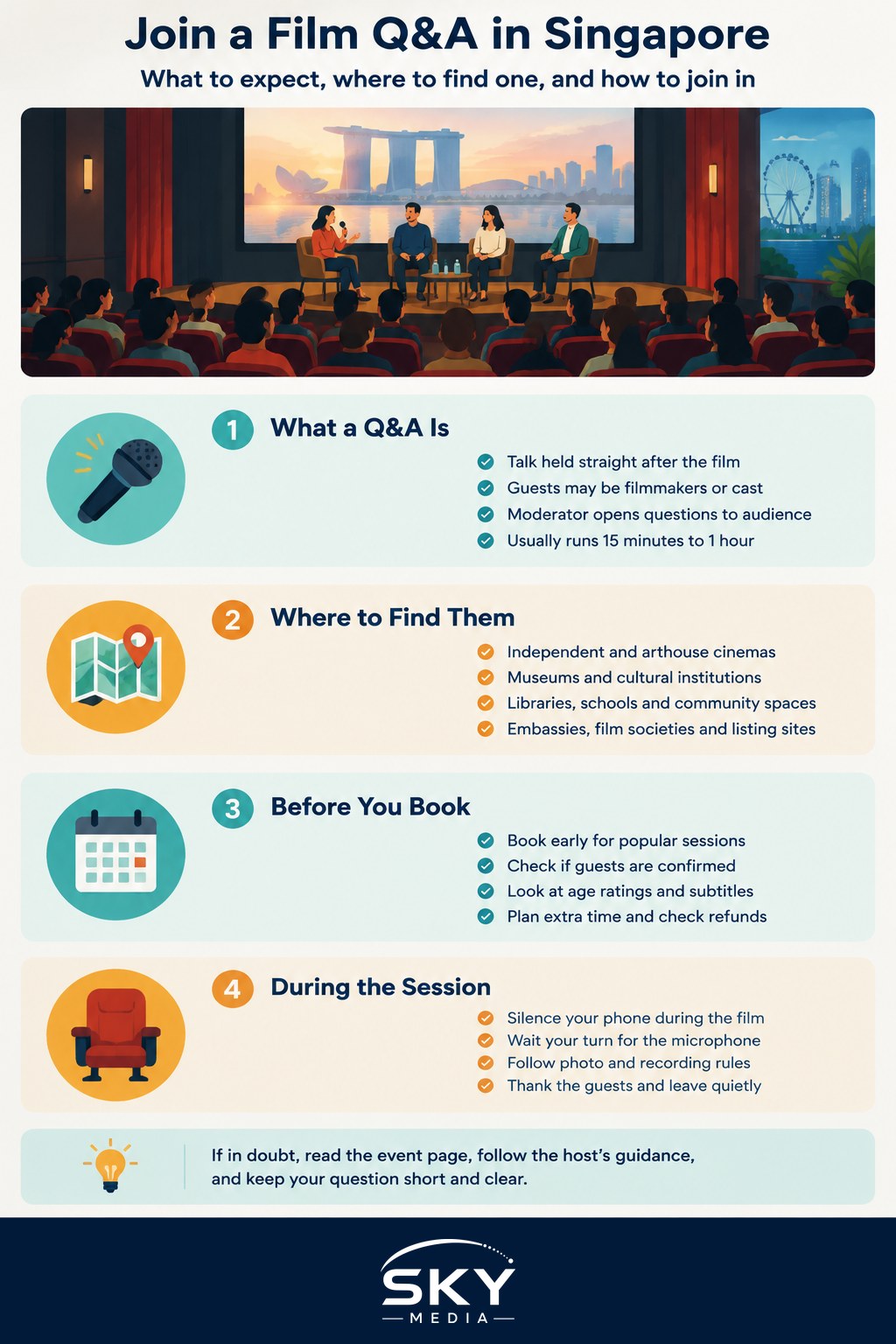
What a Post-Screening Q&A Actually Is
A screening Q&A is a talk session held straight after a film is shown, usually in the same cinema hall. The guests might include:
- The director, producer or screenwriter
- Cast members
- Crew such as the cinematographer, editor or composer
- Subject experts, for documentaries, such as researchers or community members featured in the film
- Critics or programmers who curated the screening
A moderator usually introduces the guests, asks a few opening questions, then opens the floor to the audience. Sessions commonly run somewhere between 15 minutes and an hour, depending on the venue and the guests’ schedules.
Q&As are especially common for local Singapore and Southeast Asian films, documentaries, student films and short film programmes, where filmmakers are often based nearby and keen to meet audiences.
Where to Find Screenings With a Q&A
You will not usually find these sessions by checking a mainstream cinema’s weekly listings. Instead, look at:
- Independent and arthouse cinema programmes, which often schedule special screenings with guests.
- Cultural institutions and museums, which run film programmes linked to exhibitions or themes.
- Libraries and community spaces, which sometimes host free screenings and talks. Check the National Library Board’s event listings.
- University and polytechnic film schools, which hold graduation showcases where students present their work.
- Embassies and cultural centres of other countries, which regularly organise screenings of films from their home country, sometimes with visiting filmmakers.
- Film societies and community groups, which hold regular screenings followed by discussion.
- Ticketing platforms and event listing sites, where you can search for terms such as “Q&A”, “post-screening dialogue” or “meet the filmmaker”.
Following venues and filmmakers on social media and subscribing to their mailing lists is often the quickest way to hear about sessions before they sell out.
Booking Tickets and Planning Your Evening
Screenings with guests are often small and can fill up quickly. A few practical points:
- Book early, especially if a well-known director or actor is attending.
- Read the event page carefully. It usually states whether the Q&A is confirmed, who will attend, and whether guests may join by video call instead.
- Check the age rating. Singapore’s Infocomm Media Development Authority (IMDA) classifies films, and age restrictions are enforced at the door. You may be asked for ID for films rated NC16, M18 or R21.
- Note the language and subtitles. Many Singapore and regional films are in Mandarin, Malay, Tamil, Hokkien or other languages with English subtitles. The Q&A itself may be in English, another language, or both, sometimes with a translator.
- Plan for the extra time. If the film ends at 9pm and the Q&A runs long, think about your transport home.
- Check refund terms in case your plans change.
Prices vary widely, from free community events to ticketed premieres, so look at the listing rather than assuming.
Etiquette During the Film and the Q&A
Most of this is common courtesy, but it helps to know what is usually expected. The table below compares good habits with ones to avoid.
| Moment | Do | Avoid |
|---|---|---|
| During the film | Silence your phone and keep the screen dark | Checking messages or filming the screen |
| When credits roll | Stay seated if you plan to join the Q&A | Pushing past people while guests walk in |
| Asking a question | Wait for the microphone, keep it short and clear | Long speeches or several questions at once |
| Taking photos | Follow the host’s instructions on photography | Using flash or recording without permission |
| After the session | Thank the guests, chat briefly if invited | Holding up the queue with a long conversation |
A few more points:
- Recording is often restricted. Some guests are happy for photos, others are not, and unreleased films may have strict rules. Listen to the host.
- Avoid spoilers when posting online. Others may not have seen the film yet.
- Be respectful in disagreement. It is fine to ask about a choice you did not understand, but frame it as curiosity rather than criticism.
- Leave quietly if you must go early. Wait for a natural pause and exit from the aisle closest to you.
How to Ask a Good Question
Many newcomers worry about raising their hand. Hosts generally welcome questions, and nobody expects you to be a film expert. Some tips:
- Keep it to one question, ideally one or two sentences. Others are waiting.
- Ask about process or intention, for example how a scene was shot, why a certain location was chosen, or what the filmmaker hoped audiences would feel.
- Skip questions answered in the introduction or in the moderator’s discussion.
- Introduce yourself briefly only if relevant, for example if you are a film student or come from the community featured in a documentary.
- Speak into the microphone so the guests and the recording, if any, can hear you.
If you are shy, simply listening is a perfectly good way to take part. You can also note down a question and ask the guest one to one if they stay behind to chat.
Making the Most of the Experience as a Newcomer
Film Q&As are a gentle way to settle into Singapore’s cultural life:
- Go to a mix of programmes. Try a local feature, a documentary and a short film night to see different crowds.
- Join film societies or clubs if you enjoy the discussions. Regular members often know about upcoming sessions first.
- Chat with people around you. A shared film gives an easy topic, and many regulars are friendly to newcomers.
- Volunteer at film events. Some organisers look for volunteers to help with ushering and registration, which can be a good way to meet people.
- Explore films in your own language. Many cultural centres show films with English subtitles, so you can share a film from home with new friends.
Over time, these evenings can build into a network of friends who share your interest, and a deeper understanding of the stories Singapore and the region are telling on screen.
Explore more: Film Festivals in Singapore, Arthouse Cinema Singapore and A Guide to Singapore Film and Cinema.
Frequently Asked Questions
Do I have to stay for the Q&A after a screening? No, though the guests would appreciate a good audience. If you need to leave early, wait for a natural pause and slip out through the aisle closest to you. If you plan to stay, remain seated when the credits roll, and think about your transport home if the session runs long.
Are screening Q&As in English, or can they be in other languages? It varies. Many Singapore and regional films are in Mandarin, Malay, Tamil, Hokkien or other languages with English subtitles, and the Q&A may be in English, another language or both, sometimes with a translator. Check the event page, which usually states the language.
Can I take photos or videos of the guests at a film Q&A? Follow the host’s instructions. Some guests are happy to be photographed while others are not, and unreleased films may have strict rules. Avoid flash and never record without permission. If you post online afterwards, leave out spoilers.
What if I am too shy to ask a question in front of everyone? Listening is a perfectly good way to take part. You can jot down a question and ask the guest one to one if they stay behind to chat, or simply thank them. Hosts welcome questions but nobody expects you to be a film expert.
Are film screening Q&As suitable for kids or teenagers? That depends on the film. IMDA classifies films, and age restrictions are enforced at the door, with ID sometimes checked for NC16, M18 or R21 titles. Check the rating on the event page before booking, and note that student film showcases or short programmes may suit younger audiences better.