
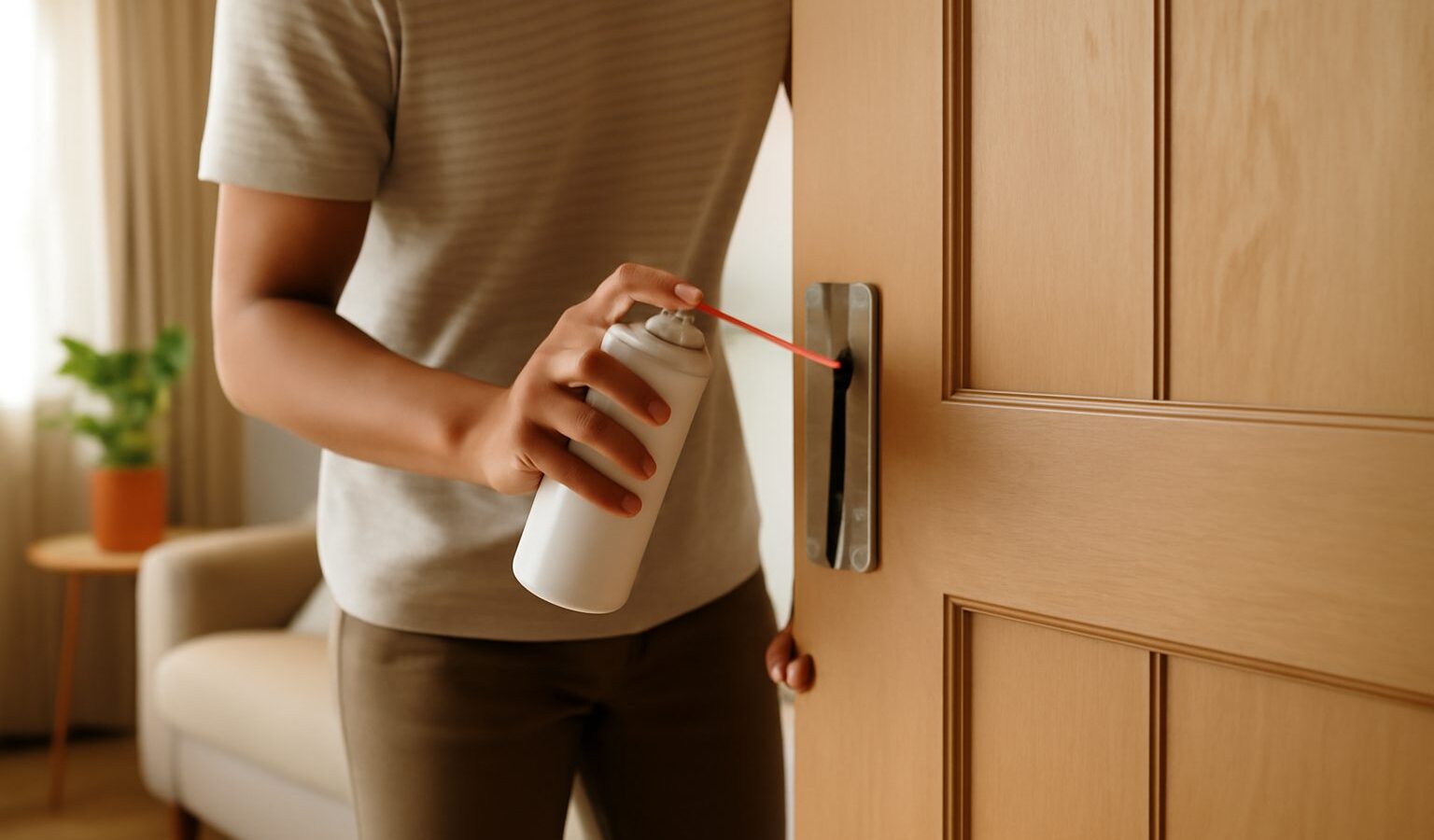
Few household noises grate quite like a door that groans every time someone walks through it. The good news is that fixing squeaky doors and hinges is one of the friendliest jobs a total beginner can take on. You rarely need to remove the door, and the whole thing usually takes ten to fifteen minutes with items you may already own. In most HDB and condo homes the culprit is simply dry metal, a little grit, or a loose screw, and all three are easy to sort out.
This guide walks you through why the squeak happens, what to have on hand, and a calm step by step method. It also covers the noises that are not really the hinge at all, so you fix the right thing the first time.
Why doors and hinges squeak
A hinge squeaks when metal rubs against metal without enough lubrication between the moving parts. Every time the door swings, the pin inside the hinge turns against the knuckles (the interlocking rings the pin runs through). When the thin film of oil there dries out or fills with dust, you get friction, and friction makes that familiar creak.
Singapore’s humidity plays a double role. Damp air encourages surface rust on the pin, which roughens it, while fine dust and hair settle into the hinge and act like sandpaper. Homes near the coast or on higher floors that catch a lot of wind-blown grit tend to see this sooner. A door that only squeaks in the morning or after rain is often reacting to moisture in the timber and frame swelling slightly, which changes how the parts press together.
Loose screws are the other common cause. When the screws holding a hinge to the frame work loose, the door drops a fraction and the hinge sits at a slight angle, so the parts bind and complain. Tightening them is often the entire fix.
What you will need
You can keep this simple. Gather these before you start, all available generically from any local hardware shop or DIY store:
- A suitable lubricant. A light penetrating oil, a silicone spray, or plain petroleum jelly all work; more on choosing below.
- A rag or old cloth and a few sheets of kitchen paper to catch drips.
- A screwdriver that matches your hinge screws, usually a cross-head (Phillips).
- Optional: a thin nail or an old flat screwdriver to lift the hinge pin, and a little washing-up liquid or bicarbonate paste to clean a grimy hinge.
Lay down some newspaper or the kitchen paper under the hinge, because oil drips and can stain floors or skirting. Open a window for a little ventilation if you are using a spray.
Step by step: silencing a squeaky hinge
Work on one hinge at a time and test the door after each, since you may not need to treat all of them.
- Swing the door slowly and listen. Move your ear close to each hinge to find which one is actually singing. It is often just the top or bottom hinge, not all three.
- Tighten the screws first. Firmly turn each screw on both the door leaf and the frame leaf. If a screw spins without biting, the hole has worn; push a couple of wooden toothpicks or a matchstick with a dab of wood glue into the hole, let it set, then drive the screw again.
- Clean if it is visibly dirty. Wipe the hinge and, if you can, lift the pin partway to clear out dust and old grease. A little washing-up liquid on a cloth handles most grime; dry it fully afterwards.
- Apply the lubricant sparingly. Aim for the top of the pin and the gaps between the knuckles so it can seep down inside. A few drops or a short burst is plenty. Too much simply attracts more dust.
- Work it in. Swing the door back and forth ten to twenty times to spread the lubricant through the moving parts.
- Wipe away the excess and test. Clean off any runs on the door and frame so they do not stain, then listen. Repeat on any hinge still making noise.
If the squeak lingers, lifting the pin right out gives the best result. Tap it up gently from below with a nail and a light tap of a hammer, slide it out, wipe it clean, smear a thin film of lubricant along its length, and slide it back. Support the door with a folded cloth or a wedge underneath while the pin is out so it does not sag.
Choosing the right lubricant
Not every lubricant suits every door, especially in a humid climate where the wrong choice attracts grime or drips onto the floor. Here is a quick comparison to help you pick.
| Lubricant | Best for | Keep in mind |
|---|---|---|
| Light penetrating oil | Rusty or stiff pins that need freeing | Can drip and stain; wipe off excess and use sparingly |
| Silicone spray | Everyday hinges; leaves a dry, clean finish | Overspray travels, so mask nearby surfaces first |
| Petroleum jelly | A tidy, drip-free option for interior doors | Rub a thin film onto the pin rather than the knuckles |
| Bar soap or candle wax | An emergency stopgap you already have at home | Wears off quickly; treat it as temporary |
Avoid cooking oils. They smell, go sticky in the heat, and can turn rancid, which leaves you worse off than the squeak. Whatever you choose, less is more.
Squeaks and creaks that are not the hinge
Sometimes the noise you blame on the hinge comes from somewhere else entirely. Check these before reaching for more oil:
- The latch and strike plate. A dry latch bolt or a misaligned strike plate (the metal plate on the frame the latch clicks into) can scrape or click. A dab of lubricant on the latch bolt and a check that it lines up with the hole usually helps.
- The door rubbing the frame. If the door drags or groans against the frame rather than at the hinge, it may be sticking, which is a different fix involving the swollen edge rather than the metal.
- The floor or threshold. Bifold and sliding wardrobe doors run on tracks and rollers, not hinges, so clean the track and add a track-safe lubricant instead.
- Loose handles or knobs. A rattly, creaky handle can masquerade as a door squeak and simply needs its screws snugged up.
When to call a professional
Most squeaks are firmly within beginner territory, but a few signs mean it is worth getting help. If a hinge is badly rusted, bent, or pulling out of a frame that is crumbling around the screws, the fix goes beyond a quick oiling and the hinge or frame may need proper repair. Heavy solid doors, fire-rated flat entrance doors, and metal gates are best handled by a contractor or your building’s handyman, since these can be awkward and heavy and the entrance door affects your home’s security. If you rent, check with your landlord before changing any hardware, and keep your fixes to non-permanent ones like lubricating and tightening.
For everything else, a few drops of the right lubricant and a firm turn of the screwdriver will give you a door that opens in blissful silence.
Explore more
If tightening the hinge screws led you to a wobbly handle, our guide on fixing a loose door handle or knob covers that next step. When the door groans because it is dragging rather than squeaking, see fixing a sticking or jammed door. And if you have caught the repair bug, our notes on fixing wobbly or broken furniture tackle another quick win around the home.