

Deloitte, PwC, EY and KPMG, known together as the Big Four, are among the largest graduate employers in Singapore’s professional services sector. Each year they take in fresh graduates and interns for audit, tax, consulting, deals and technology roles. Competition is real, but the process is predictable once you understand it. This playbook explains how a big four firm job in Singapore is usually won: when to apply, how internships feed into offers, what the assessments look like, and how to handle each interview round.
If you are still deciding whether accounting suits you, start with Exploring a Career in Accounting in Singapore. This guide assumes you have decided to apply.
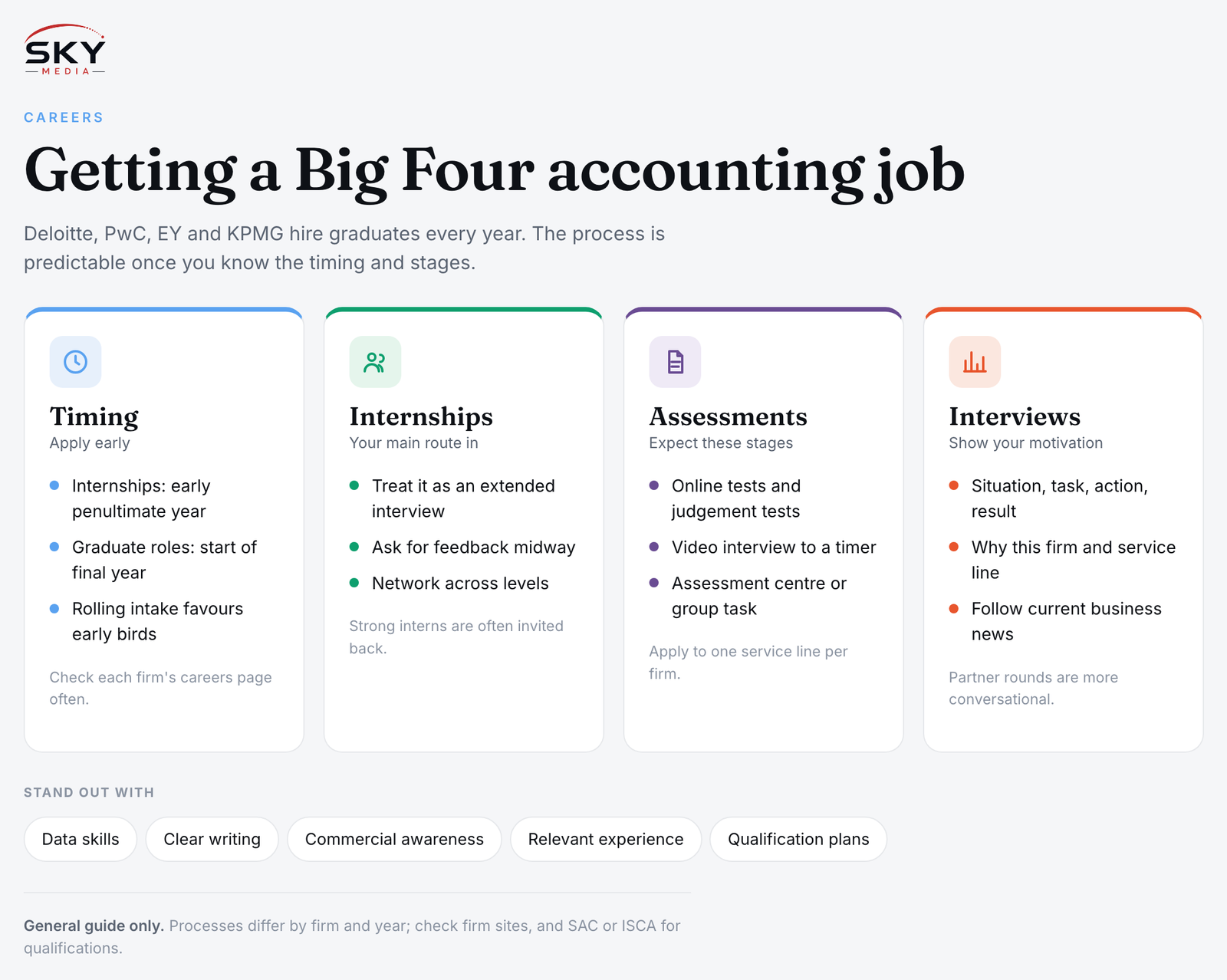
Know the Recruitment Calendar
The single biggest mistake applicants make is applying too late. The Big Four hire graduates well ahead of their start dates, and their main campus recruitment season usually opens months before final exams. Each firm sets its own dates, which can shift from year to year, so check each firm’s Singapore careers page and your university career centre regularly.
A typical pattern looks like this:
- Early in your penultimate year: watch for internship applications. Summer internships and longer semester internships are often filled months in advance.
- Start of your final year: graduate applications for the following year’s intake commonly open. Many firms run rolling recruitment, so earlier applicants see more open places.
- Through the academic year: firms visit campuses for career fairs, talks and networking sessions. These are good chances to speak to recent hires.
- Off-cycle: some service lines hire experienced or mid-year joiners outside the main season, and these openings are posted as they arise.
Set calendar reminders, and prepare your CV and transcripts before the windows open so you are not rushing.
Use Internships as Your Main Route In
For many applicants, an internship is the most reliable path to a full-time offer. Interns do real work, such as supporting audit fieldwork, preparing working papers or helping on tax computations. Teams then assess them on attitude, reliability and how quickly they learn.
To make an internship count:
- Treat it as an extended interview. Be punctual, ask good questions and take notes so you do not ask the same thing twice.
- Ask your supervisor for feedback midway, not only at the end.
- Learn the firm’s tools and methodology, and show you can work to deadlines during busy periods.
- Connect with colleagues across levels, not just other interns.
Strong interns are often invited to join the graduate intake without going through the full process again, though this depends on the firm and the year.
Assessments You Should Expect
Each firm designs its own process, and processes change, but most applicants go through some combination of these stages.
| Stage | What usually happens | How to prepare |
|---|---|---|
| Online application | CV, academic results, sometimes short motivation questions | Tailor your CV to the service line, quantify achievements |
| Online tests | Numerical, verbal or logical reasoning, often timed | Practise with free sample tests under time pressure |
| Situational judgement or game-based tests | Workplace scenarios where you choose the best response | Read each firm’s values and think about client service and teamwork |
| Video interview | Recorded answers to set questions, short preparation time | Practise answering to a timer, check lighting and sound |
| Assessment centre or group exercise | Case discussion, group task or presentation | Listen, build on others’ points, keep the group on time |
| Final interview | Manager, director or partner conversation | Know why this firm, this service line, and current business news |
Two habits help across every stage. First, read the instructions carefully, because some tests penalise rushing. Second, apply to one service line per firm unless the firm says otherwise, so your story is consistent.
Prepare for the Interviews
Big Four interviews tend to combine competency questions with motivation questions. Expect prompts such as “Tell me about a time you worked under pressure” or “Describe a situation where you disagreed with a team member.”
Use a simple structure for competency answers: describe the situation, explain your task, walk through the actions you took, and finish with the result and what you learned. Draw on school projects, part-time jobs, CCAs, national service, volunteering or internships.
For motivation questions, be specific:
- Why this firm? Mention something concrete, such as a talk you attended, a conversation with a staff member, or a practice area the firm is known for.
- Why this service line? Explain what draws you to audit, tax, consulting or deals, and how it connects to your strengths.
- Why professional services? Talk about exposure to many industries, structured training and the chance to work towards a professional qualification.
Partner interviews are often more conversational. Partners may ask about business news, a company you follow or how you handle client relationships. Read the business pages in the weeks before, and have one or two topics you can discuss with genuine interest.
Plan Around the Qualification Path
Audit and tax roles commonly come with support for a professional qualification. In Singapore, the Singapore CA Qualification is administered by the Singapore Accountancy Commission (SAC), and the Institute of Singapore Chartered Accountants (ISCA) is the national accountancy body. Some staff pursue other recognised qualifications such as ACCA or CPA programmes, depending on their background and goals.
At interviews, it helps to show you understand the commitment: working full time while studying for professional exams, especially during peak reporting season. Ask the firm how it supports study leave and exam fees, but do not assume a particular package, as policies differ by firm and change over time. Check eligibility details for any qualification directly with SAC, ISCA or the relevant professional body.
Strengthen Your Application Beyond Grades
Grades open the door, but they rarely close the deal. Ways to stand out include:
- Data skills. Comfort with spreadsheets and basic data analysis tools is increasingly valued in audit and advisory work.
- Clear writing. Much of the job involves documenting work and emailing clients. Keep your CV and cover letter error-free.
- Commercial awareness. Follow how Singapore companies report results and what is happening in sectors you care about.
- Relevant experience. Part-time roles in finance teams, case competitions and student accounting societies all give you examples for interviews.
If you are applying from overseas, the process is similar, but you should also check work pass eligibility with the Ministry of Manpower (MOM) and read How to Get a Job Offer Before You Move.
After the Offer
Offers often arrive months before your start date. Read the offer letter carefully for the start date, service line, probation terms and any bond or study support conditions. If you hold more than one offer, respond professionally and within the deadline given. Use the time before you start to rest, and perhaps refresh your accounting basics so your first busy season feels manageable.
Explore more: Learning Basic Accounting for Non-Finance People in Singapore