

Long weekends are when hotel prices climb and rooms vanish, so it is tempting to grab the cheapest rate the moment you see it. Then plans change: a child falls sick, work calls you back or the weather turns. That is when the hotel cancellation policy you skimmed past at checkout suddenly matters a great deal.
This guide explains the main types of rates, the fine print that trips people up on booking platforms and how to protect yourself without overpaying. It is general consumer information, not legal advice. Every hotel and platform sets its own terms, so the wording on your booking confirmation is what counts.
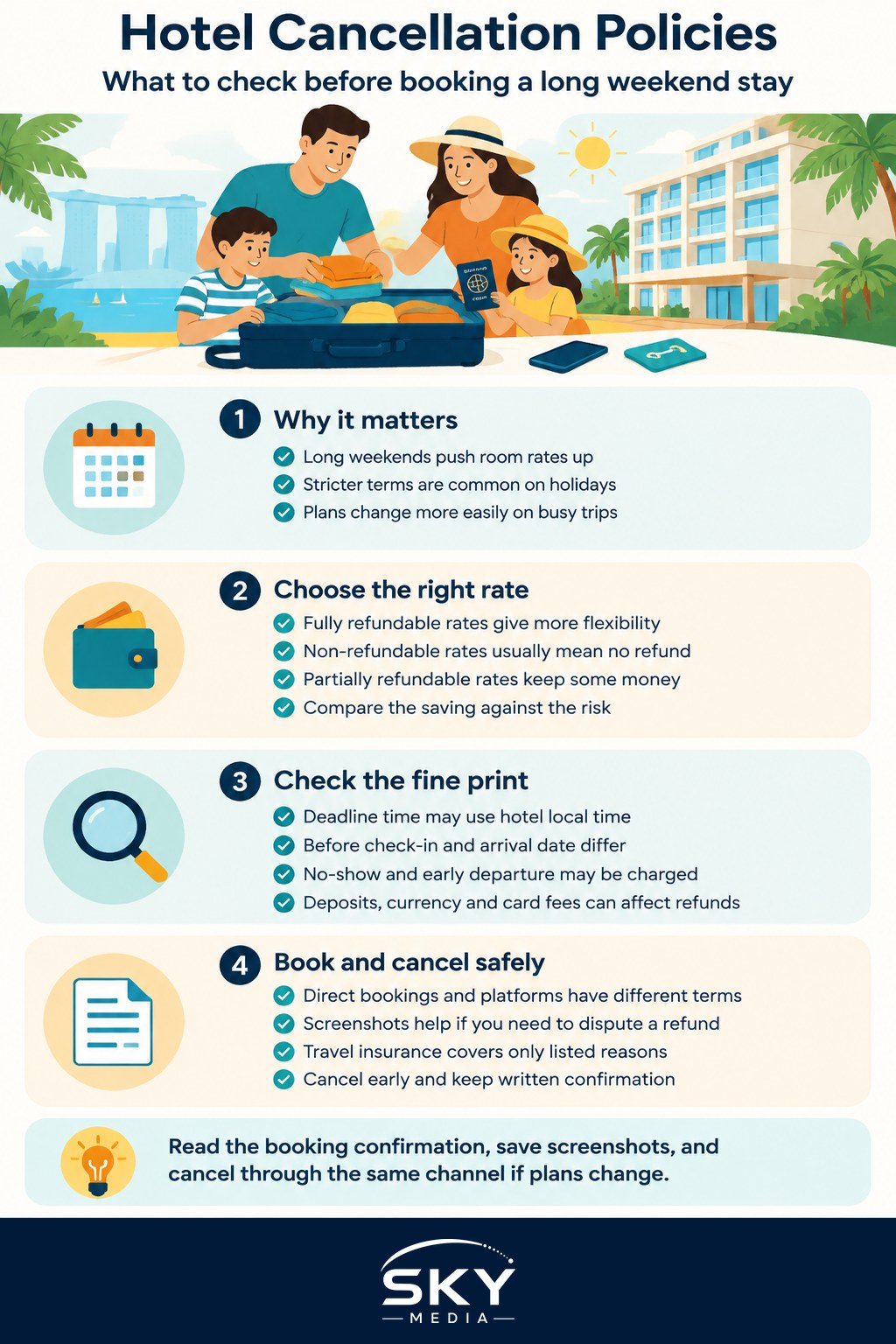
Why Long Weekends Make the Fine Print Matter More
Around public holidays such as Labour Day, Vesak Day or National Day, demand spikes both in Singapore and in nearby destinations. Hotels respond with stricter terms. You may see shorter free-cancellation windows, more non-refundable rates, minimum-stay requirements and deposits taken upfront.
At the same time, long weekend plans are more fragile. You are coordinating leave with others, travelling with family and perhaps crossing a border by road or ferry. More moving parts means a higher chance you will need to change something. Spending ten minutes on the cancellation terms before you click “book” is cheap insurance.
Refundable vs Non-Refundable Rates
Most hotels and platforms offer at least two versions of the same room. The difference is not the room, it is the risk you carry.
| Rate type | What you pay | If you cancel | Best when |
|---|---|---|---|
| Fully refundable, pay later | Usually nothing until near arrival or check-in | Free cancellation up to a stated deadline | Plans are uncertain or still being agreed |
| Fully refundable, pay now | Full amount charged at booking | Refund to your card if cancelled before the deadline, which can take time to process | You want to lock in the price and are fairly sure of the trip |
| Partially refundable | Full or part payment at booking | A fee or the first night is kept, the rest refunded | You want a lower rate but some flexibility |
| Non-refundable | Full amount charged at booking | Usually no refund, and changes may not be allowed | Dates are fixed and the saving is meaningful |
A useful rule of thumb: compare the price gap. If the non-refundable rate saves only a small amount, the flexibility of a refundable rate is usually worth it. If the saving is large and your dates are truly fixed, the cheaper rate may make sense.
The Fine Print That Catches People Out
Even “free cancellation” comes with conditions. Read these points on the booking page and again in your confirmation email.
- The exact deadline and its time zone. A policy might say free cancellation until a certain time a few days before arrival. That time is often the hotel’s local time, not Singapore time. If you are booking in a different time zone, work out what it means for you.
- “Before check-in” vs “before arrival date”. These can mean different cut-offs. Look for a specific date and time rather than relying on a vague phrase.
- No-show rules. If you simply do not turn up, many hotels charge at least the first night, and some charge the whole stay, even on a refundable rate.
- Early departure. Leaving a day early is not the same as cancelling. Some hotels charge for the full booked stay.
- Minimum stays and package rates. Long weekend deals may bundle breakfast, extra nights or activities. Cancelling part of a package can be harder than cancelling a room.
- Deposits and pre-authorisations. A hold on your card for incidentals is separate from the room charge. It is usually released after check-out, but the timing depends on your bank.
- Currency and card fees. If you are refunded in a foreign currency, exchange rate movements and card fees may mean you get back slightly less than you paid.
Booking Direct vs Booking Through a Platform
Online travel platforms make comparison easy, but they add a layer between you and the hotel.
- Whose policy applies? When you book through a platform, the platform’s terms and the hotel’s rate rules both apply. Your confirmation should state the cancellation policy for your specific booking. Screenshot it.
- Who processes the refund? Usually whoever took your payment. If the platform charged you, you generally cancel and claim through the platform, not the hotel.
- Changes and date swaps. Hotels booked directly may be more willing to move dates instead of cancelling. Platforms often treat a date change as a cancellation and new booking.
- Member and loyalty rates. Hotel loyalty programmes sometimes offer more flexible terms for direct bookings. Compare both before you decide.
Whichever route you choose, keep every email, booking reference and screenshot of the policy until your refund has cleared or your stay is over.
How Travel Insurance Fits In
Travel insurance can cover cancellation costs, but only for specific reasons listed in the policy, such as serious illness or certain unforeseen events. “I changed my mind” or “the weather looks bad” are usually not covered. Check:
- Whether trip cancellation cover applies to hotel-only bookings or only to trips with flights
- Which reasons are covered and what proof the insurer needs, such as a doctor’s memo
- Whether you must buy the policy within a certain time after booking
Defer to the policy wording and ask your insurer if anything is unclear. Our guide on flight delays and cancellations covers the travel side of disruptions in more detail.
What to Do If You Need to Cancel
Act early. The sooner you cancel, the more options you usually have.
- Find your confirmation and re-read the cancellation section.
- Cancel through the same channel you booked. Use the platform’s app or website, or the hotel’s official site, rather than an email that may sit unread.
- Get written confirmation of the cancellation and any refund amount.
- If you are outside the free window, contact the hotel politely and ask whether they can move your dates or offer a credit. Some will, especially if they can resell the room.
- Track the refund. Card refunds can take some time to appear. If it does not arrive within the stated period, follow up with the platform or hotel in writing.
If a refund dispute stalls
If a Singapore-based business refuses a refund you believe you are owed under its stated terms, the Consumers Association of Singapore (CASE) offers advice and mediation. For card payments, your bank may also be able to explain whether a dispute process applies. Check CASE and your bank’s websites for current procedures.
Building a Flexible Long Weekend Plan
Cancellation policies are one part of a well-planned break. Our guide to public holidays and long weekends in Singapore helps you pick dates early, before the best refundable rates disappear. If you would rather stay local, browse the best staycation hotels in Singapore, where shorter trips often mean simpler terms.
The cheapest rate is not always the best deal. Read the hotel cancellation policy before you pay, match the rate type to how certain your plans are and keep your paperwork until the stay is done. A few minutes now can save a frustrating argument later.
Further reading: The Best Hotels in Singapore: An Editor’s Shortlist