
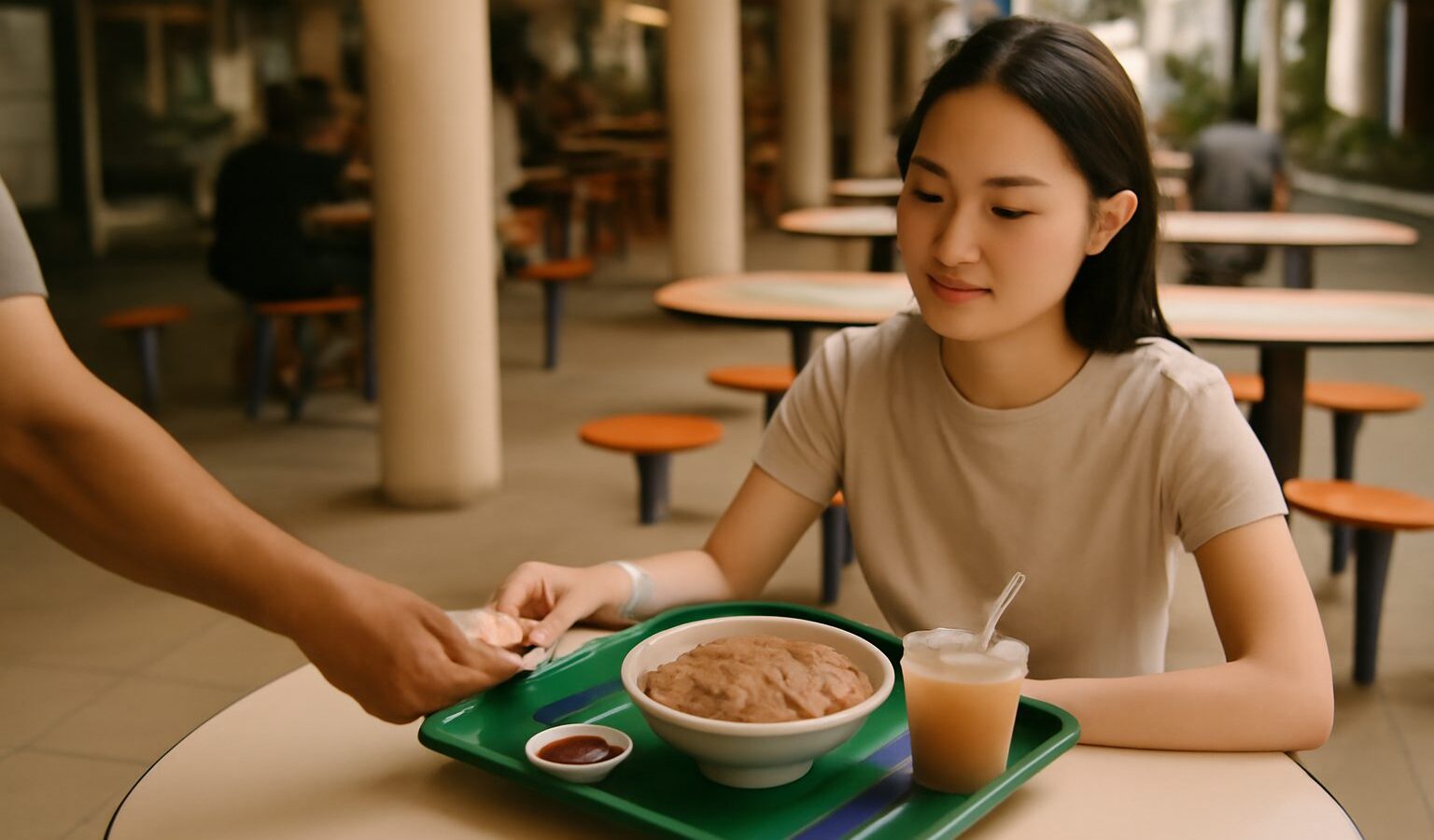
The first time you walk into a Singapore hawker centre, it can feel like everyone else got a rulebook you never received. People are waving fans over empty chairs, queues snake past a dozen stalls, and nobody seems to be waiting for a waiter. Take a breath. Hawker centre ordering in Singapore is actually simple once you understand the rhythm, and it is one of the warmest, cheapest, most delicious ways to feel at home here. This guide walks you through it step by step, the way a friend would if they were standing beside you.
If you have eaten at a mainland food court inside a mall, some of this will feel familiar and some will feel upside down. We will point out the differences as we go.
Finding a Seat and the Chope Custom
At a hawker centre you usually find a seat first, then go and order. Seats are shared and self-service, so during a busy lunch you grab a table the moment one frees up.
This is where “choping” comes in. Locals reserve a seat by placing a small personal item on it, most famously a packet of tissue paper, sometimes an umbrella or a name card. It is an informal honour system, not an official rule, and it means “this seat is taken, I have gone to order.” When you see a tissue packet on a chair, leave that seat alone. When you want to chope your own, a tissue packet works perfectly.
A few gentle pointers:
- Chope only what you need. Do not block a whole table of eight for two people at peak hour.
- Do not move someone else’s item to claim a seat. It is considered rude.
- If a table looks occupied but you are unsure, a friendly “Excuse me, is this seat taken?” always works.
In mainland food courts you often pay at a central counter, load a card, and order everything in one place. Hawker centres are the opposite: each stall is its own little business.
Ordering and Paying Stall by Stall
Every stall cooks its own specialty, so a group of friends might buy chicken rice from one stall, laksa from another, and drinks from a third, then bring it all back to the shared table. You order and pay at each stall separately.
The basic flow at a stall:
- Join the queue and look at the overhead signboard while you wait. Prices and dish names are usually listed there.
- When it is your turn, say the dish and quantity clearly, for example “One chicken rice, please.”
- Tell them if you are eating in or taking away (“dabao” is the local word for takeaway).
- Pay, then either wait for the food or give your table number if the stall delivers.
At many popular stalls you carry your own food back, so keep an eye on your dish. At others, especially drinks stalls, an “auntie” or “uncle” may bring it to your table, which is why choping a seat first is handy.
Cash, Cashless, PayNow and QR Codes
For years hawker stalls were strictly cash, and many older stallholders still prefer it. Today most stalls also accept cashless payment, and this is where newcomers from the mainland need a small mental switch.
Your WeChat Pay and Alipay from home generally will not work at a local hawker stall. Singapore runs on PayNow, a national system linked to your local bank account and mobile number, plus the shared SGQR code you will see taped to the counter. To pay, you open your Singapore banking app, scan the QR code, key in the amount shown, and let the stallholder see the “paid” confirmation.
Practical tips:
- Carry some small cash, coins and a few notes, as a backup. Not every stall is cashless, and card machines occasionally go down.
- Set up PayNow through your local bank once you have a Singapore account. It is free and instant.
- Do not assume international mobile wallets will be accepted. Ask “PayNow?” and the stallholder will point to the right QR.
Clearing Your Tray and Everyday Etiquette
One habit surprises many newcomers: you are now expected to return your own tray and clear your table when you finish. Tray-return points are placed around the centre, usually with separate slots for halal and non-halal crockery. Leaving a mountain of dirty plates behind is frowned upon, and there have been public campaigns encouraging everyone to self-clear so the next diner gets a clean table quickly.
You will also notice cleaners working the floor. Self-clearing does not replace them, it simply keeps things moving during the rush.
Halal, Non-Halal, Drinks and Hygiene Grades
A hawker centre serves a whole multicultural neighbourhood under one roof, so stalls are clearly categorised to respect different diets.
- Halal stalls are certified by MUIS (the Islamic Religious Council of Singapore) and display a halal certificate. Malay and Indian Muslim food, such as nasi lemak or biryani, is commonly halal.
- Non-halal stalls may serve pork or other items and are kept separate, which is why crockery is sorted at the tray-return point.
- Drinks stalls are their own thing. You buy your kopi, teh, sugarcane juice or soft drink here rather than at the food stall.
Every licensed stall also shows a hygiene grade issued by the Singapore Food Agency (SFA), displayed on a sticker near the stall. A higher grade reflects better hygiene standards at the last inspection. It is a quick, reassuring thing to glance at, though a long local queue is often the tastiest signal of all.
If you love the drinks-stall culture, it is worth learning the local kopi code, and we cover that in a companion guide linked below.
A Quick Step-by-Step Cheat Sheet
Here is the whole experience at a glance, with what to actually do at each point.
| Hawker step | What to do |
|---|---|
| Walk in | Scan for an empty seat before you queue for food |
| Chope a seat | Place a tissue packet or small item; do not hog a big table |
| Choose a stall | Read the overhead signboard for dishes and prices |
| Order | State dish and quantity; say “dabao” if taking away |
| Pay | Scan the SGQR with PayNow, or use cash as backup |
| Check the sticker | Note the SFA hygiene grade and halal certificate if relevant |
| Get drinks | Order kopi, teh or juice separately at the drinks stall |
| Finish | Return your tray to the correct halal or non-halal slot |
Handy Phrases and Final Encouragement
A few local words go a long way, and stallholders appreciate the effort:
- Dabao to take away.
- Makan means to eat, as in “let’s go makan.”
- Kopi / teh for local coffee and tea.
- Chope to reserve a seat.
- Auntie / uncle as a friendly, respectful way to address older stallholders.
Nobody expects you to get everything right on day one. Locals are generally patient with a polite newcomer, and a smile plus a clear order will carry you through. Go hungry, go curious, and treat your first few visits as delicious practice. Within a week or two, choping a seat and scanning a QR will feel completely natural, and you will have discovered why the hawker centre is the beating heart of everyday Singapore.
Explore more
Ready to master the drinks stall next? Learn the local coffee-shop code in Ordering Kopi and Teh Like a Local in Singapore, then build your must-eat list with Local Dishes Every Newcomer Should Try in Singapore. Both pair perfectly with your new hawker confidence.