

Most of us speak to ourselves in a way we would never speak to a friend. We are quick to criticise, slow to forgive, and convinced that being hard on ourselves is what keeps us on track. Learning how to practise self-compassion is about swapping that harshness for something steadier and kinder, without going soft on the things that matter. This is general self-help, not medical or psychological advice. If you are struggling with persistent low mood, harsh self-judgement or feelings that are affecting daily life, please speak to a doctor or counsellor.
Self-compassion is often misunderstood as making excuses or letting yourself off the hook. It is neither. It is treating yourself with the same fairness and warmth you would offer someone you care about, especially when things go wrong.
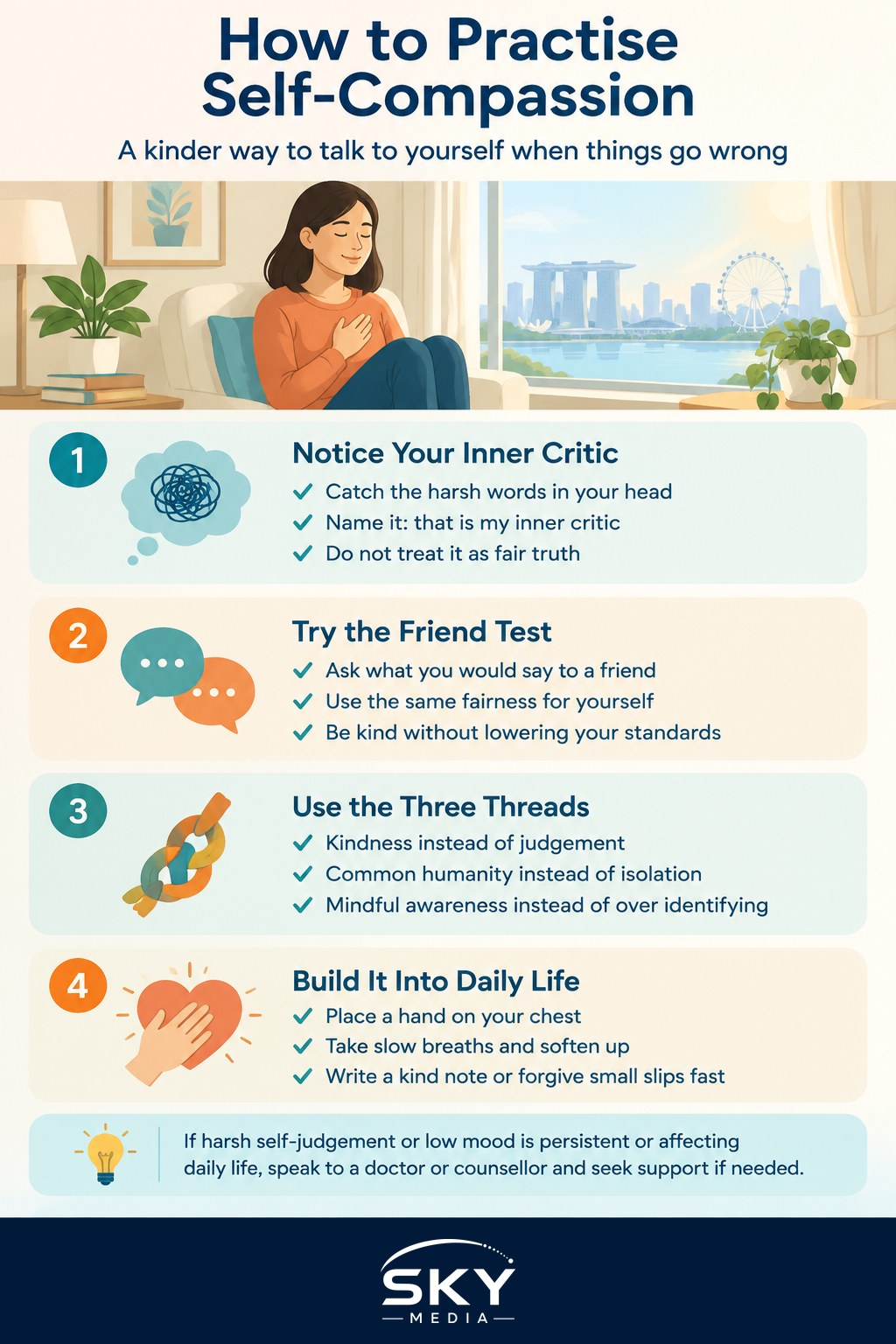
Notice how you talk to yourself
You cannot soften a voice you have not heard clearly. So the first step is to catch your inner critic in the act.
Next time you make a mistake or fall short, listen to the words in your head. Are they harsh, absolute, contemptuous? “I am so stupid.” “I always ruin things.” “What is wrong with me.” Many of us carry a running commentary this cruel and barely notice it, because it has been playing so long it sounds like truth.
Simply naming it helps. “That is my inner critic talking.” You do not have to argue with it. You just stop mistaking it for a fair witness.
Ask the friend question
Here is the single most useful move in all of self-compassion. When you are being hard on yourself, pause and ask: “What would I say to a good friend in exactly this situation?”
You would not tell a friend who failed an exam that they are hopeless. You would say, “That is really disappointing, and it does not define you. What do you need right now?” The words you would offer them are the words you are allowed to offer yourself. This is not going easy on yourself. It is being as fair to yourself as you naturally are to others.
The three parts of self-compassion
It helps to know what you are actually practising. Self-compassion has three simple threads you can weave into any hard moment.
- Kindness instead of judgement. Speak to yourself gently rather than harshly.
- Common humanity instead of isolation. Remember that struggle is part of being human, not proof that you alone are failing. Everyone stumbles.
- Mindful awareness instead of over identifying. Notice the pain without drowning in it. “This is hard right now” holds the feeling without being swallowed by it.
When something goes wrong, you can move through all three in a sentence: “This is painful. Other people feel this too. May I be kind to myself here.”
Self-compassion versus self-criticism
We often believe criticism drives us and kindness makes us lazy. In practice it is usually the other way around.
| Feature | Self-criticism | Self-compassion |
|---|---|---|
| Inner tone | Harsh, shaming | Warm, honest |
| Effect on effort | Fear driven, brittle | Steady, sustainable |
| After a mistake | Dwell and spiral | Learn and move on |
| Sense of worth | Conditional on success | Steady through ups and downs |
| Long term | Burnout, avoidance | Resilience, growth |
Kindness does not lower your standards. It gives you a safer place to fail, learn and try again, which is exactly what keeps people going for the long haul.
Let your body in on it
Self-compassion is not only words in your head. Your body responds to warmth and safety too.
- Place a hand on your chest or hold your own arm for a moment. A gentle, steadying touch calms the nervous system.
- Take a few slow breaths and soften your face and shoulders.
- Speak to yourself in a warmer tone, even silently. Tone matters as much as content.
These small physical gestures may feel awkward at first. Give them a chance. The body often believes kindness before the mind does.
Make room for the hard feelings
Self-compassion does not mean rushing to feel better or slapping a positive spin on everything. That is just another way of turning away from yourself. Real self-compassion lets the difficult feeling be there. Disappointment, grief, embarrassment, fear. You acknowledge it honestly, “This really hurts,” and you stay with yourself through it rather than abandoning yourself for feeling it.
Small practices to build the habit
- Write yourself a kind note. After a hard day, write what you would tell a friend who had lived it.
- Set a gentle reminder. A daily phrase like “I am doing my best with what I have” resets the tone.
- Forgive the small stuff fast. You forgot something, you were late, you snapped. Note it, make it right, let it go.
- Celebrate effort, not just outcome. You showed up and tried. That counts, whatever the result.
Undoing the myth that harshness helps
Many of us learned early that pushing ourselves hard was the responsible thing to do, and that kindness was something you earned only after success. It is worth questioning that. The people who last, who keep growing and recovering and trying, are usually the ones who have learned to be on their own side. Being your own ally is not indulgence. It is the ground everything else is built on.
A softer, stronger way to hold yourself
Practising self-compassion is not a single decision, it is a habit you build slowly, one kind response at a time. Some days the critic will be loud, and you will forget, and that is fine, because forgetting and beginning again is the practice, not a failure of it. Treat yourself as a friend, remember you are not alone in struggling, and let the hard feelings be held rather than punished.
Be patient with yourself as you learn this, especially if kindness towards yourself feels unfamiliar or even undeserved. It is not. If harsh self-judgement or low mood is persistent, intense or affecting your daily life, please talk to a doctor or counsellor, and look up Singapore’s current national mental health helpline if you need support now. You are worth your own kindness.
Explore more: How to Improve Your Self-Talk · How to Overcome Perfectionism · Building Resilience When Things Go Wrong
Further reading: How to Practise Radical Acceptance