

If your notes are a wall of text that you never quite want to reread, the Cornell method is worth a try. Taking Cornell notes in Singapore has quietly become popular with secondary, JC, and poly students because it does something ordinary note-taking rarely does: it builds review into the page itself. Instead of copying everything and hoping it sticks, you set up the page so that recall and summarising happen as part of the process. That small change is what makes the difference between notes you file away and notes you actually learn from.
What the Cornell method actually is
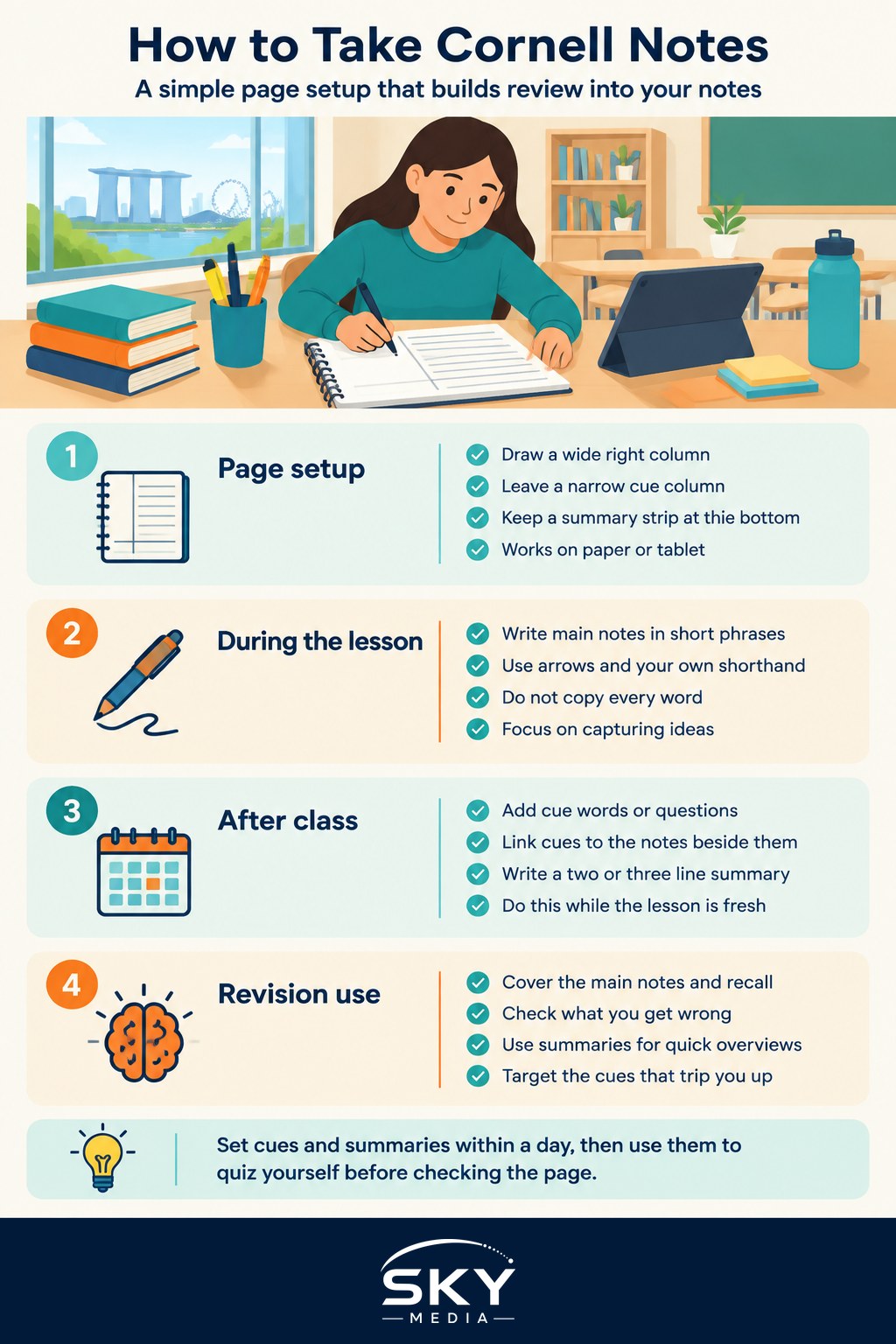
The Cornell method is simply a way of dividing your page before the lesson starts. Draw a vertical line about a third of the way in from the left, leaving a wide column on the right and a narrow one on the left. Then leave a few lines free across the bottom. That is the whole layout. Nothing fancy, and it works just as well in an exercise book as on a tablet.
During the lesson, you write your main notes in the big right-hand column. Keep them brief. Use short phrases, arrows, and your own shorthand rather than full sentences. You are trying to capture ideas, not transcribe your teacher word for word.
The narrow left column is the clever part, and you do not fill it in during class. After the lesson, when things are still fresh, you go back and write cue words or questions in that column that match the notes beside them. A note about photosynthesis might get the cue “What are the inputs and outputs?” A history paragraph might get “Why did this cause tension?” These cues become the prompts you use later to test yourself.
The strip at the bottom is for a two or three line summary of the whole page in your own words. Writing that summary forces you to decide what actually mattered, which is where real understanding starts.
Why it works so well for Singapore students
The reason the method is effective is that it lines up neatly with how memory works. The cue column turns your notes into a self-quiz, so you are practising active recall rather than just rereading. Covering the right column and answering your own cues from the left is one of the most reliable ways to revise. If you want to go deeper on that, our guide to using active recall to study explains the science in plain terms.
For a packed local timetable, the built-in structure is a gift. Between CCA, tuition, and homework, most students have little spare time, so notes that are already organised for revision save you from redoing everything before exams. You are essentially doing a light first pass of revision within a day of the lesson, which fits well with spaced repetition for better memory.
It also pairs nicely with other note-taking styles. If a topic is very visual or full of connections, you might sketch a mind map first and then convert the key points into Cornell format, or the other way round. There is no single correct system, and it is worth trying a few, as we cover in note-taking methods that work.
Setting it up without wasting time
You do not need a special notebook. Any lined paper works, and you can rule the columns in a few seconds. Some students prefer to prepare a handful of pages in advance so they are ready to go. On a laptop or tablet, a simple table or a template in your notes app does the same job.
Keep these habits in mind:
- Write cues and the summary within a day, while the lesson is still clear in your head.
- Keep the main notes lean. If you are copying the whiteboard exactly, you are probably writing too much.
- Phrase cues as questions where you can, since questions are easier to quiz yourself with.
- Do not aim for pretty. Legible and useful beats decorative every time.
Using your notes to revise
The real payoff comes at revision time. Cover the right column with your hand or a piece of paper, read a cue, and try to answer from memory before checking. Anything you fumble goes on your list to revisit. Reading your bottom-line summaries in order gives you a quick overview of an entire topic, which is handy the week before a paper.
Over time you will notice which cues keep tripping you up, and those become your priority. This turns revision from a vague reread into a targeted, honest check of what you know and what you do not.
A realistic word of encouragement
Cornell notes are a tool, not a magic fix. They will not replace understanding the material or putting in the practice, and you should not expect perfect notes on your first try. Give it a couple of weeks, tweak the layout to suit you, and keep the parts that help. If a lesson moves too fast to keep up, just capture what you can and tidy it afterwards. The goal is notes that work for you, not notes that look impressive. Start with your next lesson, rule one page, and see how it feels.