

A strong vocabulary is quietly one of the most useful things you can build. The words you know shape how clearly you read, how precisely you write, and how confidently you speak, whether that is in a composition, a job interview, a General Paper essay or an email to a client. Improving your vocabulary is not about swallowing a dictionary or showing off with long words. It is about slowly collecting the right words so that when you need to say exactly what you mean, the word is already there.
The best part is that this is genuinely achievable for anyone, at any age. You do not need a special talent, and you do not need to memorise hundreds of words at once. This guide is for Singapore students building word power for exams and everyday life, and for adult learners who want to read, write and speak with more range. The approach is the same for both: small, steady habits that make new words stick.
Why Word Lists Alone Rarely Work
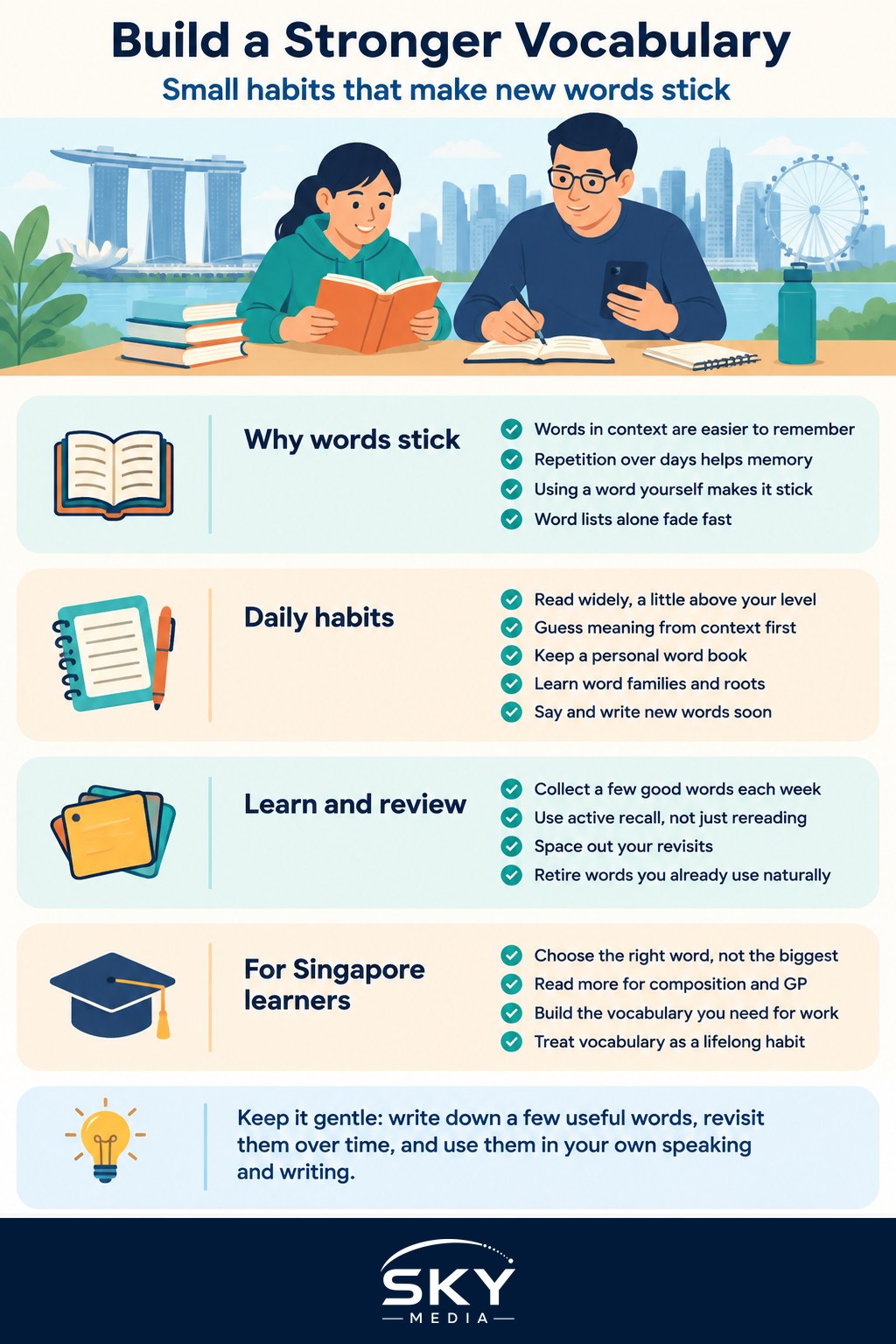
Most of us have tried it: a list of fifty “difficult words” with definitions, crammed the night before a test. A few days later, almost all of them are gone. This is not a personal failing; it is how memory works. Words learned in isolation, with no context and no repetition, fade fast.
Words stick when three things happen. First, you meet them in context, in a real sentence where the meaning is doing a job, not sitting alone next to a definition. Second, you meet them more than once, ideally spread out over days rather than all at once. Third, you use them yourself, in speech or writing, which forces your brain to retrieve the word rather than just recognise it.
That is why the strongest vocabulary habits are woven into things you already do, especially reading, rather than treated as a separate chore. Improving your vocabulary works less like cramming and more like slowly furnishing a room: one good piece at a time, kept because it is useful.
Everyday Habits That Grow Your Word Bank
You do not need extra hours in the day. You need a handful of light habits, repeated:
- Read widely and a little above your level. Reading is the single richest source of new words in natural context. Mix fiction, news, and non-fiction on topics that interest you. The National Library Board’s libraries and its NLB Mobile and Libby apps make this free across the island. If you want to read more closely, our guide on building strong reading comprehension pairs perfectly with this.
- Guess from context first, then check. When you hit an unfamiliar word, pause and predict its meaning from the sentence before reaching for a dictionary. That guess makes the real meaning stickier when you confirm it.
- Keep a personal word book. A small notebook or a notes app where you jot the word, the sentence you found it in, and a short meaning in your own words. Your own examples beat any textbook list.
- Learn word families and roots. Knowing that “port” relates to carrying unlocks transport, export, portable and porter at once. Prefixes and suffixes multiply your vocabulary quietly.
- Say it and write it. Try each new word in a sentence of your own within a day or two. A word you have used is far more yours than a word you have only read.
Two Ways to Learn a Word: Which Sticks
The difference between vocabulary that fades and vocabulary that lasts usually comes down to how the word was learned. The table below contrasts the two.
| Aspect | Cramming a word list | Learning words in context |
|---|---|---|
| Where the word comes from | An isolated list with definitions | Real reading, listening or conversation |
| How often you meet it | Once, right before a test | Several times, spread across days |
| What you do with it | Recognise it for the exam | Use it in your own writing and speech |
| How well it lasts | Fades within days | Settles into long-term memory |
| How it feels | A chore to be endured | A quiet by-product of things you enjoy |
The right-hand column is slower to start but far more durable. You are not trying to win a race this week; you are building a word bank for years.
Making New Words Stick
Meeting a word once is rarely enough. To move a word from “I sort of recognise this” to “I can use this naturally”, you need to revisit it, and revisiting works best when it is spaced out over time rather than repeated all at once.
A simple, sustainable routine:
- Collect during the week. Whenever a word stops you, note it in your word book with its sentence. Aim for quality over quantity, perhaps three to five words a day.
- Review with active recall. Once every few days, cover the meanings and try to recall each word’s sense and use it in a fresh sentence, rather than just re-reading the list. Testing yourself is far stronger than passive review, as explained in using active recall to study.
- Space out the revisits. Come back to older words at widening intervals. This spacing is the engine behind spaced repetition for better memory, and flashcards, paper or app-based, are a natural fit here (see using flashcards effectively).
- Retire the ones that stick. Once a word turns up naturally in your own writing, it has moved in. Focus your reviews on the words still finding their feet.
Keep the load gentle. Ten well-chosen words that you actually use beat a hundred you cram and forget.
Vocabulary for Singapore Students and Adults
In Singapore’s multilingual setting, many learners juggle English alongside Mandarin, Malay or Tamil, and vocabulary grows in all of them. A few local, practical notes:
- For students: wider reading feeds composition, comprehension and General Paper far more than memorising “power words” to sprinkle in. Examiners notice when a fancy word is forced. Aim for the right word, not the biggest one. Precision reads better than decoration.
- For adult and working learners: target the vocabulary of your field or your goal. If you are preparing a presentation, moving into a new industry, or working towards a WSQ or SkillsFuture-supported course, collect the terms that actually appear in that world. Podcasts and audiobooks on your commute quietly widen your range too.
- For everyone: treat vocabulary as a lifelong, low-pressure hobby rather than an exam sprint. Curiosity about words, where they come from and why one fits better than another, is what keeps the habit alive for decades.
One honest caution: bigger words are not always better words. The goal of improving your vocabulary is clarity and precision, being able to say exactly what you mean, not sounding impressive. A plain word used well beats a rare word used clumsily.
Improving your vocabulary is one of the most rewarding long games in learning. You will not notice it day to day, and then one week you will reach for a word you did not have last year and find it waiting. Read a little most days, jot down the words that catch you, revisit them gently, and use them. The words you collect will keep repaying you, in every exam, essay, conversation and email, for the rest of your life.
Further reading: How to Tackle Grammar and Vocabulary Cloze in Primary English · Improving Your English Pronunciation