

Singapore is known for competitive personal taxes, but the way the income tax rates singapore system works still confuses many newcomers. It is progressive, band by band, and it interacts with your residency status and the reliefs you claim. Once you see the structure, estimating your own bill becomes much easier. This article is general information only, not personalised financial, tax or legal advice; confirm current rates and thresholds with IRAS before making decisions.
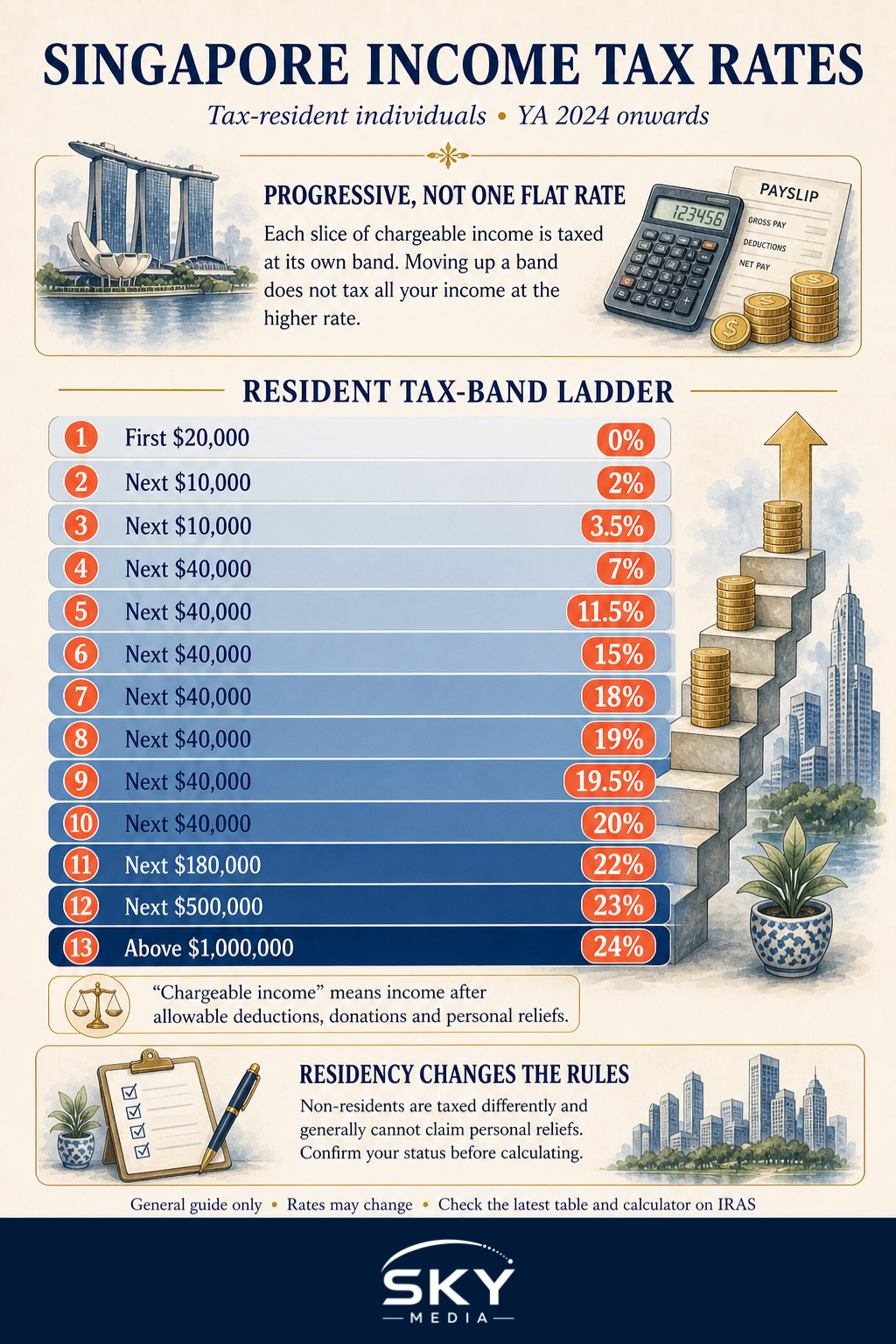
How the Progressive System Works
Singapore uses a progressive rate structure for tax residents. That means your income is sliced into bands, and each band is taxed at its own rate. The first slice of income is taxed at the lowest rate (with a portion effectively free of tax), and higher slices are taxed at progressively higher rates.
The single most important idea to grasp is the difference between your marginal rate and your effective rate:
- Marginal rate is the rate applied to your next dollar of income, in other words the top band you reach.
- Effective rate is your total tax divided by your total income, which is always lower because the lower bands are taxed gently.
A common mistake is to assume that reaching a higher band taxes all your income at that higher rate. It does not. Only the portion sitting inside that band is taxed at the band rate. Because the exact rates and band boundaries are set by policy and can be revised, check the current bands on the IRAS website rather than relying on figures in older articles.
Chargeable Income: What Is Actually Taxed
You are not taxed on your gross salary. You are taxed on your chargeable income, which is what remains after allowable deductions and reliefs are subtracted. The rough flow looks like this:
- Start with your total assessable income for the year (employment, trade, and certain other income).
- Subtract allowable deductions and expenses.
- Subtract personal reliefs you qualify for.
- The result is your chargeable income, to which the progressive bands are applied.
This is why two people earning the same salary can pay different amounts of tax. Reliefs for CPF contributions, dependants, course fees, and voluntary top-ups can meaningfully lower chargeable income. There is also an overall cap on the total personal reliefs an individual can claim in a year, so beyond a point additional reliefs stop reducing your bill. Confirm the current cap and each relief’s conditions with IRAS.
Resident Versus Non-Resident Treatment
Your residency status changes the rate structure entirely, so it is worth getting right. Broadly, tax residents enjoy the progressive bands and access to reliefs, while non-residents are taxed differently and generally cannot claim the same personal reliefs.
The table below summarises the practical differences. Treat it as orientation and verify the current rules and figures with IRAS.
| Feature | Tax resident | Non-resident |
|---|---|---|
| Rate structure | Progressive bands | Flat or fixed treatment depending on income type |
| Personal reliefs | Generally available | Generally not available |
| Employment income | Taxed on the progressive bands | Taxed under the applicable non-resident basis |
| Directors’ fees and certain income | Progressive bands | Often a separate withholding treatment |
| Who it typically covers | Those who live and work here through the year | Short-stay or limited-presence individuals |
Because the line between resident and non-resident depends on your physical presence and the nature of your stay, read our companion guide before assuming your status. The distinction can change your tax bill significantly.
Estimating What You Will Pay
You do not need software to get a reasonable estimate. Work through it in order:
- Add up assessable income for the year.
- Subtract deductions and reliefs you genuinely qualify for, keeping evidence.
- Apply the current bands in slices, taxing each portion at its own rate.
- Add the tax from each band to get your total, then divide by income for your effective rate.
Keep in mind that IRAS issues a Notice of Assessment after you file, which is the official statement of what you owe. If it differs from your estimate, review your reliefs and figures before objecting. Filing accurately and on time matters; penalties for late or incorrect filing can erase any saving you hoped to make.
A few habits keep this painless:
- Track CPF contributions and relief-eligible payments through the year, not in a last-minute scramble.
- Remember the overall relief cap so you plan voluntary top-ups sensibly.
- Where a specific rate, band boundary or relief limit matters, confirm the current figure with IRAS.
Common Misunderstandings Worth Clearing Up
Two errors come up again and again. The first is the marginal-rate myth described earlier, where people fear a raise will “push all their income” into a higher rate. It will not; only the extra slice is taxed higher, so a raise always leaves you better off after tax.
The second is treating reliefs as automatic. Most reliefs must be claimed and supported, and eligibility conditions apply. If you do not claim what you are entitled to, you simply pay more. Conversely, claiming reliefs you do not qualify for invites penalties. When in doubt, check the specific relief against current IRAS guidance or seek advice.
A third confusion is bonuses and one-off payments. A large bonus can push part of your income into a higher band for that year, which feels alarming on the payslip. But the same slice logic applies: only the portion of the bonus that falls inside the higher band is taxed at that band’s rate, and the rest stays where it was. Timing matters too, since income is generally assessed for the year it relates to, so plan around the year of assessment rather than the calendar date a payment happens to clear.
Finally, remember that rates and thresholds are policy settings that can be adjusted in any Budget. Use this guide to understand the mechanics, then plug in the current numbers from IRAS when you actually compute.
Explore More
To pin down which rate structure applies to you, read our guide to tax residency in Singapore and the detail on non-resident income tax. To lower your chargeable income legitimately, see income tax reliefs in Singapore, and once you file, our guide to understanding your Notice of Assessment explains what IRAS sends back.