

Many capable people in Singapore struggle with the same thing: saying no at work feels rude, risky, or ungrateful, so they say yes to almost everything. The result is a calendar packed with other people’s priorities, work that spills into evenings, and a quiet resentment that helps no one. Learning to decline well is not about being difficult. It is a professional skill that protects your best work, keeps commitments honest, and earns more respect than an endless stream of reluctant yeses.
This guide walks through why no feels so hard here, how to say it without burning bridges, and how to hold the line when the pressure comes back. The aim is simple: to help you be genuinely helpful on the things that matter, rather than thinly helpful on everything.
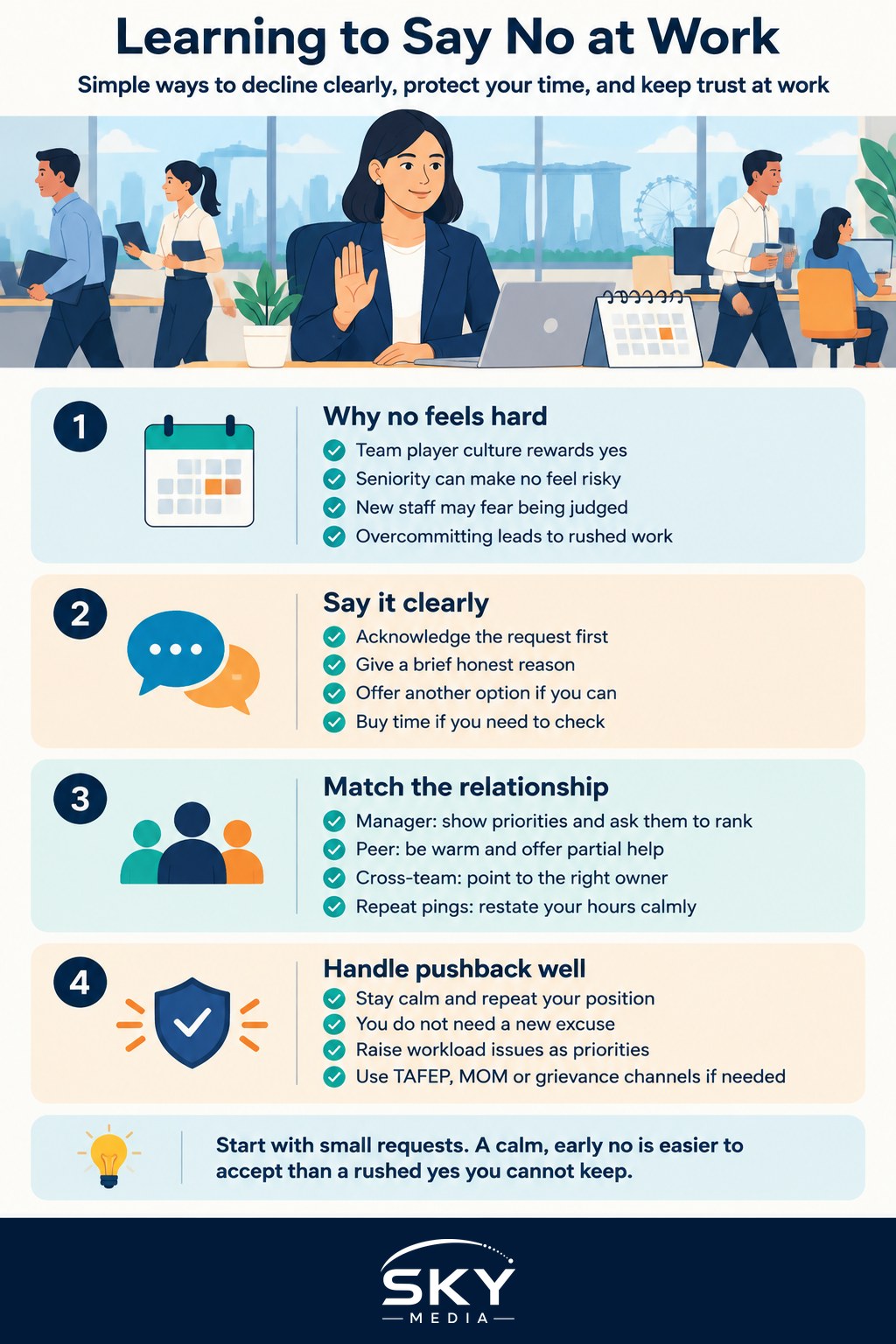
Why Saying No Feels So Hard Here
In many Singapore workplaces, being seen as a team player is prized, and saying yes is the fastest way to look like one. Add a cultural respect for seniority and a fear of looking lazy, and the word no starts to feel almost taboo. Newer staff and those on work passes can feel this even more sharply, worried that a refusal will be remembered when it matters.
The problem is that a yes you cannot deliver is worse than an honest no. When you overcommit, something slips, and the person who trusted you is left exposed. Over time, a reputation for saying yes to everything quietly becomes a reputation for missing deadlines and doing rushed work.
It helps to reframe the whole thing. You are not refusing to help. You are managing a limited resource, your time and attention, so that the work you do complete is done well. Seen that way, a thoughtful no is a form of respect: for the task, for the person asking, and for the promises you have already made.
How to Say No Without Damaging Trust
The tone matters far more than the word. A good no is warm, clear, and quick. It acknowledges the request, gives a brief honest reason, and where possible offers a path forward. You do not need a long justification, and you should not invent excuses that can unravel later.
A few patterns that work in most offices:
- Acknowledge, then decline. “Thanks for thinking of me for this. I can’t take it on this week without dropping the client report.”
- Offer an alternative. “I can’t lead it, but I can review the draft on Friday,” or “Ravi has done this before and may have more room.”
- Buy time honestly. “Let me check my current deadlines and come back to you by end of day,” rather than a reflexive yes.
- Name the trade-off. “I can do this, but the newsletter would move to next week. Which matters more to you?”
That last line is powerful with a manager. Instead of refusing outright, you make the workload visible and let them prioritise. Often they had no idea how full your plate already was, and the conversation shifts from yes-or-no to what-comes-first.
Saying No Upwards, Sideways, and Downwards
Not every no is the same, because the relationship changes what feels appropriate. Declining a peer’s favour is different from pushing back on your director, and both differ from redirecting a request from someone junior. The table below sketches how the approach shifts.
| Situation | What to lead with | What to avoid |
|---|---|---|
| A manager adds to a full plate | Show current priorities, ask them to rank | A silent yes you cannot deliver |
| A peer asks for a favour | Be direct and warm, offer partial help | Vague maybes that drag on for days |
| A cross-team request | Point to the right owner or process | Taking it on to be nice, then stalling |
| A last-minute urgent ask | Clarify the real deadline first | Assuming urgent means immediate |
| A repeated after-hours ping | Restate your working hours calmly | Snapping, or answering to keep the peace |
The common thread is clarity. Vague responses like “I’ll try” or “maybe later” feel polite but leave everyone guessing, and they usually cost more goodwill than a clean no delivered early.
Handling Guilt, Pushback, and Repeat Requests
Even a well-delivered no can trigger guilt or a second attempt. Expect both, and prepare for them. Guilt often fades once you see that colleagues cope perfectly well when you decline; the imagined disaster rarely arrives. If it lingers, remind yourself of the yes hiding inside every no. Saying no to a low-value task is saying yes to the project you were actually hired to deliver.
When someone pushes back, stay calm and repeat your position without escalating. You do not owe a fresh reason each time. A steady “I understand, but I really can’t commit to that this week” said twice is more convincing than a long defence. If a request keeps returning, the issue may be a workload one worth raising directly with your manager, framed around priorities rather than complaints.
There are limits worth respecting. If you feel pressured into something that touches your safety, ethics, or legal rights at work, that moves beyond ordinary boundary-setting. Singapore’s fair-employment framework is overseen by TAFEP, and MOM sets out employees’ rights under the Employment Act. For anything involving harassment, discrimination, or contract terms, check your own contract and the current guidance from MOM or TAFEP, and use your employer’s grievance channel rather than simply absorbing the pressure.
Building a Reputation That Makes No Easier
The most sustainable way to say no is to be visibly excellent at your yeses. When you deliver reliably on your core work, an occasional decline reads as focus, not laziness. People trust that if you say no, there is a good reason, and that if you say yes, it will actually happen.
A few habits make this easier over time:
- Keep your priorities visible. A shared task list or a short weekly update lets your manager see the load without you having to argue it.
- Protect a little focus time. Blocking an hour or two for deep work signals that your calendar is not a free-for-all.
- Say no early. A decline on day one is a favour; a decline on the deadline is a crisis.
- Follow through on what you accept. Your reliability is what earns you the right to decline elsewhere.
Learning to decline well is a slow shift, not a switch you flip. Start with low-stakes requests, notice that the sky does not fall, and let your confidence grow from there. Over a few months you will likely find that saying no, done with warmth and clarity, does not cost you respect. It builds it, because people learn that your word means something.
Explore More
Setting boundaries is closely tied to how you manage a team’s workload, so if you lead people, see our guide on how to delegate effectively. Protecting your time also helps you show up better in conversations, which pairs well with emotional intelligence at work and, if your manager tends to hover, working with a micromanager.