

For many young men in Singapore, full-time National Service (NS) is the longest stretch of structured work they have done before their first job or internship. Yet a lot of resumes reduce it to a single line: a vocation, a unit and two dates. A good national service resume Singapore employers will actually read does more than that. It turns two years of training, duty and responsibility into skills a hiring manager can recognise, in language a civilian understands.
This guide focuses on the practical mechanics: where NS goes on the page, how to translate ranks and appointments, how to write bullet points, and what to leave off. If you are still thinking about the bigger shift from uniform to office life, our guide to transitioning from National Service to work covers that wider journey.
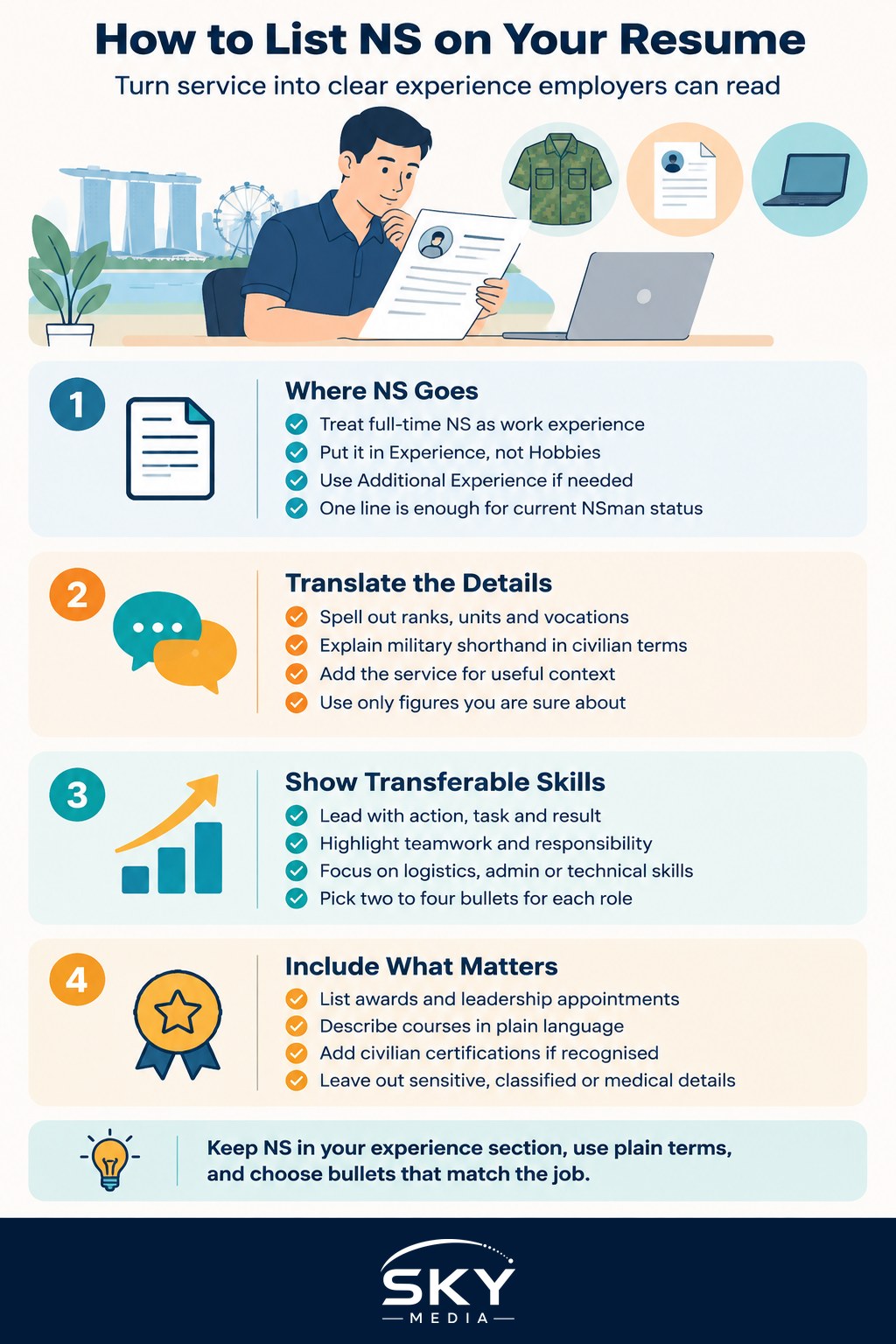
Where National Service Belongs on Your Resume
Treat full-time NS as work experience, not as a footnote. You were assigned a role, given responsibilities, assessed on performance and expected to work with a team under a chain of command. That is employment-shaped experience, even though it was compulsory.
A simple rule for placement:
- If NS is your main experience (common for fresh polytechnic or university graduates), put it in your “Experience” section in reverse chronological order, alongside any internships or part-time jobs.
- If you have since held several relevant jobs, keep NS in the experience section but shorten it to one or two bullet points, or move it to an “Additional Experience” section lower down.
- If you are an Operationally Ready National Serviceman (NSman) doing in-camp training years later, you usually do not need to list each ICT. One line noting your current NS status is enough, and it can help explain short absences an employer may ask about.
Avoid burying NS under “Hobbies” or “Others”. It undersells real responsibility and can make a gap in your timeline look unexplained.
Translating Ranks, Vocations and Jargon
The biggest mistake on NS resumes is military shorthand. A recruiter at a bank or a design agency may not know what a vocation code, a unit abbreviation or an appointment acronym means. Spell things out and describe what the role involved.
A practical formatting pattern:
Platoon Sergeant (Rank: Third Sergeant), Singapore Armed Forces
Infantry Battalion, Month Year to Month Year
Then add bullet points that explain what you did. You can mention your service (Singapore Armed Forces, Singapore Police Force or Singapore Civil Defence Force) because it gives context, but the bullets should carry the meaning.
Some common translations that help civilian readers:
| NS wording | Plain-English version for a resume |
|---|---|
| Section commander | Led and supervised a team of around eight to ten people in training and daily routines |
| Storeman or logistics clerk | Managed equipment inventory, issued and tracked items, kept accurate records |
| Admin clerk or S1 branch | Handled personnel records, leave administration and scheduling for a unit |
| Driver (transport operator) | Operated vehicles safely to schedule, conducted daily vehicle checks and kept logs |
| Medic | Provided first-line medical support and kept treatment records under supervision |
| Signaller or IT support | Set up and maintained communications or IT equipment and resolved user issues |
Only use numbers you are sure about. If you are unsure how many people you supervised on average, describe the team rather than guessing a figure.
Writing Bullet Points That Show Transferable Skills
Employers are looking for evidence of the same few qualities in almost every entry-level hire: reliability, teamwork, communication, the ability to learn fast, and some responsibility for outcomes. NS often gives you real examples of each. The trick is to write them as results, not just duties.
A useful structure for each bullet is: action verb, what you did, and the result or scale.
Weaker: “In charge of section during field camp.”
Stronger: “Led a section of nine through a two-week field exercise, planning daily schedules and briefings, with all members completing the assessment.”
Weaker: “Did admin work.”
Stronger: “Maintained leave and attendance records for a company of about 100 personnel, reducing scheduling clashes by introducing a shared tracking sheet.”
Keep the figures honest and approximate where needed (“about”, “around”). If you want more ideas on turning experience into measurable impact, see how to quantify achievements on your resume.
Skills that commonly transfer from NS roles include:
- Leadership and supervision: commanders, instructors and section leaders.
- Training and coaching: instructors who taught drills, safety procedures or skills.
- Operations and logistics: planners, storemen, transport operators.
- Administration and record-keeping: clerks and orderly room roles.
- Technical skills: signallers, IT support, technicians, medics.
- Working under pressure: duties, guard rotations and exercises with tight timelines.
Choose two to four bullets that match the job you are applying for. A logistics internship cares more about your inventory work than your shooting results.
Awards, Courses and Leadership Appointments
Formal recognition is worth including, as long as you explain it briefly. A “Best Recruit” or “Best Section Commander” award, a commendation from your unit, or completion of a leadership or specialist course all signal that someone assessed your performance and rated it highly.
Describe each in a few words: “Awarded Best Trainee in a cohort of around 60 for leadership and fitness.” If your course gave a recognised civilian certification (for example in first aid or driving), list the certification itself under a “Certifications” section as well, since employers may filter for it.
Be cautious with internal course names. If the course title only makes sense inside the military, describe it instead: “Completed a leadership course covering planning, briefing and team management.”
What to Leave Out
Some things should never appear on a resume, however impressive they feel:
- Sensitive or classified details. Do not mention operational specifics, locations, equipment capabilities or anything you were told not to disclose. Your obligations about confidentiality continue after you leave. Describe your work at a general level. If you are unsure, leave it out or check with your unit or MINDEF guidance.
- Unexplained acronyms. Every abbreviation is a small barrier for the reader.
- Disciplinary matters or medical status. You are not obliged to volunteer these, and they rarely help.
- Long lists of every duty. A dozen bullets on guard duty dilutes your strongest points.
Also keep the resume short. Fresh graduates rarely need more than one page; our guide to how long a resume should be in Singapore explains when two pages make sense.
Talking About NS in Interviews
Your resume opens the door; the interview is where NS stories do their best work. Prepare two or three short stories using a simple situation, action, result structure: a time you led a team through something difficult, a time you fixed a problem with processes or records, and a time you handled pressure or a mistake.
Interviewers who did NS themselves may ask detailed questions, while others will simply want to know what you learned. In both cases, keep the focus on transferable lessons rather than war stories. Show that you understand how discipline, planning and teamwork carry over into an office, a retail floor, a lab or a client meeting.
A Quick Checklist Before You Send
- NS sits in your experience section with a clear role title and dates.
- Ranks, units and vocations are spelled out or explained.
- Each bullet starts with an action verb and shows scale or result.
- Figures are honest and approximate where unsure.
- Awards and courses are described in plain terms.
- No sensitive information, no unexplained jargon.
- The bullets you chose match the job you are applying for.
National Service is a shared experience for many young Singaporean men, which means it will not stand out by itself. What stands out is how clearly you explain what you did and what you can now do for an employer. A few careful rewrites can turn one forgettable line into some of the strongest evidence on your page.
Frequently Asked Questions
How do I list National Service if I served after finishing my degree? Keep to reverse chronological order, so NS appears above your degree-era internships if it is your most recent experience, with clear start and end dates. Add a short line if the sequence might confuse a reader. What matters is that every period of time is accounted for.
What if my NS role was guard duty or something that sounds routine? Focus on the transferable qualities behind it: reliability, discipline, attention to detail and working shifts under pressure. Describe what you were responsible for in plain terms and any scale, such as a team you worked with, without sharing sensitive details. Even a routine role shows you can be trusted.
Should I mention reservist training on my resume? One line noting your NSman status is usually enough, rather than listing each in-camp training. It tells employers you may have short, scheduled absences. Employers in Singapore are expected to support NS obligations, and MINDEF has guidance on this if you are unsure.
How should I describe NS when applying for jobs overseas? Explain that it was compulsory national service in the Singapore armed forces or uniformed services, then describe the role and skills in plain language. Foreign recruiters may not know what NS involves, so avoid acronyms and ranks without context. Keep the focus on what you did and learnt.
Should my LinkedIn profile show my National Service the same way as my resume? It helps to keep the role, service and dates consistent, since employers often check both. LinkedIn allows slightly more detail, but the same rules apply, so avoid sensitive information and jargon. You can list NS as an experience entry and add a few bullet points or a short summary.
Official sources: MINDEF / NS Portal