

Most families in Singapore support their elderly parents without anyone needing to ask. But sometimes relationships break down, children stop helping, or a parent is simply too proud or too afraid to raise the subject. For these situations, Singapore has a specific law: the Maintenance of Parents Act. It gives parents who cannot support themselves a way to ask the children who can afford it to contribute.
This guide explains, in plain language, who the Maintenance of Parents Act is for, why the process starts with conciliation rather than a courtroom, how a parent applies to the Tribunal for the Maintenance of Parents, and what a child may be asked to pay. It is general information, not legal advice. The rules, forms and procedures are administered under the Ministry of Social and Family Development (MSF), so always check the current details on MSF’s official website or with the relevant office before acting.
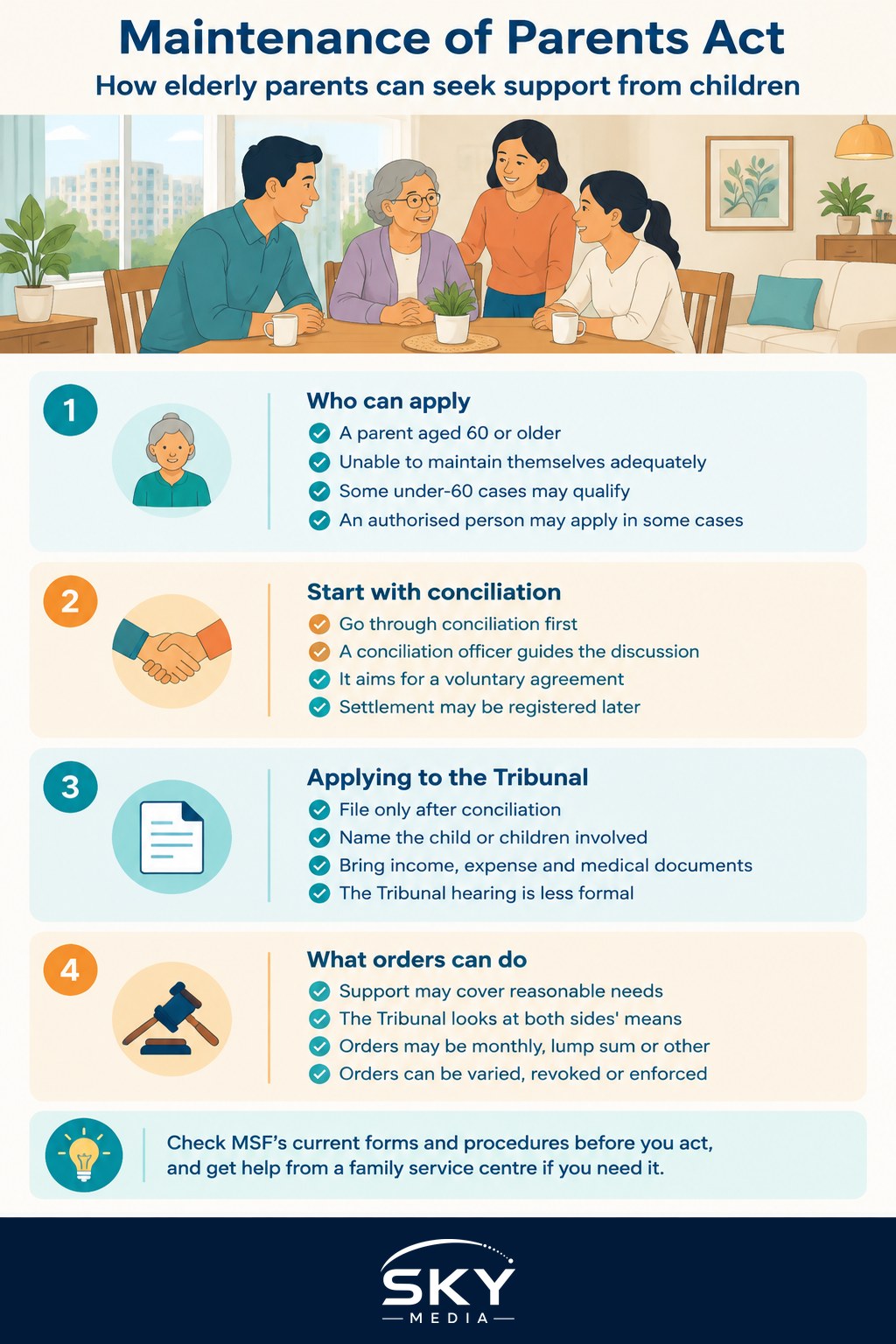
What the Maintenance of Parents Act Does
The Act was introduced in the 1990s, at a time when Singapore was preparing for an ageing population. Its core idea is simple: children who have the means have a responsibility to help maintain parents who cannot adequately maintain themselves.
In general terms, the law allows:
- A parent who is 60 or older and unable to maintain themselves adequately to seek maintenance from one or more of their children.
- A parent below 60 to apply in some situations, for example where physical or mental infirmity, disability or another special reason means they cannot support themselves. Whether this applies depends on the circumstances, so check with the official office.
- Someone acting on the parent’s behalf in certain cases, for instance when the parent lacks the capacity to apply personally. The exact rules on who can apply for a parent are set out by MSF.
“Maintenance” here means support for reasonable needs such as food, housing costs, medical expenses and daily living. It is not a way for a parent to claim a share of a child’s wealth or to settle family arguments about property.
Step One: Conciliation Before Any Tribunal Hearing
The process is designed to keep families talking. Before a parent can file an application with the Tribunal, they must first go through conciliation with the Commissioner for the Maintenance of Parents.
Conciliation is a guided, structured conversation. A conciliation officer contacts the children, explains the parent’s request and tries to help the family reach an agreement voluntarily. This step exists because:
- Many disputes come from misunderstandings, old grievances or poor communication, not from a refusal to help.
- An agreement reached together is usually easier to live with than an order imposed from outside.
- It is quicker, less formal and less stressful for an elderly parent than a hearing.
If the family reaches an agreement, it can be recorded as a settlement. Depending on the circumstances, the settlement may later be registered with the Tribunal so that it can be enforced if a child stops paying. Ask the conciliation officer how this works for your case.
If conciliation does not lead to an agreement, the Commissioner can issue a certificate allowing the parent to proceed to the Tribunal.
Step Two: Applying to the Tribunal for the Maintenance of Parents
The Tribunal for the Maintenance of Parents is the body that hears claims and makes orders under the Act. Proceedings are less formal than an ordinary court case, and many parents attend without a lawyer, though they may choose to have one.
The broad steps usually look like this:
- Obtain the go-ahead from conciliation. You generally cannot file directly without first going through the Commissioner.
- File the application. The parent names the child or children they are claiming from and sets out their needs and circumstances. Check MSF’s website for the current forms and how to submit them.
- Gather supporting documents. These typically include proof of income (or lack of it), savings, monthly expenses, medical bills and any support already received.
- Attend the hearing. Both the parent and the children have the chance to explain their positions. The Tribunal may ask about each child’s income, commitments and family obligations.
- Receive the decision. The Tribunal may make an order, dismiss the application, or make a different arrangement.
It is common to feel anxious about this step. A family service centre, a social worker or a legal aid service can explain what to expect and help prepare documents.
| Stage | Who is involved | What happens | Possible outcome |
|---|---|---|---|
| Conciliation | Parent, children, Commissioner’s conciliation officer | Guided discussion to reach a voluntary agreement | Settlement agreed, or certificate to proceed |
| Tribunal application | Parent (or authorised person), Tribunal | Application filed with supporting documents | Case set down for hearing |
| Tribunal hearing | Parent, children, Tribunal members | Both sides explain needs and means | Order made, varied or dismissed |
| After the order | Parent, children, Tribunal | Payments made; changes or enforcement if needed | Variation, revocation or enforcement action |
What Children May Be Asked to Pay
There is no fixed formula that applies to everyone. The Tribunal looks at the whole picture, including:
- The parent’s needs, such as housing, food, medical and care costs.
- The parent’s own resources, including income, savings, CPF payouts and support from other family members.
- Each child’s financial capacity, including income, assets and commitments to their own spouse and children.
- How many children there are, since the burden can be shared among siblings rather than falling on one.
Orders can take the form of a regular monthly allowance, a lump sum or other arrangements the Tribunal considers appropriate. Because each case is different, nobody can reliably predict an amount in advance.
When the Tribunal may not order maintenance. The Act recognises that some parents did not fulfil their own duties. If a child can show that the parent abandoned, abused or neglected them, the Tribunal may dismiss the claim or reduce the amount. A child raising this should be prepared to explain and, where possible, support it with evidence.
Changing or Enforcing an Order
Life changes, and orders can change with it.
- Variation: Either side can apply to vary an order if circumstances change significantly, for example if a child loses their job or a parent’s medical costs rise sharply.
- Revocation: An order may be cancelled in suitable circumstances, such as when it is no longer needed.
- Enforcement: If a child does not pay as ordered, the parent can return to the Tribunal to seek enforcement. Check with the office handling your case for the current procedure.
Where to Get Help and How to Start
For many elderly parents, the hardest part is deciding to take the first step. Some practical suggestions:
- Talk to someone you trust first. A family service centre, a social worker at a hospital or a senior activity centre staff member can listen, explain options and sometimes help mediate informally.
- Contact the Commissioner’s office. Details of how to begin are published on MSF’s official website. Have your NRIC and basic financial information ready.
- Seek legal guidance if needed. Legal aid and community legal clinics may help eligible people understand their position.
- Look at other support too. Government schemes, community assistance and healthcare subsidies may cover some needs, whatever happens with a maintenance claim.
For adult children reading this, the law is a last resort, not a first one. Practical, regular support, honest conversations about money and a willingness to share the load among siblings can prevent most disputes. Our guides to caring for an elderly parent in Singapore and what to do when an elderly parent refuses help offer practical ideas for keeping that support going before things reach this stage.
Frequently Asked Questions
Does it cost anything to apply to the Tribunal for the Maintenance of Parents? Fees and charges can change, so check the current position on MSF’s official website or with the Commissioner’s office. If money is tight, a family service centre or legal aid service can explain what support exists and what to expect before you file.
How long does a maintenance of parents claim take? There is no single timeline, because it depends on how quickly the family reaches an agreement in conciliation and whether the case goes on to a hearing. A voluntary settlement is usually faster and less stressful. Ask the conciliation officer what to expect for your situation.
What documents should an adult child prepare for conciliation? It helps to gather proof of your income, monthly commitments and any support you already give your parent. Include payslips, bills and records of what you pay for your spouse and children. Bringing organised papers lets the officer see your real circumstances.
Can a parent claim from a child who lives overseas? The Act is about children who have the means, but enforcing an order against someone abroad can be more complicated in practice. A parent in this situation should ask MSF’s office or a lawyer how the process would work, since details depend on the case and where the child lives.
How can I support my parent without going through the Act? Start with an honest family conversation about needs and how siblings can share the load. Community help, government schemes and healthcare subsidies may cover some costs too. A family service centre or social worker can help mediate informally, long before a claim becomes necessary.
Official sources: Ministry of Social and Family Development (MSF)
Further reading: Caring for Parents in China From Singapore: A Gentle Guide