

A long-distance relationship asks a lot of two people, and it also proves something quietly wonderful about them: that they would rather keep choosing each other across a few thousand kilometres than settle for someone closer. If you are reading this from a flat in Singapore while your person is studying, working or serving somewhere far away, this guide is for you. It is warm, practical and honest about the hard parts, and it assumes you are a thoughtful adult who simply wants sensible ways to keep love steady over distance.
Distance takes many shapes here. One partner is on exchange or doing a postgraduate degree overseas. A job posting lands in another city. A partner is away for National Service or work stints that keep them out of reach for stretches. Some couples meet online or while travelling and start life together already apart. Whatever brought the miles between you, the goal is the same: to stay close in the ways that count until the distance closes or your plans change.
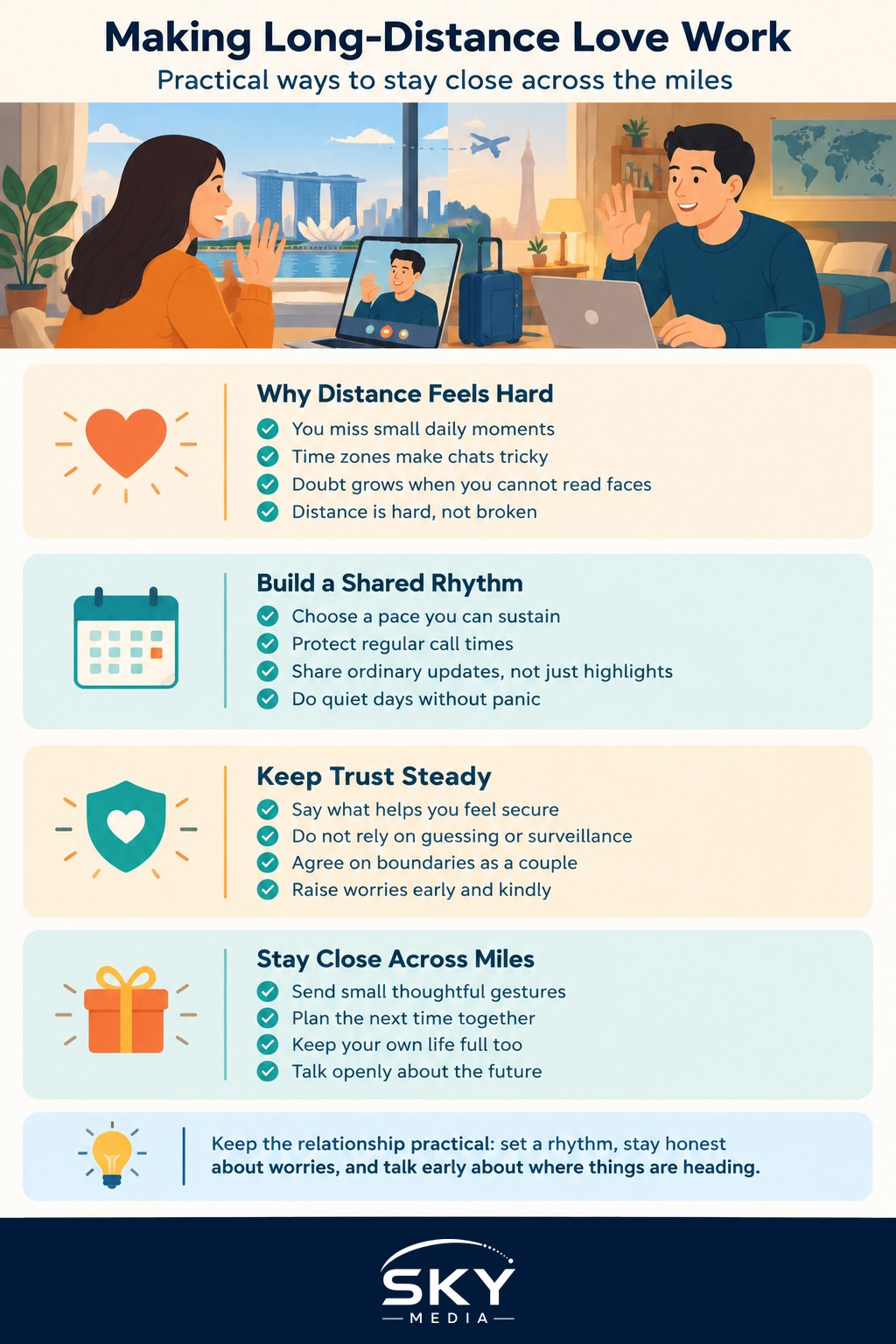
Why Distance Is Hard, and Why It Can Still Work
It helps to name the difficulty plainly. You miss the small things most: a shared plate of supper, a hand to hold on the MRT, someone to grumble to at the end of a long day. Time zones turn simple chats into logistics. Doubt creeps in more easily when you cannot read a face across a table. None of this means your relationship is weaker than one where both people live one bus ride apart.
What distance removes in convenience, it can return in intention. Couples who make it work tend to communicate more deliberately, listen more carefully, and take less for granted. You learn to trust words rather than proximity. Many people find that a season apart, handled with care, actually deepens a partnership rather than draining it. Distance is a hard mode, not a broken one.
That said, it is fair to be clear-eyed. Long distance works best when there is a shared sense of where it is heading, even if the timing is loose. A relationship with no imaginable end to the distance and no agreement on what you are building is much heavier to carry than one with a rough plan.
Building a Rhythm That Fits Both Lives
The couples who thrive over distance rarely rely on constant contact. They rely on a rhythm both people can keep. Trying to be in touch every waking moment sounds romantic but usually burns out fast, especially when one of you is juggling a demanding job or a very different clock.
Aim for a pattern you can both sustain without resentment. That might be a proper video call a few evenings a week, a steady trickle of small messages through the day, and one longer catch-up at the weekend when neither of you is rushing. Protect those anchor moments the way you would protect a real date. Put them in the calendar, show up, and give them your attention rather than half-watching a screen.
- Agree on a loose weekly shape rather than demanding fixed daily calls that pressure you both.
- Share the ordinary, not just the highlights: a photo of your lunch, the queue at the clinic, a song stuck in your head.
- Do things together at a distance, such as watching the same show, cooking the same recipe, or reading the same book.
- Let some days be quiet. Silence because life is busy is not the same as silence because something is wrong.
Mismatched time zones deserve a gentle word. When one of you is starting the day as the other winds down, take turns bending your schedule so the same person is not always sacrificing sleep. Fairness over months matters more than any single late-night call.
Trust, Reassurance and Handling the Doubts
Distance and doubt often travel together. Without daily presence, your imagination fills the gaps, and it does not always fill them kindly. The remedy is not surveillance but honest, generous reassurance. Checking a partner’s location or reading into every slow reply corrodes the very trust that distance needs.
Talk openly about what helps each of you feel secure. Some people need a quick goodnight message; others feel smothered by too many check-ins. Neither is wrong, and the point is to find what steadies you both. Agree on the boundaries that matter to you as a couple, from what counts as being exclusive to how you each want to socialise while apart, and revisit them as life shifts.
The table below contrasts habits that tend to protect a long-distance relationship with ones that slowly wear it down.
| Habits that build trust | Habits that erode it |
|---|---|
| Saying plainly what you need to feel secure | Expecting your partner to simply guess |
| Giving the benefit of the doubt when replies are slow | Reading silence as proof something is wrong |
| Sharing your plans and social life openly | Going vague or secretive to avoid questions |
| Raising a worry early and kindly | Letting it fester into a cold, distant mood |
If jealousy or anxiety starts to run your days rather than pass through them, it is worth looking at gently, perhaps with a trusted friend or a counsellor. That is not a sign the relationship is doomed. It is a sign you are human and that some support might help.
Keeping Closeness Alive Across the Miles
Emotional closeness needs feeding when you cannot rely on being in the same room. Small, thoughtful gestures carry a lot of weight over distance. A voice note left while you walk home, a surprise food delivery to their desk, a letter posted the old-fashioned way, a shared playlist that grows over the months. None of this needs to be expensive. It needs to say I was thinking of you.
Plan the next time you will actually be together, even loosely, because a date on the horizon makes the in-between easier. When you do reunite, go gently. The first day back can feel oddly awkward as you find your rhythm again, and that is completely normal. Let closeness return at its own pace rather than forcing every reunion to be perfect.
It is also healthy to keep your own life full while you are apart. Tend your friendships, keep up the hobby, say yes to the occasional gathering even when you would rather mope. A rich life on your side of the distance makes you a happier partner and keeps you from pinning your whole mood on one person who cannot always be there.
Talking About the Distance Itself
Perhaps the most important conversation is about the distance as a thing you are navigating together, not a fact you both silently endure. Roughly how long might it last? What would need to be true for one of you to move? How do housing plans, a possible BTO, family expectations or careers fit into the picture? You will not have neat answers, and you do not need them all at once, but avoiding the topic entirely tends to breed quiet resentment.
Be honest, too, if the distance is costing more than the relationship is giving. Sometimes the kindest and bravest choice is to change the plan, and sometimes it is to let go with love. Neither outcome erases what you shared. If you are unsure, talk it through with someone you trust, and remember that a good partnership should on balance add to your life rather than leave you constantly depleted.
Most of all, be patient and tender with yourselves. Loving someone across distance is not a failure to be near them. It is a daily act of faith, and countless couples in Singapore and beyond have crossed the miles and come out closer for it.
Explore more
If the road ahead is on your mind, the guide on talking about the future as a couple pairs naturally with this one, and meeting the expectations of both families can help once plans start to firm up. When a stretch apart leaves things feeling strained, navigating a rough patch in your relationship offers a gentle next step.
Related across Sky Media: Long-Distance Relationships in Singapore · Long-Distance Caregiving for Elderly Parents in Singapore
Frequently Asked Questions
How do we cope with different time zones? Share the inconvenience instead of letting one person always give up sleep. Take turns bending your schedule, fix a couple of regular call slots that suit both of you, and use voice notes or messages for the rest. Fairness over several months matters more than any single late call.
What are signs a long-distance relationship is not working? Warning signs include dreading calls, growing secrecy, constant arguments, or no shared idea of how the distance will end. Feeling drained far more often than supported is another clue. Talk honestly about it first, and consider a counsellor if you are unsure what to do.
How can I deal with jealousy when my partner goes out without me? Acknowledge the feeling without acting on it, and tell your partner what would reassure you instead of demanding their location or messages. Agree what exclusivity means for you both. Keeping your own life full also eases the urge to fill the gaps with worry.
What should we do when we finally meet again? Go gently, because the first day or two can feel oddly awkward even when you have missed each other badly. Plan some relaxed time together rather than a perfect itinerary. Give closeness room to return at its own pace, and talk about how the visit felt afterwards.