
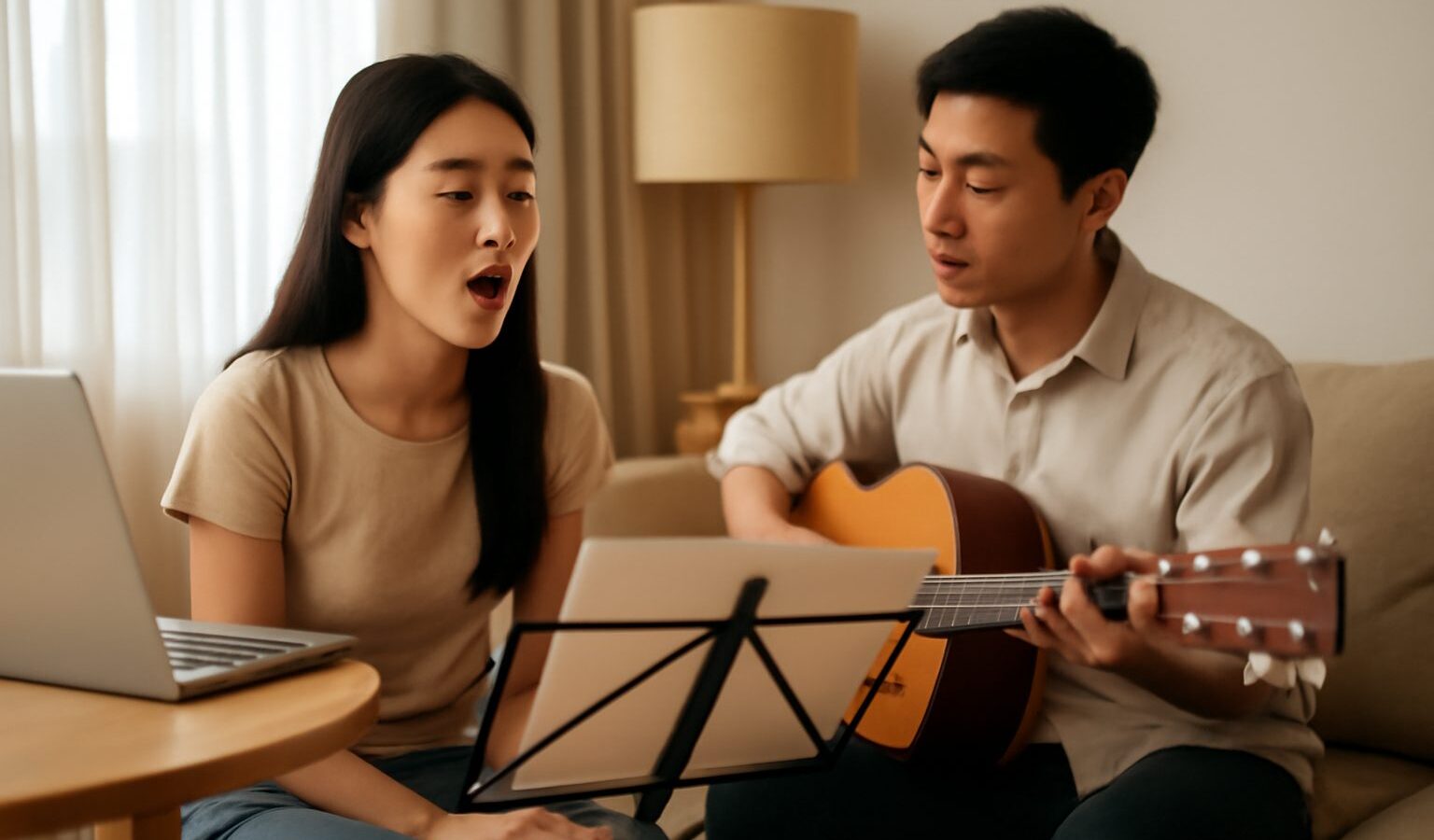
If you have moved to Singapore from mainland China and want to keep singing, or start properly for the first time, you will find a good range of options. Singapore has a large Mandarin-speaking community, an active Mandopop and Chinese choral scene, and many vocal teachers who are comfortable teaching in Mandarin. The challenge is knowing where to look and how lesson arrangements here differ from what you may be used to at home. This guide to Mandarin singing lessons Singapore explains the main lesson formats, how to compare teachers, what repertoire support to ask for, and the practical details to check before you pay.
How Singing Lessons Work in Singapore
In many Chinese cities, adults learn singing through a conservatory-linked teacher, a training centre or a company or community art troupe. In Singapore, the landscape is similar but organised a little differently:
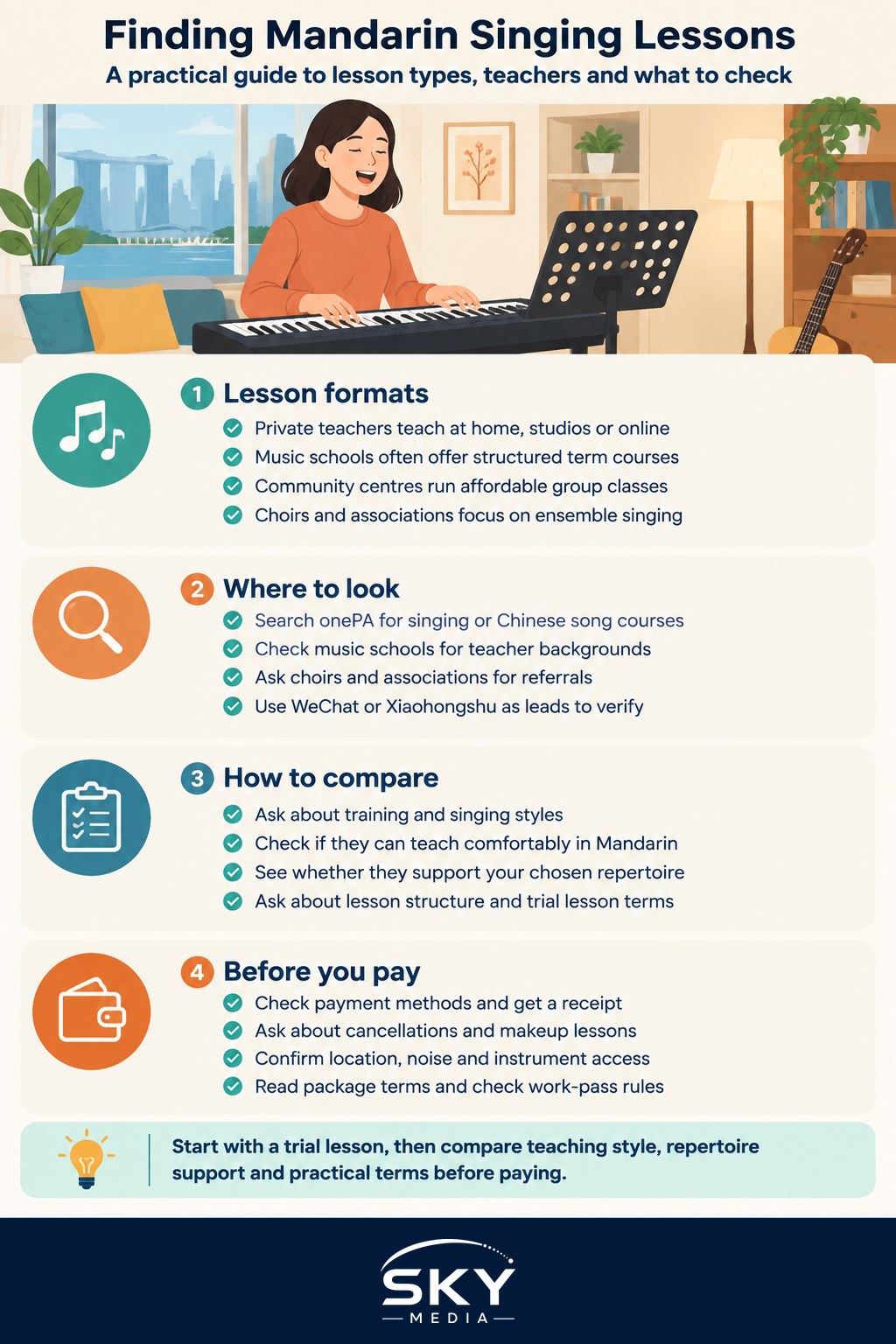
- Private teachers run lessons at home, in rented studios or online. Many are freelancers.
- Music schools and vocal studios are commercial businesses offering structured courses, often by term.
- Community centres under the People’s Association run affordable interest courses, including Chinese song and karaoke classes, booked through the onePA website or app.
- Choirs and clan or cultural associations offer group singing, often in Mandarin, with a conductor who gives vocal guidance.
Lessons are usually paid per lesson, per month or per term in advance. Unlike some places in China where a training centre may sell a large package upfront, many Singapore teachers prefer shorter commitments, but terms vary, so always ask.
Comparing Lesson Formats
| Format | What to expect | Good for | Things to check |
|---|---|---|---|
| Private one-to-one lessons | Personalised technique work and song choice | Fast progress, specific goals such as performing or exams | Teacher’s training, cancellation policy, travel or studio location |
| Music school or vocal studio course | Structured syllabus by term, recitals | Learners who like a clear plan | Term length, makeup lessons, class size |
| Community centre class | Group sessions, relaxed pace, Chinese songs common | Beginners, social learning, lower cost | Course dates, level, teaching language |
| Choir or cultural association | Ensemble singing, regular rehearsals | Meeting people, harmony singing | Audition needs, rehearsal schedule, membership |
| Online lessons | Lessons by video call, sometimes with China-based teachers | Busy schedules, specific teacher preference | Audio delay, time zones, payment method |
If you are completely new to singing, our general guide to singing for beginners covers breathing and warm-up basics that will help in any format.
Where to Find Mandarin-Speaking Vocal Teachers
- Community centre listings. Search onePA for singing, vocal or Chinese song courses. Course descriptions often state the teaching language.
- Music schools. Many list their vocal teachers’ backgrounds online. Ask specifically whether lessons can be conducted in Mandarin.
- Choirs and associations. Chinese choirs and cultural groups often know independent teachers who coach their singers.
- Chinese-language social media groups and newcomer communities. Fellow newcomers frequently share teacher recommendations on WeChat groups and Xiaohongshu. Treat these as leads to check, not guarantees.
- University and arts institution networks. Students and graduates of local music programmes sometimes teach privately.
How to Compare Teachers
When you shortlist a few teachers, ask the same questions so you can compare fairly:
- Training and experience. What vocal training do they have, and in which styles: classical (bel canto), Chinese folk or national style (民族唱法), pop, musical theatre? A teacher strong in bel canto may teach differently from a Mandopop coach.
- Teaching language. Can they explain technique comfortably in Mandarin? Some teachers mix English and Mandarin, which is common in Singapore.
- Repertoire support. Can they help with the songs you love, such as Mandopop ballads, Chinese folk songs or classic Teresa Teng or Jay Chou style songs, and also introduce exercises in English and other languages if you want them?
- Goals. Do they work with hobby singers, competition singers, choir members or people preparing for performances or exams?
- Lesson structure. How long is each lesson, how much is warm-up versus repertoire, and do they give practice recordings?
- Trial lesson. Is there a trial lesson, and what does it cost?
A good teacher listens to you sing first, identifies one or two technical priorities and explains them clearly. If you leave a trial lesson with no idea what to practise, keep looking.
Repertoire and Style: What Mandarin Singers Should Ask For
Singing in Mandarin brings particular challenges that a teacher should address:
- Diction and tones. Sung Mandarin does not follow spoken tones exactly, but clear initials and finals still matter. A teacher should help you keep words understandable while keeping a smooth vocal line.
- Head voice and belting in Mandopop. Many popular Mandarin ballads sit high and need a healthy mix voice. Ask how the teacher approaches high notes without straining.
- Folk and national style. If you trained in China in 民族唱法, look for a teacher who understands that style or who can help you adapt it.
- Karaoke versus performance. If your main goal is to sing well at KTV with colleagues, say so. Lessons can focus on song selection, key changes and microphone technique.
If karaoke is how you mainly enjoy singing, see our guide on karaoke and singing as a hobby, and if you enjoy singing with others, singing in a choir explains how to join one.
Practical Details Before You Pay
- Payment. Many teachers accept PayNow (Singapore’s instant bank transfer by phone number or UEN), bank transfer or cash. Some schools accept cards. Get a receipt or written record for any prepayment.
- Cancellation and makeup lessons. Ask how much notice you need to give to reschedule, and whether missed lessons can be made up.
- Location and noise. Home studios in HDB flats and condos are common. Check travel time and whether the space has a piano or keyboard.
- Contracts and packages. Read terms carefully before paying for a large package. For disputes with a commercial business, consumer help is available through the Consumers Association of Singapore (CASE).
- Your pass conditions. If you plan to teach or perform singing for income yourself, that is a separate matter. Whether you can work depends on your pass type and MOM (Ministry of Manpower) rules, so check with MOM before taking paid work.
Building a Routine That Lasts
Most adult learners progress best with a weekly lesson and short daily practice of 15 to 20 minutes. Record yourself on your phone each week and compare over a month. Join a community performance, choir concert or informal open mic when you feel ready, because performing for others builds confidence quickly.
Finding the right Mandarin singing teacher in Singapore can take a few trial lessons, but it is worth it. Once you find a teacher who understands both your language and your musical taste, singing becomes a rewarding way to feel at home here.
Frequently Asked Questions
Can I teach or perform singing for money on my pass? That is a separate matter and depends on your pass type. Whether you can do paid work, even part-time or as a freelance teacher, is set by MOM, so check its rules before taking any paid work instead of assuming it is allowed.
How much practice do adult singing learners need each day? Most adults progress best with a weekly lesson and short daily practice of around fifteen to twenty minutes. Recording yourself weekly on your phone and comparing over a month shows your progress.
Is it fine to take lessons online from a teacher in China? It can be, if you are comfortable with audio delay, time zones and the payment method. Online lessons suit busy schedules or a specific teacher preference, but ask for a trial lesson first.
Does my China-trained national-style technique work in Singapore? Yes, but you should look for a teacher who understands that style or can help you adapt it. Tell any teacher your background and goals so they can plan lessons around them.
What if I only want to sing better at KTV with colleagues? Say so up front. Lessons can focus on song choice, key changes and microphone technique rather than formal technique. A community centre class or a choir are relaxed, lower-cost ways to practise.