

Welcoming a child is life-changing, and parental leave gives families precious time to adjust and bond. Singapore provides various forms of leave for new parents, but the details and eligibility can be confusing. This guide explains the main types of parental leave and where to confirm the specifics.
This is a general overview, not official guidance. Entitlements, durations and eligibility are set by the authorities and change, so always confirm current details with the Ministry of Manpower (MOM) and the relevant government schemes.
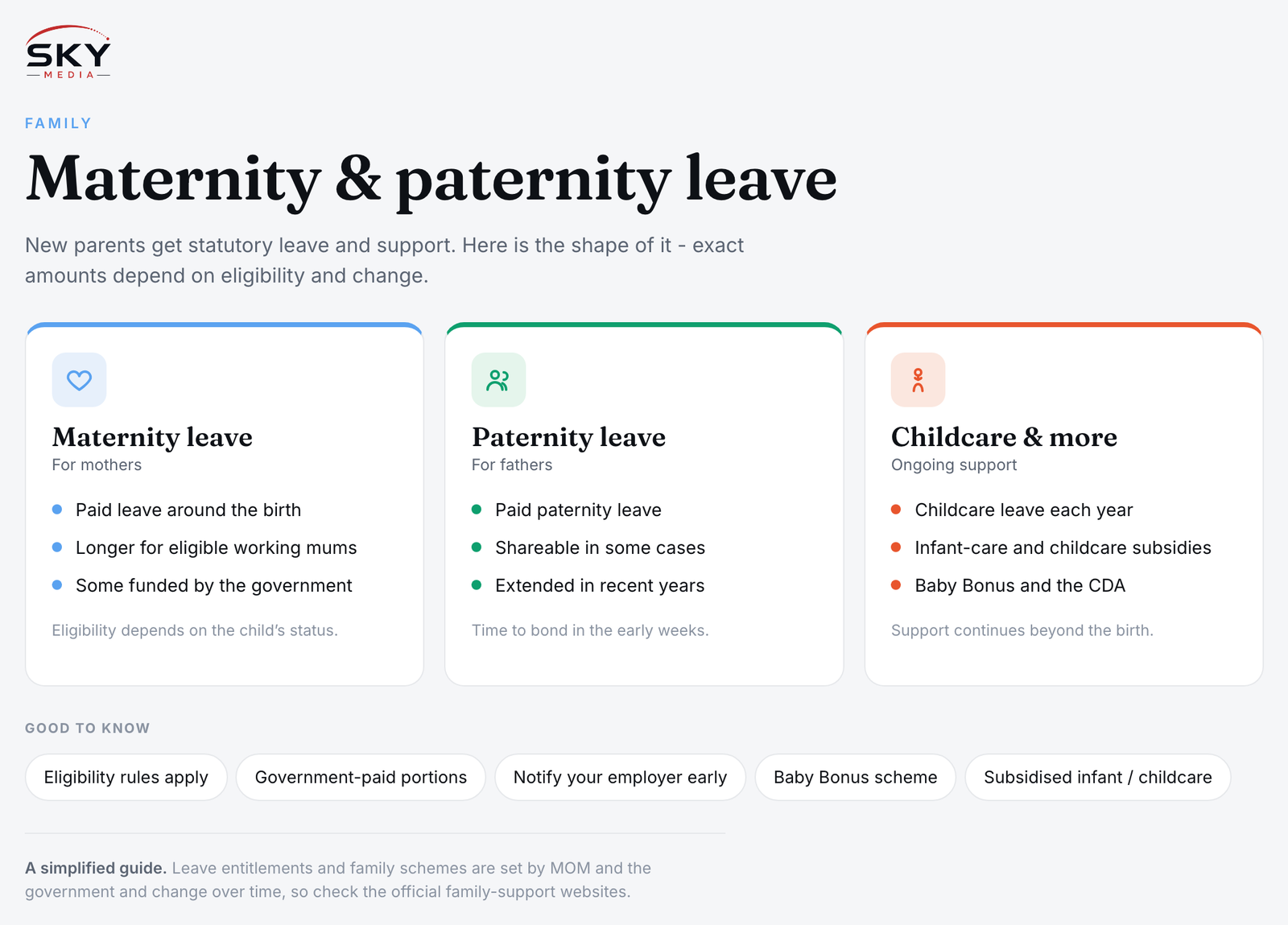
The main types of parental leave
Singapore offers several forms of leave to support new and working parents, each with its own purpose and eligibility.
- Maternity leave, giving mothers time to recover and care for a newborn.
- Paternity leave, giving fathers time to support the family and bond with the child.
- Shared parental leave, allowing some sharing of leave between parents.
- Childcare leave, for parents to care for young children.
- Infant care leave, additional leave for parents of very young children.
- Adoption leave, for parents adopting a child.
Together these schemes aim to support families through the early stages of a child’s life, and understanding what is available helps parents plan.
Maternity and paternity leave
Maternity leave provides mothers with a period of leave around childbirth, much of it government-paid for eligible cases, to recover and care for the newborn. Paternity leave gives fathers a period of leave to support the family and bond with the child, also government-paid for eligible cases, and there has been a trend towards strengthening support for fathers’ involvement. The exact durations and the split between employer-paid and government-paid portions depend on the scheme and eligibility criteria, which is why checking the current entitlements with MOM is essential when planning.
Eligibility basics
| Factor | Why it matters |
|---|---|
| Child’s citizenship | Many schemes tie entitlement to the child’s status |
| Parents’ status | Eligibility can depend on the parents’ situation |
| Employment | Working parents and qualifying periods matter |
| Marriage | Some entitlements have related conditions |
Eligibility for the various leave schemes depends on factors such as the child’s citizenship, the parents’ circumstances, and employment. The government-paid portions in particular have specific eligibility criteria. Because these conditions are detailed and can change, parents should check their specific eligibility for each type of leave with the official sources rather than assuming, ensuring they claim what they are entitled to.
Childcare and infant care leave
Beyond leave around the birth itself, working parents may be entitled to childcare leave to care for their young children through the year, and infant care leave provides additional days for parents of very young children. These are valuable for handling the ongoing needs of raising young children, from illnesses to appointments and important moments. As with the other schemes, the entitlements and eligibility have specific conditions, so confirming the current details helps parents make the most of the support available for balancing work and family life.
Planning your leave
- Understand your entitlements by checking the current details with MOM and the official schemes.
- Confirm eligibility for each type of leave that may apply to you.
- Communicate with your employer early to plan your leave.
- Coordinate as a couple, considering shared leave and how to divide time.
- Keep documentation in order for any claims.
Planning ahead, understanding what you are entitled to, and coordinating with your employer and partner all help ensure a smooth transition into parenthood with the support these schemes provide.
The takeaway
Singapore provides a range of parental leave schemes, from maternity and paternity leave to shared parental, childcare and infant care leave, designed to support families through the early years of a child’s life. The entitlements, durations and eligibility have specific conditions that depend on factors like the child’s citizenship and the parents’ circumstances, and they do change over time. The key is to understand what is available, confirm your specific eligibility with MOM and the official sources, and plan your leave with your employer and partner. Doing so ensures you make full use of the support on offer, giving your family precious time together when it matters most.
Common mistakes parents make with parental leave
Even well-prepared families slip up when it comes to leave, often because the rules are more detailed than they appear at first glance. Being aware of the usual pitfalls helps you avoid losing entitlements or creating friction with your employer.
- Assuming eligibility instead of confirming it. Many parents take it for granted that they qualify, only to discover a condition they did not meet. Check your specific situation against the criteria set out by MOM before you count on any scheme.
- Telling the employer too late. Leaving notice until the last minute leaves your employer scrambling and can complicate approval. Raise your plans early so cover can be arranged and paperwork sorted in good time.
- Overlooking the government-paid portions. Some of the leave is government-funded for eligible cases, but claims may need to be submitted correctly and on time. Missing a step can mean missing reimbursement, so understand who submits what.
- Forgetting to keep documents. Birth certificates, medical records and employment details are often needed to support claims. Keep them organised from the start rather than hunting for them later.
- Not coordinating with your partner. Where leave can be shared or split, a lack of planning can mean one parent stretched thin while the other returns to work too soon. Map out the weeks together before the baby arrives.
Most of these mistakes come down to acting on assumptions rather than confirmed facts. When in doubt, verify the current position with MOM and the relevant official schemes instead of relying on what a colleague or forum post said.
Self-employed and unusual work situations
The picture is a little different for parents who are not conventional employees. Self-employed people, those between jobs, and parents on non-standard contracts may still be able to benefit from certain government-paid leave schemes, but the way entitlements are calculated and claimed is not the same as for salaried staff.
If you are self-employed, government-paid leave may be provided as a reimbursement based on your income and the qualifying conditions, rather than as paid days off arranged through an employer. This means the responsibility for submitting a correct and timely claim usually falls on you, along with keeping records of your income and the period you were away from work. Parents who change jobs around the time of the birth, or who work part-time or on short-term contracts, should pay particular attention to any qualifying-period requirements, as these can affect what you receive.
Because these arrangements hinge on individual circumstances, it is worth confirming your position directly with MOM and the relevant scheme administrators rather than assuming the standard employee rules apply to you. A short check before the birth can save a great deal of stress, and ensure you claim everything you and your family are entitled to during this important stage.
Explore more: Having a baby in Singapore · Childcare subsidies explained · Baby Bonus and the CDA explained