

Moving to Singapore from mainland China can be exciting, but dating in a new country brings its own questions. Where do people actually meet? Will language be a barrier? Do you need dating apps? The good news is that Mandarin is widely spoken here, and there are many relaxed, everyday settings where Chinese speaking singles Singapore residents and newcomers meet naturally. This guide focuses on Mandarin-friendly social routes, beyond swiping on apps, that help you build real connections.
Understanding the Singapore Context
Before you start, it helps to know a few things about the local scene.
- Mandarin is common, but not universal. Many Chinese Singaporeans speak Mandarin, often mixed with English and sometimes dialects such as Hokkien or Cantonese. Younger locals may be more comfortable in English. Many Malaysian Chinese and Taiwanese residents also speak Mandarin.
- Accents and vocabulary differ. Singapore Mandarin uses some local words and a different rhythm. Do not worry, people generally understand each other well.
- English is the main working language. Even in Mandarin-friendly circles, you will hear a lot of English. A bit of English confidence widens your options.
- Pace can be slower. Many people here prefer getting to know someone through group activities first, rather than formal introductions.
The key idea: shared interests are the easiest bridge. Go where you enjoy spending time, and meeting people becomes much more natural.
Mandarin-Friendly Places to Meet People
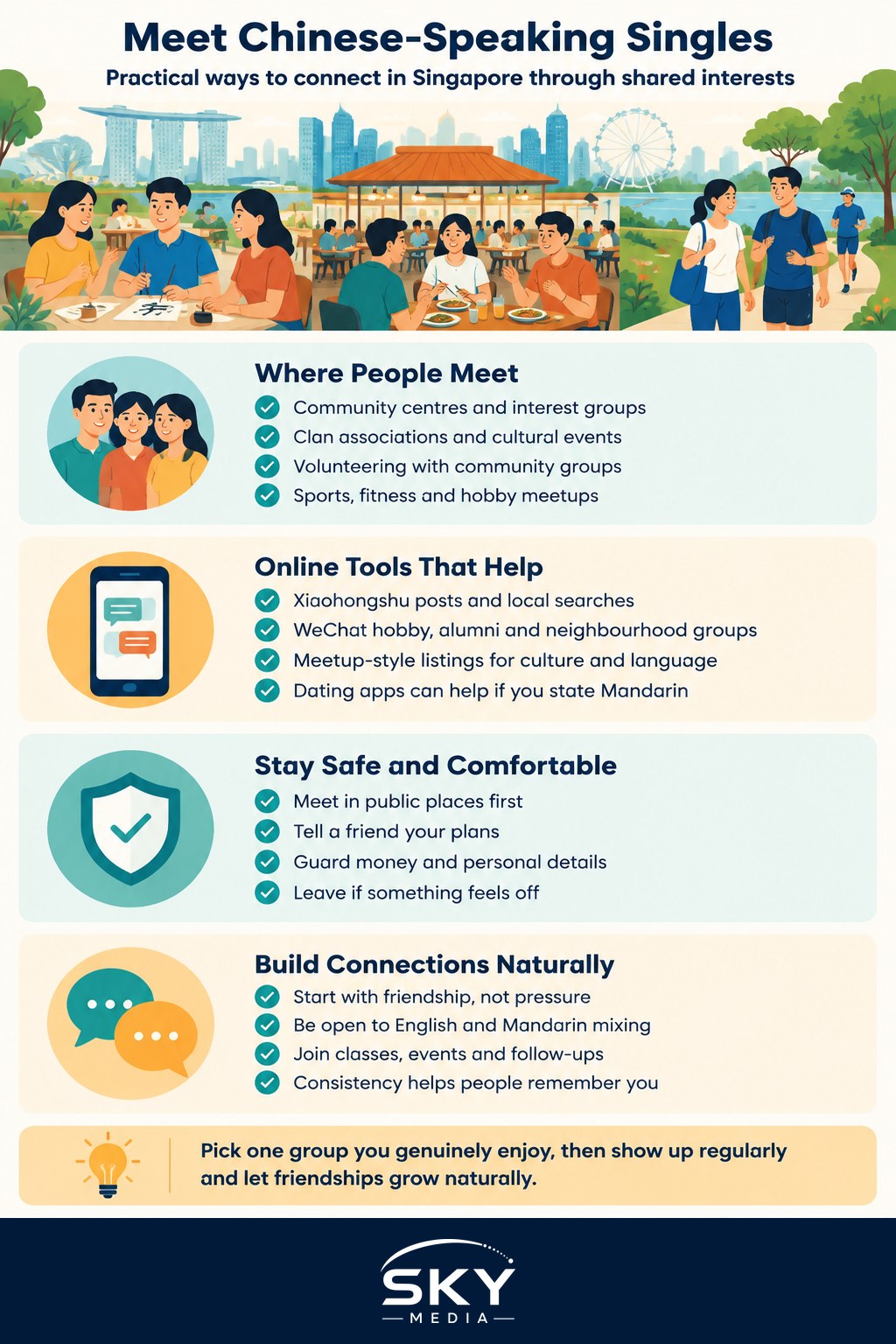
Here are social routes where Mandarin speakers often gather. None of them are “dating events”, which is exactly why they work. You meet people as themselves.
Community centre classes and interest groups. Community centres (CCs) under the People’s Association run courses and interest groups across the island, from calligraphy and Chinese painting to dance, cooking and sports. Many classes are taught in Mandarin or are bilingual.
Chinese clan associations and cultural groups. Singapore has many clan associations (会馆) linked to ancestral regions in China, plus cultural bodies running events, talks and youth activities. Some have youth wings that organise outings and festival events.
Volunteering. Volunteer groups that serve elderly residents often need Mandarin and dialect speakers. Volunteering is a meaningful way to meet kind, community-minded people.
Sports and fitness groups. Badminton, running, hiking, table tennis and dance groups often include many Mandarin speakers. These are often organised through WeChat, Xiaohongshu or community notice boards.
University alumni and professional networks. If you studied in China or work in a particular industry, alumni associations and professional networks in Singapore hold regular gatherings.
Chinese-language arts and culture. Chinese theatre, xiangsheng (crosstalk) shows, book clubs, Chinese film screenings and music events attract Mandarin speakers who share your interests.
Religious and spiritual communities. Some temples, churches and other communities have Mandarin-language services and youth or young adult groups. Join for the community, and connections may follow.
For more ideas on meeting people offline, see How to Meet People Without Dating Apps.
Comparing Your Options
Each route suits different personalities and goals. This table helps you pick a starting point.
| Social route | Good for | How Mandarin-friendly | Tips |
|---|---|---|---|
| Community centre classes | Learning a skill while meeting regulars | Often bilingual or Mandarin-taught | Choose classes with group work, not just lectures |
| Clan associations and cultural groups | Shared heritage and festival events | Usually strong Mandarin use | Look for youth wings or young adult activities |
| Volunteering | Meeting caring, grounded people | Mandarin and dialects often valued | Commit regularly so people get to know you |
| Sports and hiking groups | Active, outgoing people | Varies by group | Join through WeChat or Xiaohongshu group posts |
| Book clubs and arts events | Thoughtful conversations | High for Chinese-language events | Chat during breaks and after the session |
| Dating apps with language filters | Direct dating intent | Depends on profile settings | Mention Mandarin in your profile, stay safe |
Using Online Tools Wisely
Apps are not the focus here, but online tools can help you find offline groups.
- Xiaohongshu (小红书). Many newcomers post about hobby groups, meetups and social events in Singapore. Search with terms like 新加坡 交友 (Singapore make friends) or 新加坡 兴趣小组 (Singapore interest groups).
- WeChat groups. Hobby, neighbourhood and alumni WeChat groups are common. Ask friends and colleagues to invite you.
- Meetup-style event platforms. Some event listings include Mandarin language exchange or Chinese culture gatherings.
- Dating apps. If you use them, state in your profile that you speak Mandarin and what you enjoy doing. It helps like-minded people find you.
Dating Safety and Common Sense
Wherever you meet people, a few safety habits protect you.
- Meet in public places first. Cafes, malls and busy parks are ideal for early dates.
- Tell a friend your plans. Share where you will be and who you are meeting.
- Be careful with money requests. Romance scams are a known problem. Never transfer money, buy gift cards or invest in a “great opportunity” for someone you have not known well for a long time. The Singapore Police Force and ScamShield have official guidance on spotting these scams.
- Protect personal details. Do not share passport, work pass or banking information.
- Trust your feelings. If something feels wrong, it is fine to leave.
Bridging Culture and Language Differences
Even when you share a language, cultural habits can differ between someone from China and someone who grew up in Singapore or Malaysia.
- Communication styles. Singaporeans may mix English and Mandarin in one sentence. It is normal, and you will pick up common phrases.
- Food and dates. Hawker centres and kopitiams (traditional coffee shops) are normal date spots, not just fancy restaurants.
- Family expectations. Expectations about family involvement vary from family to family. Talk openly as the relationship grows. When the time comes, our guide on what to wear to meet the parents can help.
- Festivals. Chinese New Year, Mid-Autumn Festival and other celebrations are lively social times, and a good chance to join community events.
Building Confidence as a Newcomer
Meeting new people in a new country can feel tiring at first. Some practical mindset tips:
- Focus on friendship first. Many couples here start as friends in a shared group.
- Say yes to invitations, even small ones, in your first few months.
- Be consistent. Returning to the same class or group every week builds familiarity.
- Practise a little English, which opens more doors without replacing Mandarin.
- Enjoy single life too. Building your own happy routine makes you more relaxed when you do meet someone. Read How to Be Happily Single in Singapore for ideas.
Your First Month Plan
- Week 1: Sign up for one community centre class or interest group.
- Week 2: Join two hobby WeChat or Xiaohongshu groups in Singapore.
- Week 3: Try a volunteer session or a cultural event.
- Week 4: Follow up with people you enjoyed talking to, perhaps a coffee or hawker meal.
Meeting Chinese-speaking singles in Singapore is less about finding one perfect venue and more about building a social life you enjoy. Choose activities that make you happy, show up regularly, and connections tend to follow.
Frequently Asked Questions
What if I am shy and find it hard to meet new people? Choose small, structured settings where you share an activity, like a class, a volunteer shift or a hobby group, since you have something to talk about. Go regularly rather than once, and set a small goal such as speaking to one new person each time.
Does being a foreigner on a pass affect marriage or relationship plans? Dating itself is straightforward, but if a relationship becomes serious, immigration status is a separate matter. Marrying does not by itself give a right to stay in Singapore. Check the current rules with ICA and MOM before making plans around passes.
Is it fine to date someone who does not speak Mandarin? Of course. Many people in Singapore are comfortable in English, and couples often mix languages. A shared language for daily life matters more than a shared mother tongue. It can be a good chance to practise English, and for them to learn some Mandarin.
What are some good low-cost first date ideas? A hawker centre meal, a walk in a park, a visit to a free exhibition or a coffee at a kopitiam are relaxed, affordable options. Pick a public place, keep it short enough to leave easily, and choose an activity that lets you talk.
How do I tell if someone is serious or just casual? Look at consistency over time: do they show up, keep plans and communicate clearly? Ask honestly about what each of you wants once you are comfortable. If their words and actions do not match, or if they avoid the question, take that as an answer.