
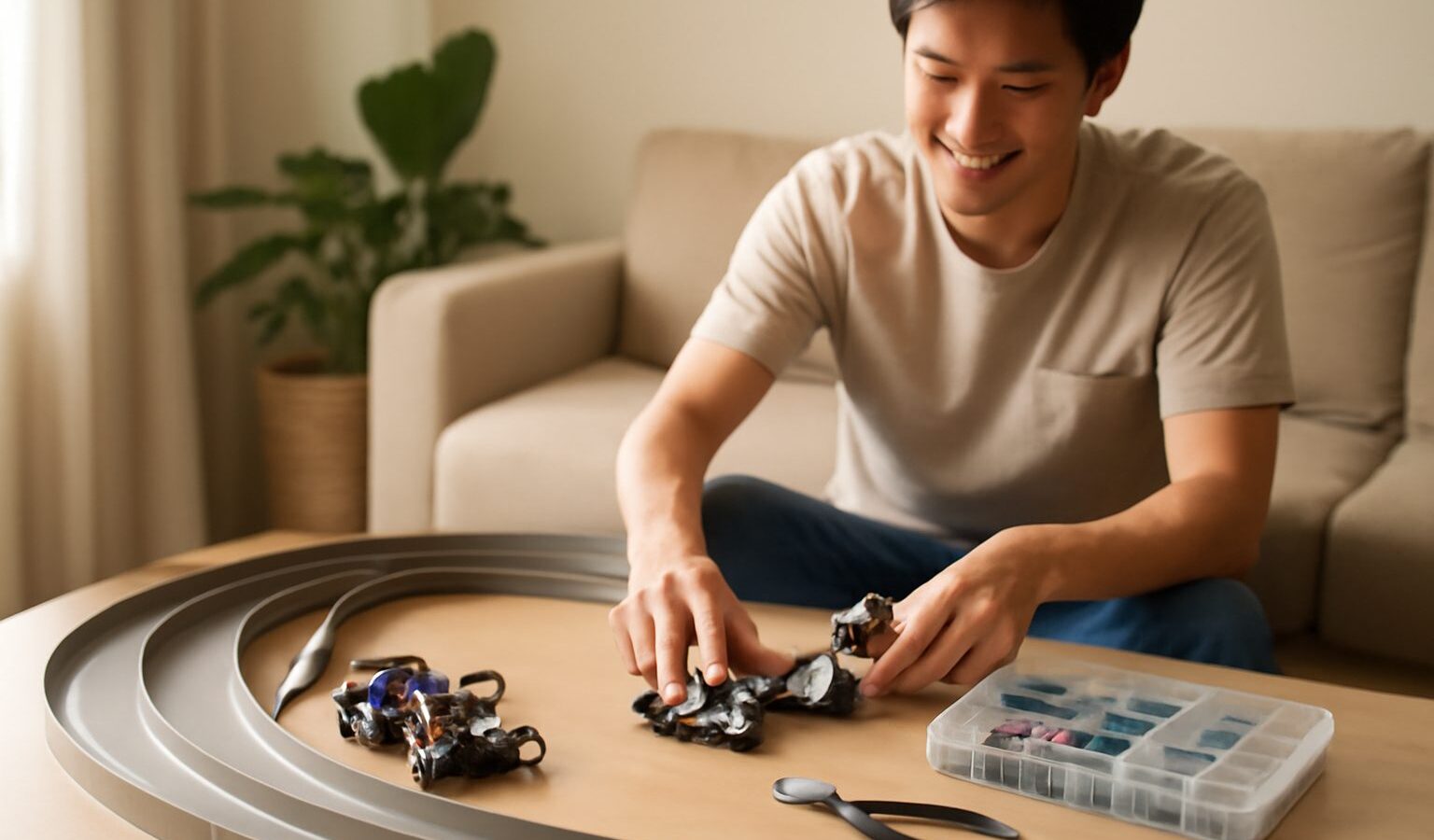
If you grew up in Singapore in the late 1980s or 1990s, there is a good chance you remember the whine of a tiny motor and the clatter of a plastic car slamming into a track wall. Mini 4WD, the small battery-powered racing cars first popularised by Japanese model maker Tamiya, never really went away. The hobby has had several revivals, and today the Mini 4WD Singapore scene draws a mix of nostalgic adults, parents racing alongside their kids, and newcomers who simply enjoy building and tinkering. This guide covers how the hobby works, how to choose a first kit, how to tune sensibly, and how to start racing.
How Mini 4WD Differs From RC Cars
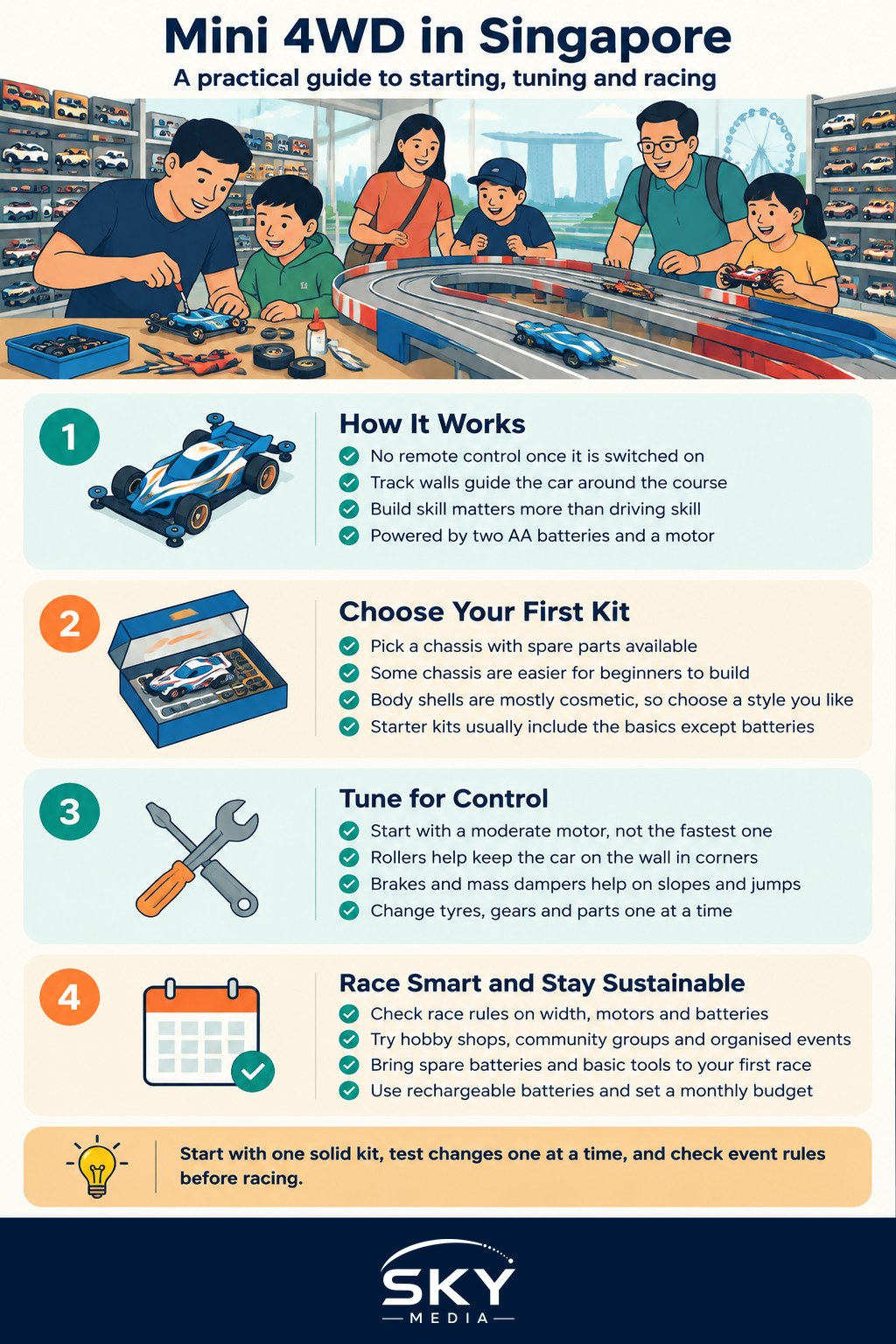
The biggest thing to understand is that a Mini 4WD car has no remote control. Once you switch it on and place it on the track, it runs on its own. The track’s walls guide it, and the car’s job is to stay on and go fast.
That changes everything about the hobby. In RC cars, driving skill matters most. In Mini 4WD, the skill is in the build: choosing parts, balancing speed against stability, and setting the car up for a particular track layout. Race day is about preparation, not reflexes.
Key features of a typical Mini 4WD car:
- powered by two AA batteries and a small electric motor
- four-wheel drive through a central shaft and gears
- plastic chassis with a snap-on body shell
- side rollers that ride along the track walls
- built from a kit, usually without glue
Choosing Your First Kit and Chassis
Kits are sold by chassis type, and the chassis is the most important choice you will make. Each has its own layout, motor position and parts compatibility. Over the years, chassis have included both single-shaft designs (motor at one end) and double-shaft designs (motor in the middle). Common names you will see on boxes include MA, MS, VZ, AR and FM-A, among others, though availability changes as new versions are released and older ones are reissued or discontinued.
When choosing, think about:
- Parts availability. Popular, current chassis are easier to find upgrades and spares for. Ask at a hobby shop which chassis local racers commonly use.
- Ease of building. Some chassis are more forgiving for first-timers.
- Looks. The body shell is mostly cosmetic, so pick a design you like. Classic designs from the original boom are regularly reissued, which is part of the nostalgia appeal.
Starter kits normally include everything needed to build a running car except batteries.
A simple starter shopping list:
- one kit with a chassis you can find spare parts for
- a pack of rechargeable AA batteries and a charger
- a small Phillips screwdriver and side cutters for trimming plastic parts from the runners
Tuning Basics Without Overdoing It
Tuning is where the hobby becomes addictive. It is also where beginners make the most mistakes, usually by adding speed before they add control.
Motors
Motors are the heart of the speed question. Tamiya’s range includes motors tuned for torque, for top speed, or a balance of the two, with names such as Torque-Tuned, Atomic-Tuned, Hyper-Dash and Mach Dash. A faster motor is not always better. On a twisty track, a car with too much speed simply flies off at the first lane change or slope. Start with a moderate motor and work up.
Rollers and stability
Rollers keep the car against the wall in corners. Wider-set, well-placed rollers give better cornering. Many builders add front and rear plates or stays to mount rollers further out.
Brakes and mass dampers
Brakes are small sponge or plastic pads that touch the track on slopes, slowing the car before jumps. Mass dampers are weights that absorb the bounce when a car lands, helping it settle rather than bouncing off. Both are key for modern tracks with jumps and slopes.
Tyres and gears
Tyre diameter and material affect grip and top speed, while gear ratios change the balance of acceleration and top speed. Change one thing at a time so you can tell what actually helped.
Check the rules before you modify
Official and club races have regulations on which parts and modifications are allowed, such as limits on car width, roller count, motor types or battery types. Always read the rules for the race you plan to join, as they can differ between events and change over time.
Understanding Tracks and Layouts
Mini 4WD tracks are made of modular plastic sections with walls. The classic setups are three-lane and five-lane tracks, where cars race side by side in separate lanes. A lane-change section crosses cars over so each one covers the same distance over a lap.
Modern layouts often add features that test your setup:
- Slopes and drops that launch cars into the air
- Banked corners that test roller placement
- Wave sections that unsettle cars with poor suspension or damping
- Lane changers that punish cars that are too fast or unstable
The table below shows how common setup choices behave on different features.
| Track feature | What usually helps | What usually goes wrong | Beginner tip |
|---|---|---|---|
| Lane change | Stable rollers, moderate speed | Car jumps the wall at the crossover | Test at lower motor speed first |
| Slopes and jumps | Brakes and mass dampers | Car flies off or lands badly | Add brakes before adding speed |
| Long straights | Faster motor, low-friction setup | Overheated motor, flat batteries | Charge batteries fully before racing |
| Tight corners | Wide roller spacing | Car slows sharply or flips | Adjust roller height and position |
Where to Race and Find Other Racers
Racing in Singapore tends to happen through a few channels:
- Hobby shops with in-store tracks. Some shops that sell Mini 4WD kits set up tracks for customers to test cars, and some run regular races. Ask at the counter whether they hold practice sessions or events.
- Community groups. Local racers often organise through social media groups and chat channels, sharing race dates, track layouts and parts advice.
- Organised competitions. From time to time there are larger events, including qualifiers linked to international Tamiya competitions. Dates, formats and rules vary, so follow the organiser’s announcements.
When you join your first race, expect a friendly crowd. Experienced racers are often happy to look at your car and suggest fixes. It helps to:
- bring spare batteries and basic tools
- arrive early to test on the actual layout
- read the event rules and check your car meets them before inspection
Costs and Keeping It Sustainable
Mini 4WD can be cheap or surprisingly expensive, depending on how far you go. A starter kit is an affordable entry point, but upgrade parts add up quickly, especially if you chase competitive setups. Prices vary by shop and by part, so compare before buying.
To keep the hobby enjoyable:
- Set a budget per month rather than buying every new part
- Use rechargeable batteries to save money and reduce waste
- Keep spares organised in a parts box so you do not rebuy what you already own
- Build with your kids if you are a parent, as it is a good hands-on project that teaches basic mechanics and patience
Who the Hobby Suits
Mini 4WD suits people who enjoy building, small adjustments and the satisfaction of seeing a well-tuned car stay on a tricky track. It is a social hobby without needing to commit to a big setup at home. If you like the thrill of racing but prefer it on a screen, racing and sports games offer a different route. And if building is the part you love most, Lego as an adult hobby scratches a similar itch.
Whichever way you came to it, the best advice is simple: build one solid car, learn how each part changes its behaviour, and turn up at a local track. The nostalgia gets you in; the tinkering keeps you there.
Frequently Asked Questions
What age is suitable for starting Mini 4WD? Many children can enjoy building and racing once they can handle small parts and a screwdriver, often with a parent helping. Young kids need supervision for tiny pieces and tools. Building a car together is a good way to teach patience and basic mechanics.
Should I use rechargeable or alkaline batteries in a Mini 4WD car? Rechargeable AA batteries are popular because they save money and give steady power, and many racers keep several sets charged. Some events set battery rules, so read the regulations first. Always charge fully before racing, as weak batteries slow the car.
Why does my Mini 4WD keep flying off the track? It is usually going too fast for its setup. Common fixes are a calmer motor, brakes and mass dampers for slopes, and better roller placement for corners. Change one thing at a time so you can see which adjustment actually helped.
Do I need to buy a track to get started? Not at first. You can build and test the car, then try it on a hobby shop’s track or at a community meet-up. Buying a track makes sense later if you want regular practice at home and have space to set it up.
How can a beginner tell if a race is suitable for newcomers? Check the event rules and ask the organiser or community group whether there is a beginner or open class. Friendly local meets are often relaxed, and experienced racers will usually look over your car. Arrive early to test on the actual layout.
Further reading: Getting Into Pinball as a Hobby in Singapore