

You send a thoughtful paragraph. They reply four hours later with “haha ya”. Or the opposite: you are in back-to-back meetings and come out to a string of messages ending with “you ok?”. In the early weeks of dating, mismatched texting styles are one of the most common sources of quiet anxiety, and they are often misread as a lack of interest when they are really just a difference in habits.
This guide focuses on three things that cause the most friction: response times, message tone and unspoken expectations. It also covers how to raise the subject without making it awkward.
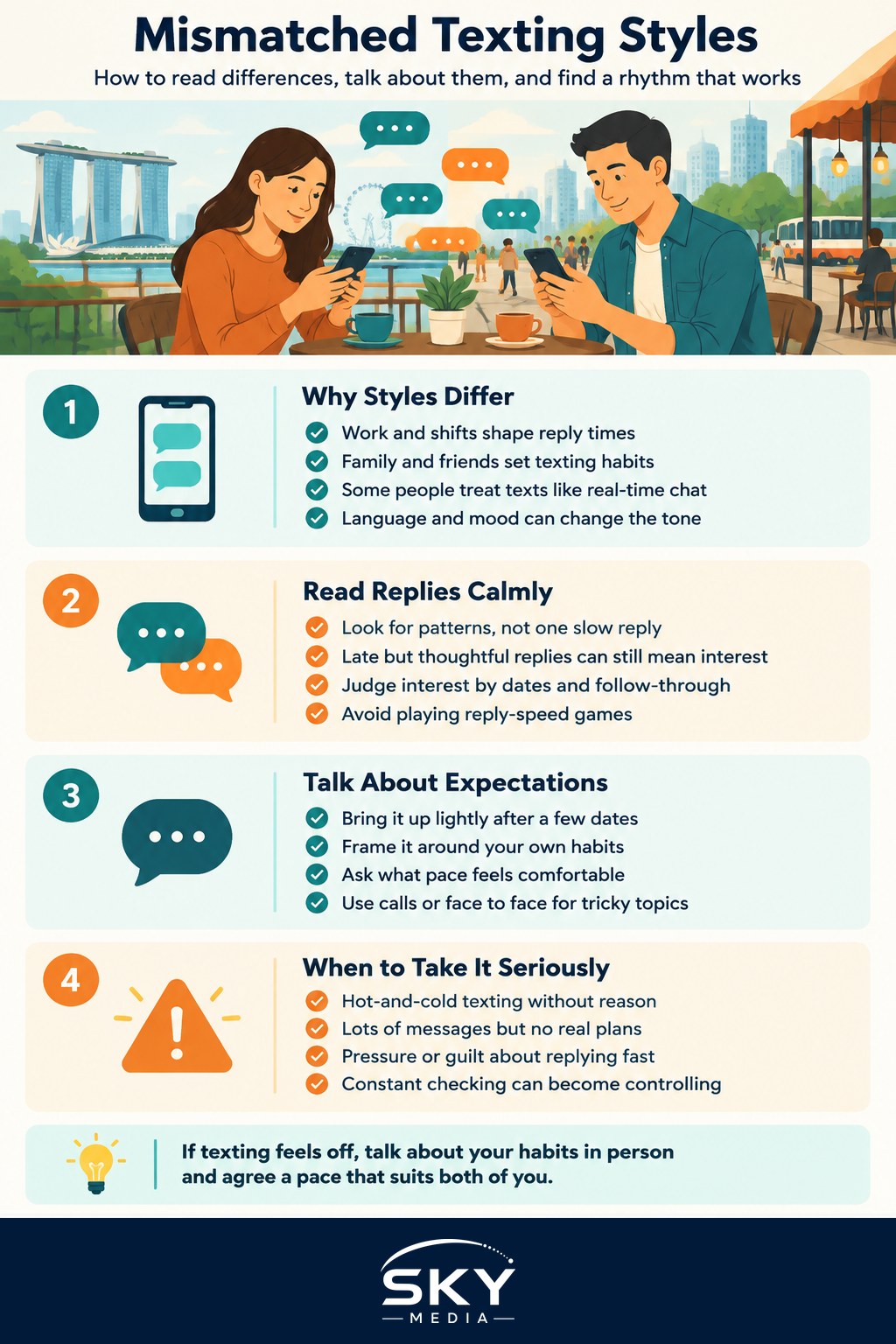
Why Texting Styles Differ So Much
People build their texting habits long before they meet you. Some common influences:
- Work patterns. Someone on shift work, in healthcare, in a classroom or in client-facing roles may simply not be able to check their phone for hours. Others sit at a desk with chat open all day.
- How their friends and family text. If someone’s family group chat runs on voice notes and stickers, that becomes their default. If their friends send one line a day, long messages may feel intense to them.
- Attitude to phones. Some people treat messaging as a real-time conversation. Others see it as a noticeboard to check a few times a day.
- Language habits. In Singapore, many people switch between English, Singlish, Mandarin or another language depending on who they are talking to. Short replies, “lah”-style particles or a single emoji can carry warmth that a newcomer, or someone used to a more formal style, might not read the same way.
- Energy and mood. A very brief reply after a long day often means tired, not uninterested.
None of these styles is wrong. The problem only starts when each person reads the other’s habits through their own rulebook.
Reading Response Times Without Spiralling
Reply speed is where most overthinking happens. It helps to separate what you can observe from the story you are telling yourself.
- Look at patterns, not single messages. One slow reply means very little. A consistent pattern over a couple of weeks tells you more.
- Notice whether they come back to the thread. Someone who replies late but picks up properly where you left off is engaged, just not instant.
- Watch what happens in person. If dates are warm, plans get made and they follow through, a slow texter is still a keen one.
- Avoid mirroring games. Deliberately waiting as long as they did before replying tends to create distance on both sides.
The table below shows common mismatches, how they are often misread, and what may actually be going on.
| What happens | Common misreading | Often the real reason | A better response |
|---|---|---|---|
| Replies take several hours | “They are not that into me” | Busy job, phone kept away at work | Judge interest by plans and follow-through |
| Very short replies to long messages | “I am being brushed off” | They prefer to talk properly in person or on a call | Suggest a quick call or save the long story for a date |
| Lots of messages through the day | “This is too intense” | Messaging is how they show care | Say what pace feels comfortable for you |
| Flat tone, no emojis | “They are annoyed with me” | That is simply how they write | Ask lightly if unsure, rather than assuming |
| Messages only in the evening | “I am an afterthought” | Evenings are their only free time | Agree a rough rhythm that suits both |
Tone: When Words on a Screen Get Lost
Text strips out tone of voice, facial expression and timing. A dry joke can read as criticism. A full stop at the end of “ok.” can feel cold to one person and completely neutral to another.
Some practical habits:
- Assume the kinder reading first. If a message could be playful or annoyed, start with playful until you have reason to think otherwise.
- Keep serious topics off text. Disagreements, sensitive family matters and anything that needs nuance go better on a call or face to face.
- Use voice notes sparingly but wisely. A short voice note can fix a tone problem, but long ones can feel like homework to someone who prefers reading.
- Do not over-edit. Drafting and redrafting a message for twenty minutes usually signals that you need clarity, not better wording.
Talking About Texting Expectations Early
The simplest fix for mismatched texting styles is a light conversation, ideally in person once you have been on a few dates. It does not need to be a big talk. Something like:
- “I’m terrible at replying during work, so if I go quiet in the day, that’s why.”
- “I like a message at night just to say how the day went. Is that your style too?”
- “I’m more of a call person than a texter. Would you be up for a quick call sometimes instead?”
Framing it around your own habits, rather than their faults, keeps it relaxed. Ask about their preferences too, and listen. You are looking for a rhythm that works for both of you, not to win.
If texting has been going on for a while without meeting, the bigger step is usually to get off the phone altogether. Our guide to moving from texting to meeting in person covers how to make that shift naturally.
When a Mismatch Is a Real Signal
Most texting differences are harmless, but some patterns deserve attention:
- Inconsistency that matches nothing else. Warm and chatty one day, silent for a week, with no explanation and no change in circumstances.
- Plans that never firm up. Lots of messages but repeated vague replies when you suggest meeting.
- Pressure to reply instantly. Repeated irritation or guilt-tripping when you take a few hours, especially after you have explained your schedule.
- Checking up rather than checking in. Constant questions about where you are and who you are with can move from caring into controlling.
If any of these show up, talk about it directly. If the response is dismissive or the pattern continues, it is reasonable to step back. Compatibility in communication matters as a relationship grows.
Small Habits That Make Texting Easier on Both Sides
- Give a heads-up when you will be offline. “Long day of meetings, will message tonight” removes a lot of guesswork.
- Close loops. If you cannot reply properly, a quick “Seen this, will reply later” helps.
- Do not let texts replace dates. Messaging should support time together, not substitute for it.
- Respect different home situations. Someone living with family may text less in the evenings or prefer not to take calls at home. If that applies to you, our piece on dating while living with your parents has practical ideas.
- Put the phone down sometimes. Checking for replies every few minutes feeds anxiety. Set it aside and get on with your day.
Finding a Rhythm That Fits
Texting style is a small part of who someone is. A fast texter is not automatically more caring, and a slow one is not automatically less interested. What matters is whether you both feel comfortable, whether you can talk about differences openly, and whether the time you spend together in person feels good.
If you can say “this is how I text, how about you?” and land on a rhythm that works, mismatched texting styles stop being a problem and become just another thing you have learned about each other.
Frequently Asked Questions
How long should I wait before worrying about a slow reply? One slow reply means very little. Look at patterns over a couple of weeks, and at whether they pick up the thread properly when they come back and follow through on plans in person.
Should I copy how long they take to reply? No. Deliberately waiting as long as they did tends to create distance on both sides. Judge interest by plans and follow-through instead of reply speed.
How do I bring up texting expectations without sounding needy? Frame it around your own habits, ideally in person after a few dates. For example, tell them you reply slowly during work, and ask what rhythm suits them too.
Are voice notes better than text for fixing tone problems? A short voice note can fix tone, but long ones can feel like homework to someone who prefers reading. Disagreements and sensitive matters are better on a call or face to face.
What texting patterns are a genuine red flag? Be alert to hot-and-cold behaviour with no explanation, plans that never firm up, irritation or guilt-tripping when you take a few hours to reply, and constant checking up on where you are. If they brush it off, it is reasonable to step back.
Further reading: Dating a Gamer: Making It Work When One of You Plays a Lot · How to Handle Unequal Desire for Public Displays of Affection