
If your child is starting at a Ministry of Education school, one early surprise is that not every family pays the same. The moe school fees pr foreigner singapore structure charges Singapore citizens, permanent residents and international students on separate tiers, and those rates are reviewed regularly. This guide explains how the system is organised so you can plan, without quoting figures that date quickly. School fees are set by MOE and revised most years, so always confirm the current amounts on official MOE channels before you budget.
How MOE Sets School Fees by Residency Status
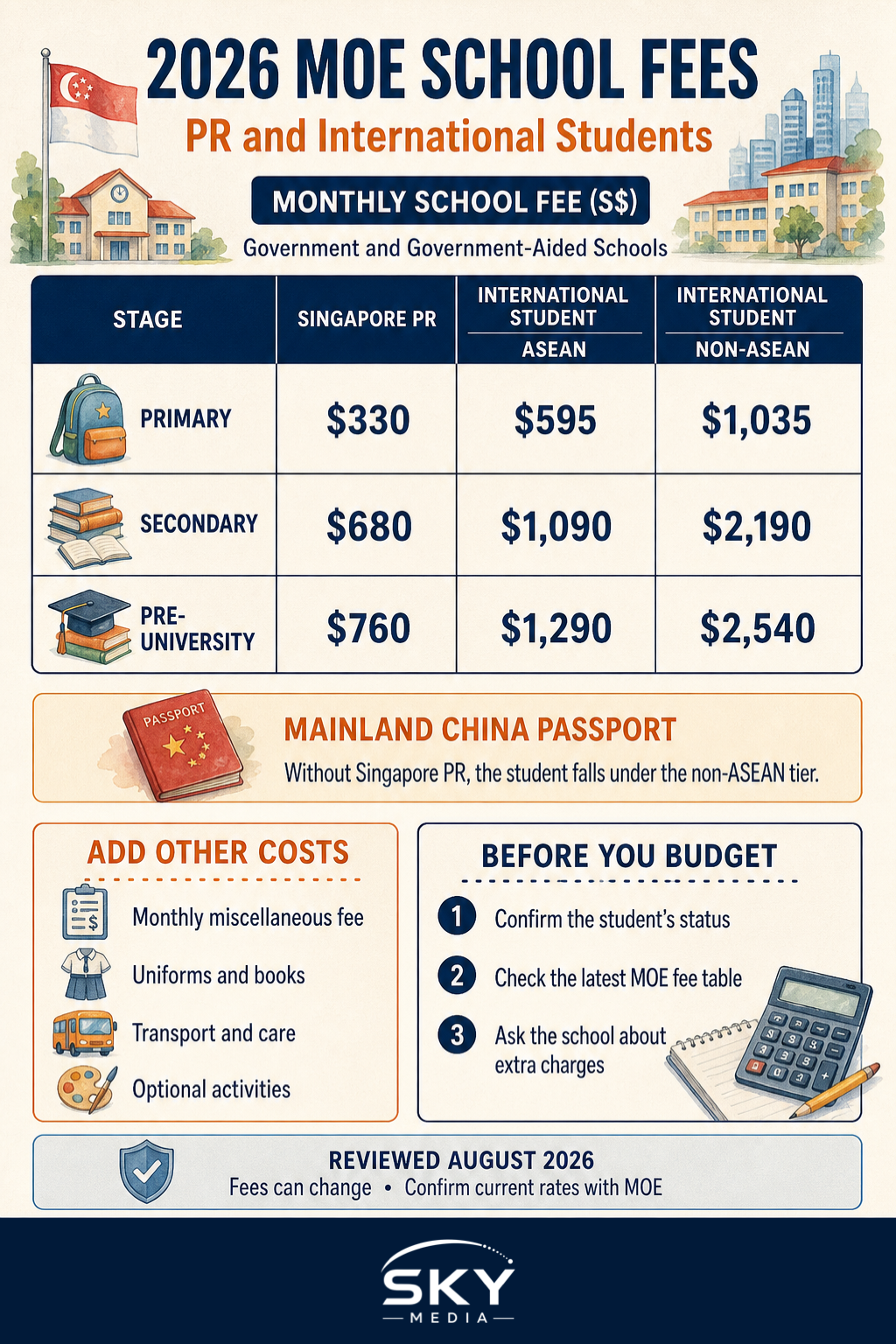
Government and government-aided schools in Singapore charge fees according to a student’s residency status, not their family income. The Ministry of Education publishes fee tables that separate students into broad groups, and each group pays a different monthly rate for the same place in the same school. The principle is that Singapore citizens are supported most heavily by public funding, with permanent residents paying more, and international students more again.
Two features of the system matter for newcomer families:
- The tiers apply across primary, secondary and pre-university levels, though the actual amounts differ at each stage.
- Fees have been phased upward over several years for PR and international students, with increases usually announced ahead of time so families can prepare.
Because the amounts move, treat any figure you hear from another parent or an older web page as out of date until you have checked the current MOE table yourself.
The Fee Tiers: Citizen, PR and Foreign Students
The clearest way to understand the structure is to see the ladder of tiers, from the most subsidised to the least. Singapore citizens sit at the bottom of the ladder, permanent residents on the next rung, and international students above that. International students are themselves usually split into two bands, one for citizens of ASEAN member states and a higher one for all other nationalities.
For a mainland-Chinese family, this last point is worth noting: a child holding a Chinese passport without Singapore PR falls into the non-ASEAN international student band, which carries the highest school fees. If the same child later obtains permanent residence, the family moves down to the PR tier. This is one of several everyday ways in which securing PR changes a household’s costs, alongside healthcare and other subsidies.
It also means the fee your family pays is tied to a status that can change mid-year. If your child’s residency updates partway through their schooling, the applicable tier usually changes from the point the new status takes effect, so keep the school informed and ask when a revised rate begins. Coming from the mainland, where public schooling is organised around the hukou and the local catchment, this residency-based ladder can feel unfamiliar at first, but the logic is consistent once you know your tier: your fee follows your status, and it is reviewed on a national timetable rather than negotiated school by school.
Comparing the Fee Tiers at a Glance
The table below shows the relative position of each group. It deliberately gives no dollar amounts, because those are set by MOE and change; use it to see where your family sits, then look up the current figures.
| Student category | Relative fee level | Notes |
|---|---|---|
| Singapore Citizen | Lowest, most subsidised | Pays only the standard miscellaneous fee at many levels |
| Singapore PR | Higher than citizen | Monthly school fee plus miscellaneous fee |
| International student (ASEAN) | Higher than PR | Concessionary international rate for ASEAN nationals |
| International student (non-ASEAN) | Highest | Standard international rate; where most China-passport pupils sit |
Reading down the table, each step away from citizenship raises the monthly fee, which is why families often factor school costs into decisions about applying for permanent residence.
What the Fees Cover and the Miscellaneous Fee
Beyond the headline monthly school fee, every pupil also pays a miscellaneous fee, sometimes called the standard miscellaneous fee, which helps cover items such as some enrichment activities, supplementary materials and the running of school programmes. This charge exists for citizens too, and it is separate from the residency-based school fee, so a PR or foreign family effectively pays both the higher school fee and this additional amount.
A few other costs sit outside the official fee tables entirely and are easy to overlook when budgeting:
- School uniforms, textbooks and workbooks, bought at or before the start of the year.
- Optional activities and school trips, which vary by school and level.
- Before or after-school care and school bus transport, arranged privately in many cases.
- The National Examinations fees, which apply at the relevant graduating years.
None of these are set by a single figure that stays put, so the safest approach is to ask the specific school for its current charges once your child has a place.
Financial Assistance and What PR Families Should Know
Singapore runs financial help for school costs, but eligibility is tied closely to citizenship. The MOE Financial Assistance Scheme and the Edusave account, for instance, are directed at Singapore citizens who meet the criteria, so permanent resident and international families should not assume they qualify. Some schools and community bodies run their own bursaries, and it is worth asking the school directly what support, if any, is open to non-citizen pupils.
For permanent resident families in particular, remember that PR and citizen treatment differ across many public schemes, not just school fees, and the rules are reviewed over time. Rather than rely on what applied a few years ago, confirm your child’s tier, the current monthly fee, the miscellaneous fee and any assistance directly with MOE and with the school. That way you budget from today’s figures, not yesterday’s, and avoid an unwelcome surprise when the first bill arrives.
Explore More
Getting to grips with school costs is part of settling your family in Singapore. If you are weighing the benefits of permanent residence, our guide to SkillsFuture and training subsidy eligibility for PRs shows another area where status matters. To keep mainland finances running while you pay local fees, see keeping China bank apps and OTP working from Singapore, and to guard against fraud aimed at newcomers, read avoiding fake China police and officials scams.
Related across Sky Media: The Student’s Guardian Pass for Mothers of Foreign Students