

A surgery quote in Singapore can feel impossible to judge. Is the surgeon’s fee normal? Is the anaesthetist charging too much? Will the hospital bill end up twice what you were told? MOH fee benchmarks are one of the best tools for answering those questions before you agree to an operation, yet many patients never look at them.
This guide explains what the Ministry of Health (MOH) publishes, how to find the right numbers for your procedure, and how to use them to have a calm, informed conversation with your doctor and insurer. It is general information, not medical or financial advice. Your doctor decides what treatment you need, and your insurer decides what it will pay.
What MOH Fee Benchmarks Are
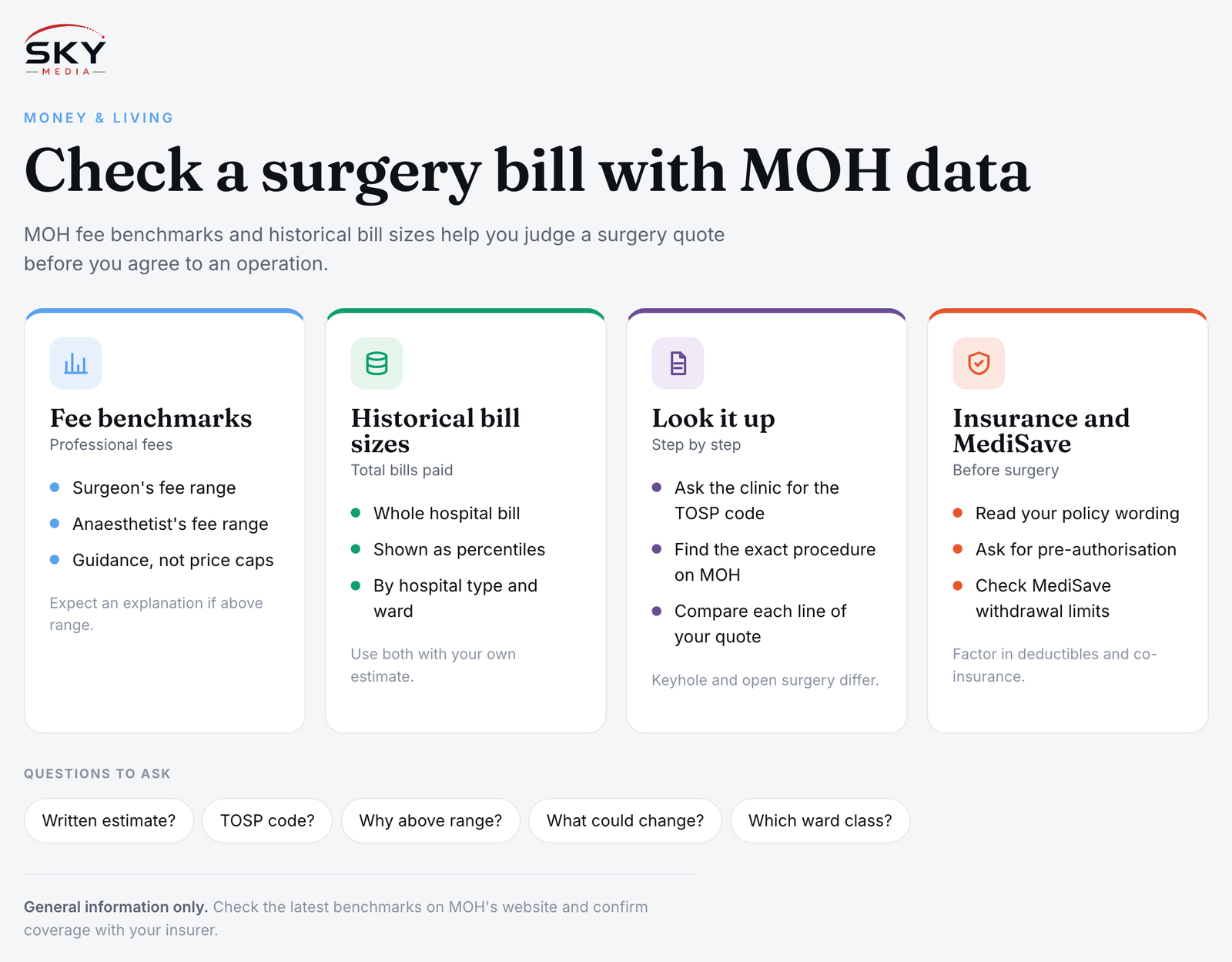
MOH publishes fee benchmarks for many common surgical procedures. A fee benchmark is a reference range for professional fees, meaning the fees charged by doctors rather than the hospital. Benchmarks typically cover:
- Surgeon’s fee for performing the procedure.
- Anaesthetist’s fee, where anaesthesia is needed.
- Consultation and related professional fees, depending on the benchmark set.
The ranges are developed with input from the medical community and are meant to reflect what is reasonable for most patients in the private sector. They are guidance, not price caps. A doctor can charge outside the range when a case is genuinely more complex, but you should expect a clear explanation if they do.
Benchmarks are reviewed and updated from time to time, so always check the latest version on MOH’s website rather than relying on numbers a friend saw years ago.
Benchmarks Versus Historical Bill Sizes
MOH publishes a second, separate set of data that is just as useful: historical bill sizes. These are the total bills that patients actually paid for common procedures and conditions at public and private hospitals, usually shown as percentile figures.
The difference matters, because a fee benchmark only covers part of what you pay.
| Data source | What it covers | What it does not cover | Best used for |
|---|---|---|---|
| MOH fee benchmarks | Professional fees such as surgeon and anaesthetist charges | Ward, operating theatre, implants, drugs, lab tests | Judging whether a doctor’s quoted fee is reasonable |
| Historical bill sizes | Total hospital bill for a procedure or condition | Your individual complications or extra procedures | Estimating the realistic total cost |
| Your doctor’s or hospital’s estimate | Your specific planned treatment | Unplanned changes during or after surgery | Your personal budget and insurance pre-authorisation |
Use all three together. If your doctor’s quoted fee sits comfortably in the benchmark range, and the hospital’s total estimate is in line with historical bill sizes for that hospital type, you can be reasonably confident the quote is not out of line.
How to Look Up the Right Benchmark for Your Procedure
The hardest part is matching your operation to the right line in MOH’s tables. Here is a practical way to do it.
- Ask for the procedure code. Surgical procedures in Singapore are classified using the Table of Surgical Procedures, usually called TOSP. Ask your surgeon’s clinic for the TOSP code and full name of the planned procedure. Clinics deal with this all the time for insurance and MediSave claims.
- Go to MOH’s website. Search for the fee benchmarks section and the historical bill sizes section. Both are published on official MOH pages.
- Find your procedure. Search by procedure name or code. Similar operations can have quite different ranges, for example keyhole versus open surgery, so make sure you match the exact one.
- Note the range. Write down the benchmark range for the surgeon’s and anaesthetist’s fees, and the historical bill size percentiles for your hospital type and ward class.
- Compare with your quote. Line up each component of your quote against the matching figure.
If you cannot find your procedure, it may not be benchmarked yet. In that case, rely on detailed written estimates and ask whether the doctor can explain how their fee was set.
Reading Your Quote Line by Line
A good written estimate should break down costs rather than give one lump sum. Expect to see separate lines for:
- Surgeon’s professional fee.
- Anaesthetist’s professional fee.
- Facility charges such as operating theatre and ward or day surgery charges.
- Implants and consumables, which can be significant for orthopaedic or cardiac procedures.
- Medicines, investigations and lab tests.
- Follow-up consultations.
When you check each line, ask:
- Is the professional fee within the benchmark? If it is above, ask why. Legitimate reasons can include unusual complexity or combined procedures.
- Are there two separate procedures? Some operations involve more than one TOSP code. Each may have its own fee.
- What could change the bill? Ask what happens if the surgeon finds something unexpected, or if you need to stay longer.
- Which ward class is assumed? A higher ward class usually means a higher bill.
For procedure-specific context, our guides on cataract surgery costs and knee and hip replacement surgery for seniors show how these factors play out in practice.
Checking Your Insurance and MediSave Before Surgery
Knowing the reasonable cost is only half the work. The next step is working out how much you will pay yourself.
- MediShield Life and Integrated Shield Plans. Read your policy wording on how claims are assessed. Some insurers and plans reference fee benchmarks or use panel doctors, and claims can be affected if fees exceed what the policy considers reasonable. Your insurer is the only one who can confirm this.
- Pre-authorisation. Many insurers offer a pre-authorisation process for planned surgery. Submitting your doctor’s estimate in advance gives you clarity on what will be covered.
- MediSave. MediSave can be used for many approved surgical procedures, subject to withdrawal limits. Check the current limits on the CPF Board or MOH websites, and ask the hospital’s billing team to estimate how much MediSave can be applied.
- Deductibles and co-insurance. These are the portions you pay before and alongside insurance. Factor them into your budget.
If you have employer coverage, check with HR as well, since corporate plans have their own rules.
Talking to Your Doctor About Fees Without Awkwardness
Many patients feel uncomfortable asking a surgeon about money. You should not. Doctors in Singapore are expected to provide clear information about fees, and asking for a written estimate is entirely normal.
Some phrases that work well:
- “Could you give me a written estimate with the TOSP code so I can check with my insurer?”
- “I saw MOH’s benchmark range for this procedure. Could you help me understand how your fee compares?”
- “What are the most likely reasons the final bill might be higher than this estimate?”
If a quote still seems out of line after a reasonable explanation, it is acceptable to seek a second opinion, including from a public hospital where subsidised care may be available for eligible patients through the referral route.
After the Surgery: Checking the Final Bill
When the final bill arrives, compare it with your original estimate. Differences are not automatically wrong, since surgery does not always go exactly to plan, but each one should be explainable.
Ask the hospital’s billing office for an itemised bill if you did not receive one. Query any charge you do not understand. If you believe there is a billing error, raise it with the hospital first. For concerns about professional fees, you can discuss them with the doctor’s clinic, and serious concerns about conduct can be directed to the appropriate professional body.
Planning your recovery matters too. Our guide on recovering well after surgery as a senior covers the practical side once you are home.
Official sources: Ministry of Health (MOH)
Further reading: Planning for a Major Medical Bill