
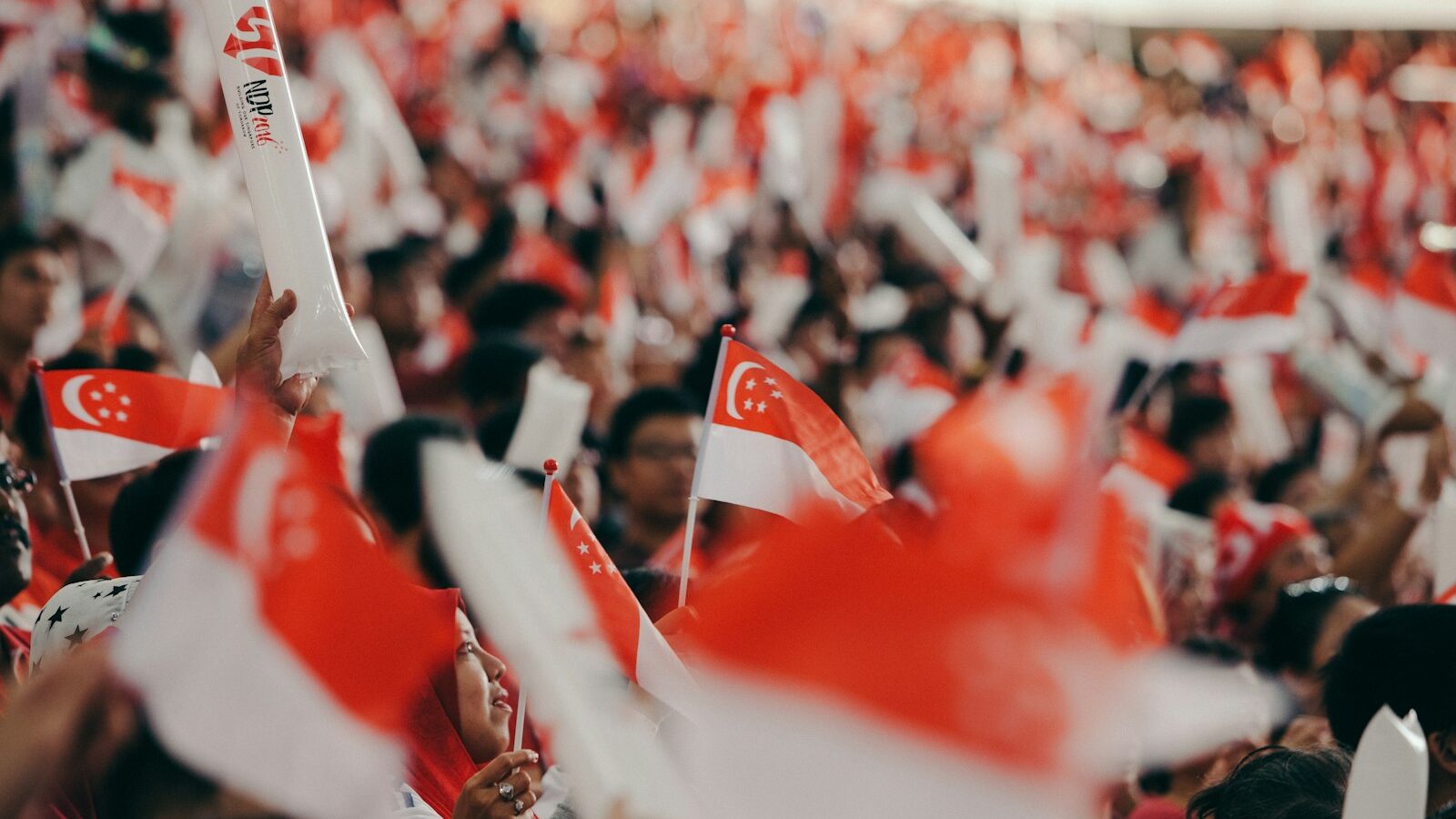
Every August, the same handful of tunes start playing in malls, on the radio, in schools and at community events across Singapore. These are the national day songs, and for many Singaporeans they are as much a part of the season as flags on HDB blocks and fireworks over Marina Bay. If you have moved here from China, learning a few of them is one of the easiest ways to feel included, especially when colleagues, neighbours or your children’s classmates start singing along.
This guide goes beyond the National Anthem and the Pledge. It introduces the classic songs from the National Day Parade (NDP), what they are about, and how they compare with the patriotic songs you may know from home. If this is your first August here, our guide to your first National Day as a newcomer covers the wider celebrations.
Why National Day Songs Matter So Much in Singapore
In China, patriotic songs often celebrate national history, struggle and achievement on a grand scale. Singapore’s National Day songs feel different. Most are about home, belonging and togetherness across different races and religions, rather than about battles or heroes.
There are a few reasons for this:
- Singapore is young. The country became independent in 1965, so its national identity has been built consciously over a few decades, and songs were one of the tools used to build it.
- It is multiracial. Chinese, Malay, Indian and other communities share one small island. Songs written in English, the common working language, help everyone sing together.
- Schools teach them. Children learn many of these songs in primary school, so they carry strong memories for adults who grew up here.
That last point is useful for newcomer parents. Your child will likely come home humming these tunes in July and August. Learning them too gives you something to share.
The Classic Songs and What They Mean
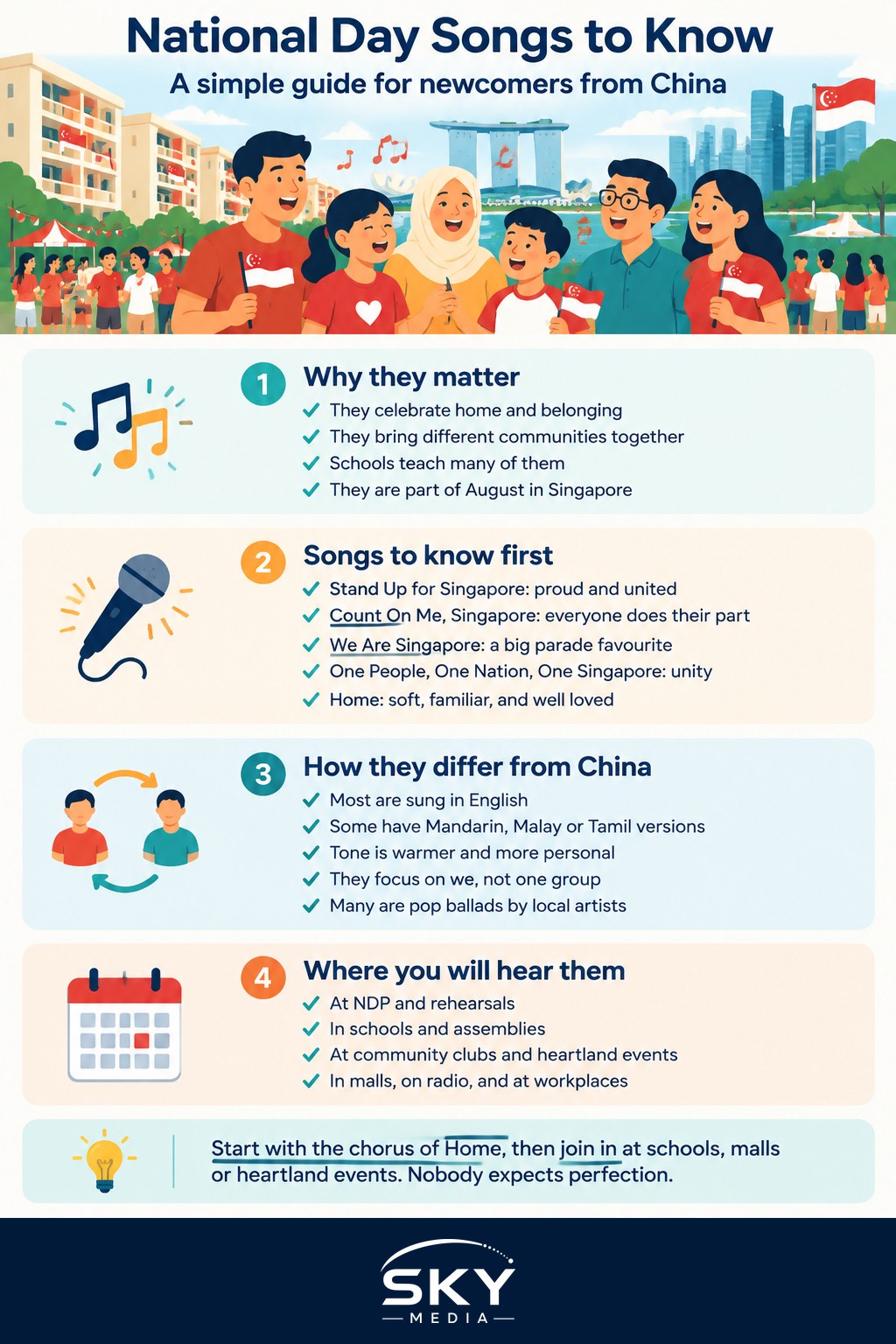
Each year, the NDP has a new theme song, and some become instant favourites while others fade. A small group of older songs, however, are played again and again. The table below covers the ones you are most likely to hear.
| Song | First released | What it is about | Mandarin context |
|---|---|---|---|
| Stand Up for Singapore | 1984 | A rousing call to stand proud and build the nation together | Similar energy to a marching song, but focused on unity rather than history |
| Count On Me, Singapore | 1986 | A promise from each citizen to do their part for the country | Comparable to a pledge set to music; the chorus is easy to learn |
| We Are Singapore | 1987 | A celebration of a small nation that has made its own way | Often sung loudly at the parade; the title line is the hook |
| One People, One Nation, One Singapore | 1990 | Unity across races and religions | The theme of 多元种族 (multiracial harmony) in song form |
| Home | 1998 | A gentle, personal song about Singapore as the place you belong | Also has a well-loved Mandarin version, 《家》, sung by the same singer |
“Home”: the one almost everyone knows
If you only learn one song, make it “Home”. Written by local musician Dick Lee and first sung by Kit Chan, it is often described as the unofficial favourite among National Day songs. It is soft rather than stirring, and the lyrics talk about the familiar sights and feelings that make a place home.
For Mandarin speakers there is good news: Kit Chan also recorded a Mandarin version, 《家》. Listening to both side by side is a gentle way to understand the meaning while picking up the English lyrics. Many newcomers say this song helped them think of Singapore as more than a place to work.
The 1980s “community” songs
“Stand Up for Singapore”, “Count On Me, Singapore” and “We Are Singapore” came out of the national campaigns of the 1980s. They are upbeat, simple and built for group singing. You will often hear them at the parade, at school events and at community celebrations in the heartlands.
When the crowd sings “We are Singapore, Singaporeans”, it is a moment of shared pride. You do not need to be a citizen to join in. Singing along is generally seen as a friendly gesture, not a claim.
How These Songs Compare With Patriotic Songs From China
Many newcomers grew up with songs like 《我和我的祖国》 or 《歌唱祖国》. Comparing them with Singapore’s songs helps explain the local mood.
- Language. Most Singapore National Day songs are in English, though some have versions or lines in Mandarin, Malay or Tamil. The National Anthem, “Majulah Singapura” (meaning “Onward Singapore”), is in Malay, the national language.
- Tone. Chinese patriotic songs are often grand and historical. Singapore’s songs are usually warmer and more personal, about neighbours, family and the island itself.
- Who sings them. In Singapore, these songs are sung widely by people of all races together, so the emphasis is on “we” rather than on any one community.
- Pop style. Many newer NDP theme songs are written as pop ballads by local artists, with music videos released each year. They feel closer to a pop single than a formal anthem.
Understanding this difference can help you avoid feeling that the songs are “light”. They are deliberately inclusive, because a shared song is one of the few things every community can hold equally.
Mandarin Songs With a Singapore Story
Singapore also has its own tradition of Mandarin songwriting. In the 1980s, a movement called Xinyao (新谣, “Singapore folk songs”) grew among students who wrote and performed simple guitar songs about local life, school, friendship and growing up here. These are not official National Day songs, but you may hear them at Chinese community events around August, and many older Chinese Singaporeans feel strongly about them.
If you enjoy Mandarin music, exploring Xinyao is a lovely way to understand how Chinese Singaporeans see themselves: connected to Chinese culture, but with their own local identity. Ask a Singaporean colleague for their favourite and you will probably start a long conversation.
Where and When You Will Hear National Day Songs
From around July to mid-August, these songs are everywhere. Expect to hear them:
- At the NDP and its rehearsals, where the crowd sings along to classics and the new theme song.
- In schools, during National Day observance ceremonies and assemblies.
- At community clubs and heartland celebrations, often with karaoke-style lyrics on a screen.
- In malls and on local radio, sometimes on a loop.
- At workplaces, where some companies hold small National Day events.
If you are unsure of a common abbreviation you hear during the season, such as NDP, CC (community club) or RC (residents’ committee), our list of common Singapore acronyms will help.
Easy Ways to Learn the Songs
You do not need to memorise every verse. A few simple steps go a long way:
- Start with the chorus. Most NDP songs repeat a short, catchy chorus. Learn that first.
- Use official videos. Official music videos and lyric videos are widely available on the NDP and broadcaster channels, often with subtitles.
- Listen with your children. If your child is in a local school, ask them to teach you. They will enjoy being the expert.
- Pair English with Mandarin. For “Home”, listen to the English and Mandarin versions together.
- Sing at a community event. Nobody expects perfection, and joining in is warmly received.
A Welcoming Way Into Local Life
Learning a few national day songs will not make you an instant local, and nobody expects it to. But it shows interest and goodwill, and it gives you a shared moment with the people around you each August. For many newcomers from China, singing “Home” at a heartland celebration for the first time is the moment Singapore starts to feel a little more like home too.
Explore more: National Day and What It Means for Newcomers · Your First National Day as a Newcomer in Singapore