

You do not need a parade ticket to feel the buzz of National Day. The NDP mobile column, a convoy of military, Home Team and civil defence vehicles that drives through housing estates, brings a slice of the parade straight to the heartlands. For many families it is the most accessible part of the celebrations.
This guide explains how the mobile column usually works, where routes are announced, and how to choose a good spot so you actually see it rather than the back of someone’s head. It focuses on the ground convoy. If you want to spot the aircraft overhead, that is a different exercise with different timing.
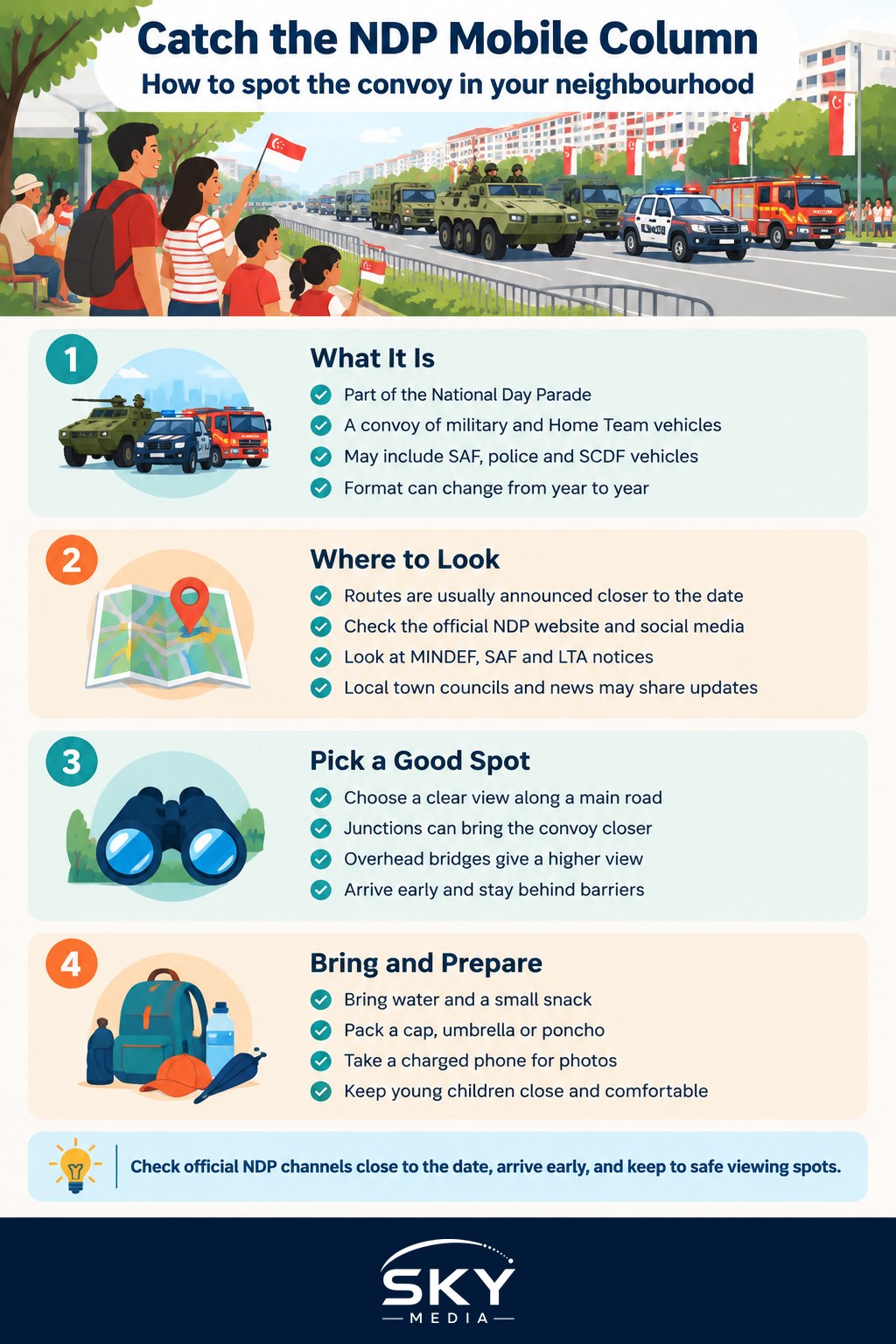
What the NDP Mobile Column Actually Is
The mobile column is a segment of the National Day Parade (NDP) in which vehicles from the Singapore Armed Forces (SAF), the Singapore Police Force, the Singapore Civil Defence Force (SCDF) and other agencies travel in a long procession. Depending on the year’s theme, you may see armoured vehicles, artillery, logistics trucks, fire engines, ambulances and police vehicles, often with personnel waving from the hatches.
In many years, the column has driven past the parade venue and then continued out into residential areas, or has been routed through selected towns as a separate heartland showcase. The exact format changes from year to year. Treat every detail in this guide as a pattern, not a promise, and confirm the current year’s plan with the official NDP channels.
What tends to stay the same:
- The convoy moves at a slow, steady pace, so you have a short window to watch, wave and take photos.
- Routes follow main roads that can handle large vehicles, not narrow estate lanes.
- Roads along the route may have temporary closures or traffic control while the convoy passes.
Where Mobile Column Routes Are Announced
Routes are not usually released months ahead. They tend to appear closer to the date, once planning and traffic arrangements are confirmed. The most reliable places to look are:
- The official NDP website and social media pages. This is where route maps, timings and any changes are typically published first.
- MINDEF and SAF channels. The Ministry of Defence often shares parade segment details, including vehicle line-ups.
- LTA and traffic advisories. The Land Transport Authority (LTA) and the Traffic Police may issue notices about road closures and diversions along the route, which is a good clue to where the convoy will run.
- Your town council, community club or grassroots groups. If the column passes your estate, local grassroots organisations sometimes promote a gathering point or a community celebration around it.
- Local news outlets. Mainstream news sites often publish a summary of the routes once they are out.
A route map usually shows a line along named roads with approximate pass times at key points. Timings are estimates. The convoy can run early or late depending on traffic and the parade schedule, so plan to arrive with a generous buffer.
Choosing the Best Viewing Spot
Once you have the route, think like a photographer and a parent at the same time. A good spot is one where you can see clearly, stay safe and leave easily afterwards.
| Viewing spot type | What to expect | Watch out for |
|---|---|---|
| Straight stretch of main road | Long view of the convoy approaching, good for photos and video | Fills up early, little shade |
| Near a junction or bend | Vehicles slow down, so you get a closer look | Traffic marshals may keep crowds further back |
| Overhead pedestrian bridge | Elevated view over the crowd, great for kids | May be closed or crowded for safety reasons; follow any instructions |
| Void deck or park beside the route | Shade, seating and space for strollers | View may be partly blocked by trees or barriers |
| Near the start or end of a route segment | Thinner crowds | Convoy may pass at a less predictable time |
A few practical points help:
- Arrive early. Thirty to sixty minutes before the estimated time is sensible in popular estates, longer if you want a front spot.
- Stay behind barriers and kerbs. Large vehicles need space, and marshals will move people back from the road edge.
- Pick the sunny or shady side deliberately. Afternoon sun can be harsh, so a spot with building shade makes the wait easier for children and older relatives.
- Know your exit. Roads may reopen gradually, and nearby bus stops can be crowded, so walking home is often easiest if you live nearby.
What to Bring and How to Prepare
The mobile column is short but the wait can be long, especially in August heat or a sudden shower. Pack light but smart:
- Water bottles for everyone, plus a small snack for children.
- A cap, umbrella or compact poncho. Umbrellas can block others’ views, so close them when the convoy arrives.
- Small flags or anything red and white for kids to wave. If your family has an NDP funpack, a few items from it work well here.
- A charged phone, with storage space cleared for photos and video.
- Ear protection for very young children, since some vehicles are loud.
If you are bringing a stroller or wheelchair, scout the area a day before for kerb ramps and shade.
Making It Fun for Children
For kids, the mobile column can be the highlight of National Day, especially if they are too young to sit through a full evening parade. A little preparation makes it more meaningful:
- Talk about the vehicles beforehand. Look up pictures from previous years on official SAF or SCDF pages and play “spot the vehicle” during the convoy.
- Explain who the people are. Many of those waving from the vehicles are full-time national servicemen or regulars, and children enjoy waving back.
- Keep expectations realistic. The convoy passes quickly. Tell kids that it is a short, exciting moment, then plan something afterwards like a meal or a playground visit.
Keep children close in crowds and agree a meeting point in case anyone gets separated.
Mobile Column vs Other Ways to See NDP Up Close
The mobile column is one of several low-cost ways to soak up the atmosphere. If your family enjoys it, you might also look at:
- Rehearsals and previews. Before the actual day, there are usually rehearsals and preview shows. Our guide on where to watch NDP rehearsals and previews explains how these usually work.
- Fireworks from outside the venue. Many people watch the fireworks from vantage points around the city. See our tips on taking better NDP fireworks photos if you want to capture them.
- The flypast. Aircraft displays can sometimes be seen from beyond the parade venue, but they follow a different schedule and route from the ground convoy, so check separately.
If you are new to Singapore and want the bigger picture of why the nation celebrates on 9 August, start with National Day and the NDP, explained.
Etiquette and Safety on the Day
The mood along the route is friendly and festive. A few simple habits keep it that way:
- Follow instructions from police, marshals and volunteers, even if it means moving to a less ideal spot.
- Do not step onto the road for a better photo, and keep drones at home. Drone flying is tightly restricted around major events, so check the Civil Aviation Authority of Singapore (CAAS) rules before even considering it.
- Avoid blocking pavements, bus stops and building entrances with bags, chairs or strollers.
- Take your rubbish with you.
Above all, check the official NDP channels in the days before. Routes, timings and even whether a heartland mobile column runs that year can change. With a confirmed route, an early start and a bottle of water, catching the convoy in your own neighbourhood is one of the simplest and most joyful ways to celebrate National Day.
Explore more: What’s inside the NDP funpack and how it is used.