

If you are heading to ITE, the Institute of Technical Education, you will quickly meet a lot of course labels. Nitec, Higher Nitec, Work-Study Diploma, Technical Diploma. They sound similar, and many students and parents are unsure how they relate. This guide explains the practical differences between Nitec and Higher Nitec, and how work-study routes fit in, so you can plan a path that matches your interests and goals.
A quick note before we start: ITE reviews its courses and structures from time to time, and has announced changes to how its curriculum is organised for newer cohorts. Course names, durations, entry requirements and progression rules can change, so always confirm the current details on ITE’s official website and in the official admissions booklet for your intake year.
Nitec: The Foundation Certificate
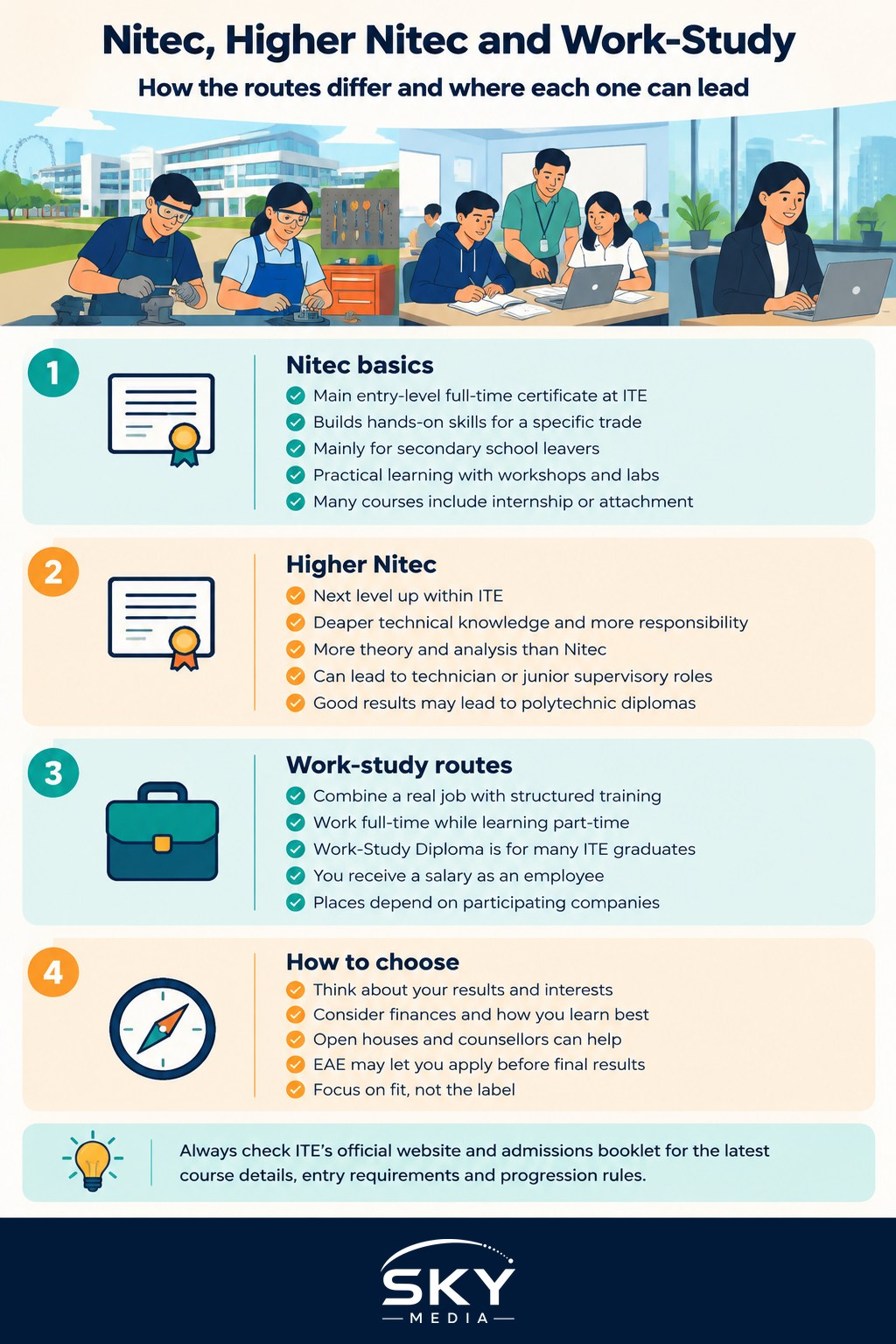
Nitec (National ITE Certificate) is the main entry-level full-time certificate at ITE. It is designed to build hands-on skills for a specific trade or industry, such as engineering, electronics, hospitality, business services, beauty, IT or healthcare support.
What Nitec usually looks like in practice:
- Who it is for. Mainly students coming from secondary school, based on their national exam results or school-based subject levels. Adults can also enter through part-time or continuing education routes.
- Focus. Practical, skills-based learning in workshops, labs and simulated workplaces, with a smaller share of classroom theory.
- Industry exposure. Many courses include an internship or industry attachment.
- Outcome. Graduates can enter the workforce as skilled technicians or operators, or continue studying.
Nitec is not a dead end. Students who do well can go on to a Higher Nitec course, and in some cases apply directly to selected polytechnic diploma courses, depending on their grades and the current progression rules.
Higher Nitec: Deeper Skills and Broader Scope
Higher Nitec is the next level up within ITE. It goes deeper into technical knowledge and adds more responsibility, such as supervising tasks, troubleshooting more complex problems, planning work or handling customers more independently.
Key features:
- Who it is for. Students with stronger secondary school results can enter some Higher Nitec courses directly. Nitec graduates who meet the grade requirements can also progress into a related Higher Nitec.
- Focus. More theory and analysis than Nitec, combined with practical training, so graduates can work at a technician or junior supervisory level.
- Progression. Higher Nitec graduates with good results can apply for polytechnic diplomas, and may get credit or exemptions for some modules, depending on the course and the polytechnic’s rules.
- Outcome. Graduates often enter roles with more scope than those open to Nitec holders, though pay and roles depend on the industry and employer.
Work-Study Routes: Learning While Earning
Work-study programmes combine a real job with structured training. Instead of studying full-time and then looking for work, you are hired by a company and learn on the job, with part of the training delivered by ITE.
At ITE, the best known option is the Work-Study Diploma, which is generally aimed at ITE graduates. You sign on as a full-time employee with a participating company, receive a salary, and attend classes and training while you work. On completion, you receive a diploma-level qualification. There are also other work-study and traineeship options under SkillsFuture, Singapore’s national skills movement, for graduates of ITE, polytechnics and universities.
Why students choose work-study:
- You earn a salary while gaining a qualification.
- You gain real work experience early, which can help with future job applications.
- You learn how a workplace actually runs, including teamwork, deadlines and customer expectations.
Things to weigh up:
- You are an employee first, so you have work responsibilities alongside studying.
- Your training is tied to your employer and their industry, so choose a field you are genuinely interested in.
- Places depend on which companies are participating in a given intake.
Our wider guide to work-study programmes in Singapore covers options at other institutions as well.
Comparing the Three Routes Side by Side
| Feature | Nitec | Higher Nitec | Work-Study Diploma |
|---|---|---|---|
| Main entry point | Secondary school leavers | Secondary school leavers with stronger results, or Nitec graduates | Mainly ITE graduates hired by a participating company |
| Learning mode | Full-time, mainly in school | Full-time, mainly in school | Employed full-time, with structured training |
| Focus | Core hands-on skills | Deeper technical skills and more responsibility | Job-specific skills built through work |
| Salary during course | No, apart from any internship allowance | No, apart from any internship allowance | Yes, as an employee |
| Next steps | Higher Nitec, selected poly diplomas, or work | Poly diplomas, or work | Continue working, further upgrading |
Treat this table as a general guide. Exact entry rules, course lengths and progression pathways are set by ITE and the polytechnics and can change.
How to Decide Which Path Suits You
There is no single “best” route. The right one depends on your results, interests, finances and how you like to learn.
Ask yourself:
- What do I enjoy doing? Look at course descriptions and visit ITE open houses to see the workshops and talk to lecturers and students.
- Do I want to study further? If you are aiming for a polytechnic diploma, check the progression requirements from Nitec and Higher Nitec in your chosen field, and plan to work consistently for good grades.
- Do I want to start earning soon? If income matters to you or your family, a work-study route after ITE can let you earn while continuing to learn.
- How do I learn best? If you learn best by doing, ITE’s practical style and work-study training may suit you well.
Tips for students:
- Use your ITE course counsellors and your secondary school’s Education and Career Guidance (ECG) counsellor. They know the current pathways and requirements.
- Consider the Early Admissions Exercise (EAE), which lets students apply for some courses based on aptitude and interests before their final results are released. Check ITE’s website for the current EAE window and criteria.
- Talk to seniors who are already in the course or working in the industry.
If you are juggling a part-time job or family responsibilities while studying, our guide on balancing work, study and family has practical ideas.
For Parents Supporting the Decision
Parents sometimes worry that ITE limits a child’s future. In practice, Singapore’s education system offers many routes for ITE graduates to keep learning: from Nitec to Higher Nitec, to polytechnic, to work-study programmes and, for some, to university later on. Many people also upgrade part-time while working.
The most helpful thing you can do is focus on fit. A course your child is interested in, and is motivated to do well in, opens more doors than a course chosen only for its label. Attend open houses together, read the official materials and let your child lead the conversation.
Whichever path you choose, Nitec, Higher Nitec and work-study are all respected routes into skilled careers in Singapore. Check the current requirements with ITE, ask questions early and choose with confidence.
Official sources: Ministry of Education (MOE)