

A gym trial, a lucky draw or a condo guardhouse asks for your full NRIC number. Should you hand it over? Singapore’s NRIC collection rules say that, in most everyday situations, a business should not need it at all. This guide explains what the rules cover, when a request is legitimate, the alternatives organisations are expected to use, and what you can do when you are not comfortable with a request.
If you need a refresher on what the card and number actually are, start with The NRIC and National Registration, Explained. This article focuses on the other side: who is allowed to ask for it.
This is general information, not legal advice. The Personal Data Protection Commission (PDPC) publishes the official guidance and updates it from time to time, so check its website for the current position.
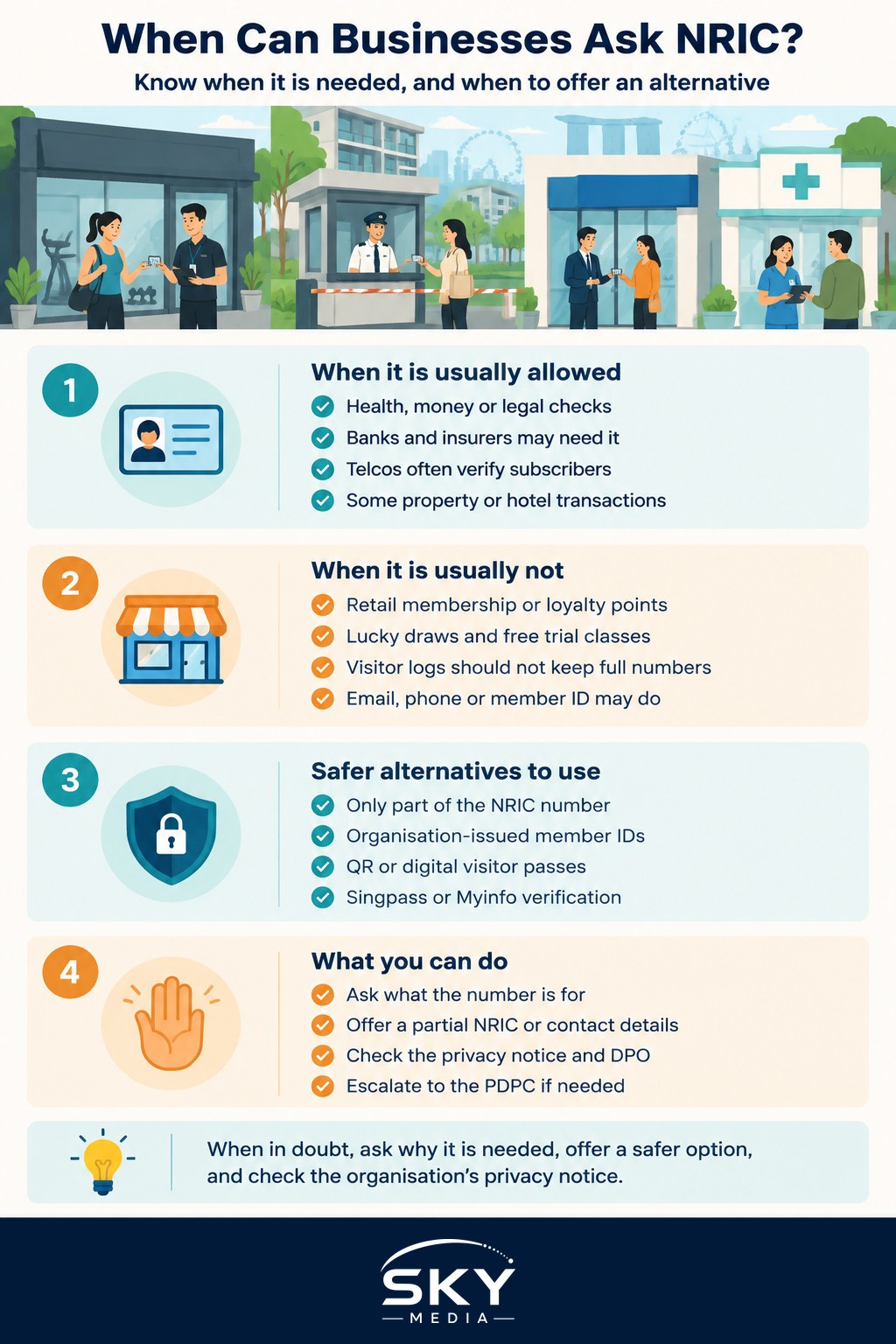
What the NRIC Collection Rules Actually Say
Singapore’s main privacy law for the private sector is the Personal Data Protection Act (PDPA), overseen by the PDPC. Under the PDPA, the PDPC has issued advisory guidelines specifically on NRIC numbers and other national identification numbers. The core principle is simple: organisations should generally not collect, use or disclose your NRIC number, or make a copy of your NRIC card, unless one of two conditions applies.
- The law requires it. Some laws or regulations require an organisation to record your identity number, for example in certain financial, telecommunications, healthcare or property transactions.
- It is necessary to verify your identity to a high degree of fidelity. This applies where getting your identity wrong could cause significant harm to you or the organisation, such as financial loss, a safety risk or a serious legal consequence.
The rules also cover more than the pink and blue cards. The same approach applies to Foreign Identification Numbers (FIN), birth certificate numbers, work pass numbers and passport numbers. Newcomers holding a FIN have the same protection as citizens. For background on those numbers, see Your NRIC and FIN Explained for Newcomers.
There is a separate, stricter point about the physical card. Organisations should generally not retain your actual NRIC card, for example by holding it at a counter in exchange for a visitor pass, unless the law specifically allows it. Asking to see the card briefly to check your identity is different from keeping it.
Why the Rules Exist
Your NRIC number is permanent; you cannot change it like a password. Many companies once used it as a membership ID or login, so one leaked database could expose the same number across many services.
The government has since stressed that the NRIC number is an identifier, not a secret, and that organisations should not treat knowledge of it as proof that someone is who they claim to be. In practice this means two things for you:
- A business should not rely on your NRIC number alone to let you into an account or approve a transaction.
- You should still avoid spreading it around unnecessarily, because it helps scammers sound convincing and links your records across services.
When a Request Is Usually Legitimate, and When It Is Not
The table below gives a general sense of common situations. It is a guide, not a ruling: the specific circumstances, and the law that applies to that sector, decide the outcome.
| Situation | What you can generally expect |
|---|---|
| Seeing a doctor, dentist or hospital | Full identification is normally needed to keep accurate medical records and process subsidies or claims |
| Opening a bank account, applying for a loan or buying insurance | Identity checks are typically required by financial regulations |
| Signing up for a mobile line or broadband | Telcos are generally required to verify and record subscriber identity |
| Buying or renting property, or checking into a hotel | Identity details are often required under the relevant rules |
| Retail membership, loyalty points or a lucky draw | Collecting your full NRIC number is generally not justified; a phone number, email or member ID should do |
| Visitor registration at a condo or office | Staff may ask to see your card to verify you, but generally should not record your full number or keep the card |
| Online event registration or a free trial class | Usually no good reason to need it; expect to give a name and contact details instead |
The pattern is clear. Where accurate identification protects you, such as your health records, money or legal obligations, a request is more likely to be justified. Where it is just for convenience or marketing, it usually is not.
Alternatives Organisations Are Expected to Use
When a business genuinely needs to tell customers apart but does not need full identity verification, the PDPC guidance points towards alternatives. You will commonly see:
- Partial NRIC numbers. Many organisations ask for only the last three digits and the final letter, for example as part of a visitor log or lucky draw entry. Collecting this partial form is generally accepted as a reasonable alternative, because it is far less useful to someone who obtains it.
- Organisation-issued IDs or contact details. A member number, mobile number or email, often with a one-time code.
- QR or digital passes. Visitor systems that send you a pass in advance instead of recording your identity document at the door.
- Singpass-based verification. Where strong identity verification is needed online, many services use Singpass and Myinfo so that verified details are shared with your consent, rather than you typing your number into a form.
If an organisation offers one of these, use it. If it does not, it is fair to ask whether it can.
What to Do When a Business Asks for Your NRIC
Stay calm: most front-line staff are simply following a form someone else designed. For non-essential things like a contest, you can also just decline.
Ask why it is needed
Politely ask what the number is for and whether the law requires it. A legitimate answer usually points to a specific regulation or a financial or medical need.
Offer an alternative
Suggest giving your phone number, email, a partial NRIC or simply showing your card without the number being written down. Many places will agree straight away.
Check the privacy notice
Look for the organisation’s data protection or privacy policy, which should say what personal data it collects, why, and how to contact it. Organisations covered by the PDPA are expected to have a Data Protection Officer (DPO), the person responsible for handling personal data questions.
Contact the Data Protection Officer
If the counter staff cannot help, write to the DPO. Keep your message factual: what was requested, when, and why you are concerned. Ask for the purpose of collection and whether an alternative is available. Give the organisation a fair chance to respond.
Escalate to the PDPC if needed
If an organisation collects NRIC numbers without a valid reason and does not resolve your concern, you can complain to the PDPC through its official website. It generally expects you to raise the matter with the organisation first.
Protecting Your NRIC Number Day to Day
The NRIC collection rules place the main duty on organisations, but a few personal habits help too:
- Do not post photos of your NRIC, or documents showing the full number, on social media or in group chats.
- Be wary of anyone who calls or messages claiming to be from a bank or agency and asks you to confirm your full NRIC number. Hang up and call the official number yourself.
- Mask the number when you send scanned documents that do not need it, such as a tenancy query or a job application at an early stage.
- If your card goes missing, report it promptly. What to Do If You Lose Your Passport or NRIC walks through the steps.
The short version: in Singapore, your full NRIC number should be asked for when the law or genuine high-fidelity identity checks require it, not as a default. When in doubt, ask why, offer an alternative, and know that you have a route to raise concerns.
Explore more: Getting Your NRIC and FIN Explained
Frequently Asked Questions
Do the NRIC collection rules protect foreigners with a FIN too? Yes. The same approach covers Foreign Identification Numbers, along with work pass, passport and birth certificate numbers, so newcomers get the same protection as citizens. A business still needs a valid reason, such as a legal requirement, before collecting a FIN.
Is giving only the last three digits and letter of my NRIC acceptable? It is generally accepted as a reasonable alternative where a business needs to tell people apart but not fully verify identity, such as a visitor log or lucky draw entry. It is far less useful to anyone who obtains it. Do not assume it is needed, though, and ask whether a phone number would do.
Can a condo guard keep my NRIC card in exchange for a visitor pass? Organisations should generally not hold your physical card unless a law specifically allows it. Staff may look at it briefly to verify you. If a guard insists on keeping it, politely ask for an alternative such as a QR pass, or raise it with the management’s Data Protection Officer.
Is it safe to send a scanned NRIC copy for a job application? Avoid it at the early stages unless the employer clearly needs it. Where a scan is necessary, mask the number if the purpose does not require it, and ask how the document will be stored. Check the employer’s privacy notice and the PDPC website for current guidance.
Where do I complain if a company keeps asking for my NRIC? Start with the organisation’s Data Protection Officer, stating what was asked, when, and why you are concerned. If it is not resolved, you can complain to the PDPC through its official website, which generally expects you to raise the matter with the organisation first.