

For many young men in Singapore, the timing of National Service (NS) collides with school. You turn 18 midway through junior college, or your polytechnic course runs past your enlistment date, and you start to wonder whether you will have to stop studying. This is where NS deferment for studies comes in. In most cases, the Ministry of Defence (MINDEF) and the Central Manpower Base (CMPB, the office that handles enlistment) allow full-time students to finish their pre-university or diploma studies before enlisting.
This guide explains who usually qualifies, how deferment for overseas study differs, and what to check so there are no surprises. It is general information only. Deferment rules are set by MINDEF and can change, so always confirm your own case on the official NS Portal or with CMPB.
What NS Deferment Means
NS liability generally begins at 18. Singapore citizens and permanent residents who are liable register for NS at around 16.5 years old, then receive an enlistment notice. Deferment is a postponement of enlistment, not an exemption. You still serve full-time NS, just later, once your approved course of studies ends.
Deferment for studies exists so that students who are progressing normally through their education do not have to break off halfway. It is tied to a recognised full-time course and a reasonable completion timeline.
Which Studies Usually Qualify for Deferment
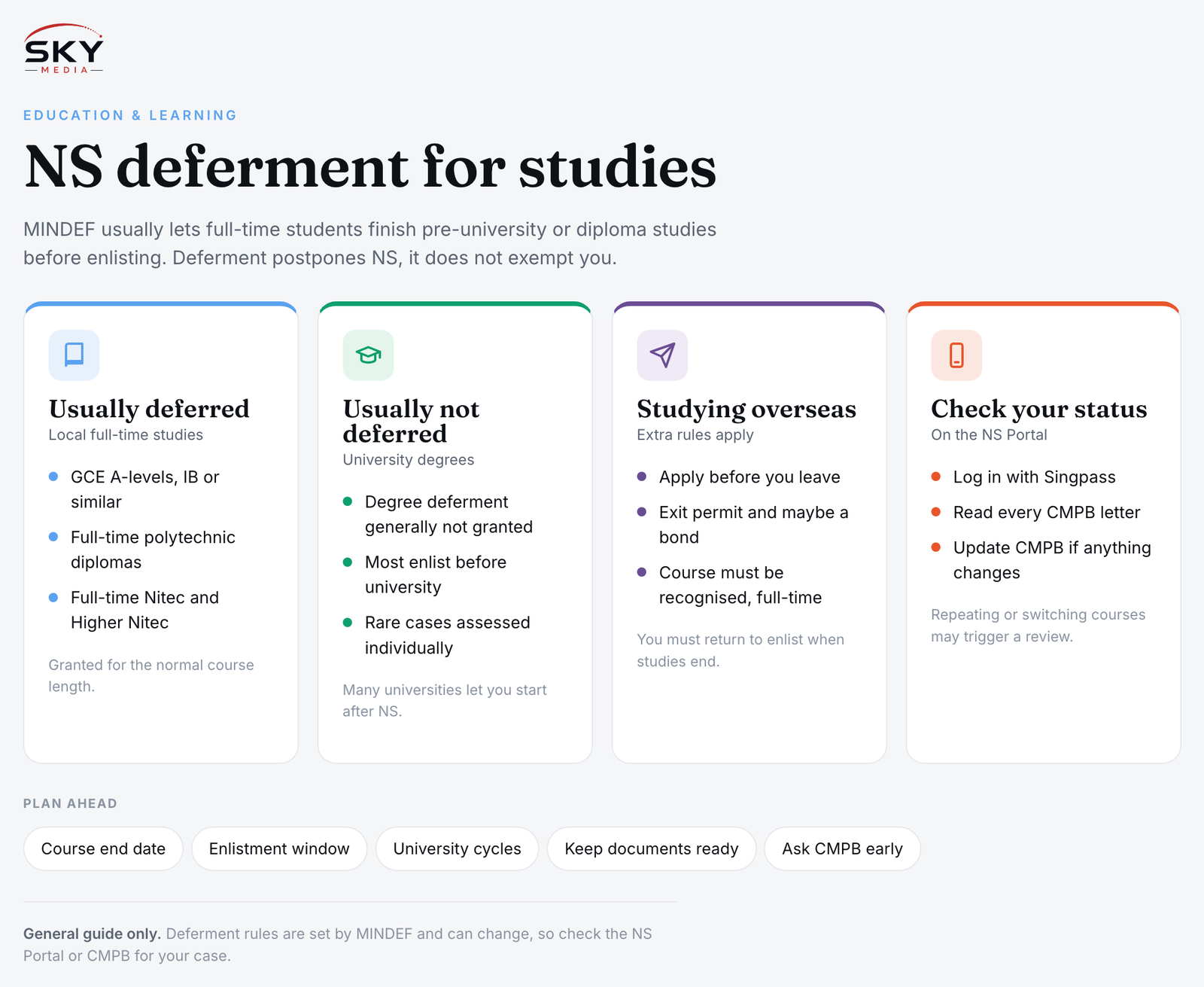
MINDEF’s long-standing policy is to grant deferment to pre-enlistees who are pursuing full-time studies up to a certain level, typically:
- GCE A-level studies at a junior college or centralised institute, or the International Baccalaureate and similar pre-university programmes at recognised schools.
- Polytechnic diplomas in full-time courses.
- ITE courses such as Nitec and Higher Nitec, when taken full-time.
- Equivalent qualifications at other recognised institutions, subject to MINDEF’s assessment.
University studies are a different matter. Deferment for a degree is generally not granted, which is why most men complete NS between their A-levels or diploma and university. MINDEF has historically considered certain exceptions on a case-by-case basis, so if you believe your situation is unusual, ask CMPB directly rather than relying on hearsay from friends.
Progression matters. Deferment is usually granted for the normal duration of a course. If you repeat a year, switch courses or take a break, your deferment may be reviewed and may not be extended. Students who are retained or who change programmes should check their status early.
Local vs Overseas Studies: How Deferment Differs
| Situation | What usually happens | What you should do |
|---|---|---|
| Full-time A-level or diploma in Singapore | Deferment is commonly granted for the course duration | Check your status on the NS Portal and keep your school records accurate |
| Full-time ITE course in Singapore | Deferment is commonly granted for the course | Confirm your expected completion date with your school |
| Pre-university or equivalent study overseas | May be granted, subject to MINDEF conditions and exit permit rules | Apply for an exit permit and any deferment before leaving, and plan to return on time |
| University degree, local or overseas | Generally not granted before NS | Plan to enlist first, then apply to university or defer your university place |
| Repeating a year or changing course | Deferment may be reviewed or shortened | Inform CMPB early and ask how your enlistment will be affected |
Studying Overseas Before NS
Overseas study adds a layer of rules because of exit permits. NS-liable males above a certain age need an exit permit from CMPB to stay or travel overseas for extended periods, and depending on age and length of stay, a bond (a financial guarantee) may be required. Our guide to exit permits for National Service-liable sons explains how these work.
If you are studying overseas at a pre-university level, the general points to know are:
- Apply before you leave. Deferment and exit permits must be sorted out in advance, not after you have started the course.
- The course must be recognised and full-time. MINDEF assesses whether an overseas programme is equivalent to the levels it normally defers for.
- You must return to enlist. Once your approved studies end, you are expected to come back and serve. Failing to do so is a serious offence under the Enlistment Act.
- Families living abroad should check the rules early, because the age at which a son becomes subject to exit permit and bond requirements comes sooner than many parents expect.
How to Apply or Check Your Deferment Status
For most students in local schools, polytechnics and ITE, deferment is processed using enrolment information. You may not need to do much beyond keeping your details accurate. Still, do not assume it has all been handled.
- Log in to the NS Portal with your Singpass to view your NS status, enlistment details and any deferment granted.
- Read every letter from CMPB. Enlistment notices and deferment notifications include dates and instructions.
- Update CMPB if anything changes, such as switching courses, withdrawing, repeating a year or moving overseas.
- For overseas studies, submit your exit permit and deferment applications through the official channels before your course begins.
- Keep supporting documents ready, such as letters of offer, enrolment confirmation and expected graduation dates.
If you are unsure, contact CMPB through the channels listed on the NS Portal. Officers can explain how the rules apply to your exact situation.
Common Questions From Students and Parents
Can I defer NS to study at university first? Generally no. Most men enlist after A-levels or a diploma. Many universities allow students to accept a place and start after NS, so check the university’s policy on deferring admission.
Can I defer for sports, arts or other reasons? MINDEF has considered deferment for exceptional cases, such as athletes preparing for major international competitions, on a case-by-case basis. These are rare, and applications usually need support from the relevant national body.
Will I lose my deferment if I fail my exams? Not automatically, but if your course takes longer than its normal duration, your deferment may be reviewed. Talk to your school and CMPB early.
Do permanent residents get the same deferment? NS-liable PRs are generally subject to the same enlistment framework. Check the NS Portal for the rules that apply to you.
What about stress about timing? It is normal to feel uncertain when NS, exams and future plans all collide. School counsellors and education and career guidance (ECG) counsellors can help you map out options calmly.
Planning Ahead So Studies and NS Fit Together
A little planning goes a long way:
- Map out your course end date against your expected enlistment window.
- If you plan to study overseas, start the conversation with CMPB a year or more ahead.
- Look at university application cycles so you know when to apply relative to your ORD (Operationally Ready Date, the end of full-time NS).
- Keep an eye on NS allowances and make-up pay if you are budgeting for life during and after full-time service.
Deferment rules, age thresholds and exit permit requirements are set by MINDEF and may change. Always check the latest details on the NS Portal or with CMPB before making plans.
Explore more: Balancing CCA and Studies
Official sources: MINDEF / NS Portal