

A number plate looks like a small detail, but in Singapore it is regulated closely. The Land Transport Authority (LTA) sets out how plates must look, where they must be mounted and how they must be lit, and enforcement officers and traffic cameras rely on them to identify vehicles. Stylish fonts, tinted covers and creative spacing can all land you a fine. This guide walks through the number plate rules Singapore motorists need to know, what makes a plate illegal and how to check your own vehicle.
This is general information, not legal advice. The detailed specifications are set out in LTA’s rules and guidance, and they can change, so confirm the current requirements on the LTA website or with an authorised plate maker before you make any changes.
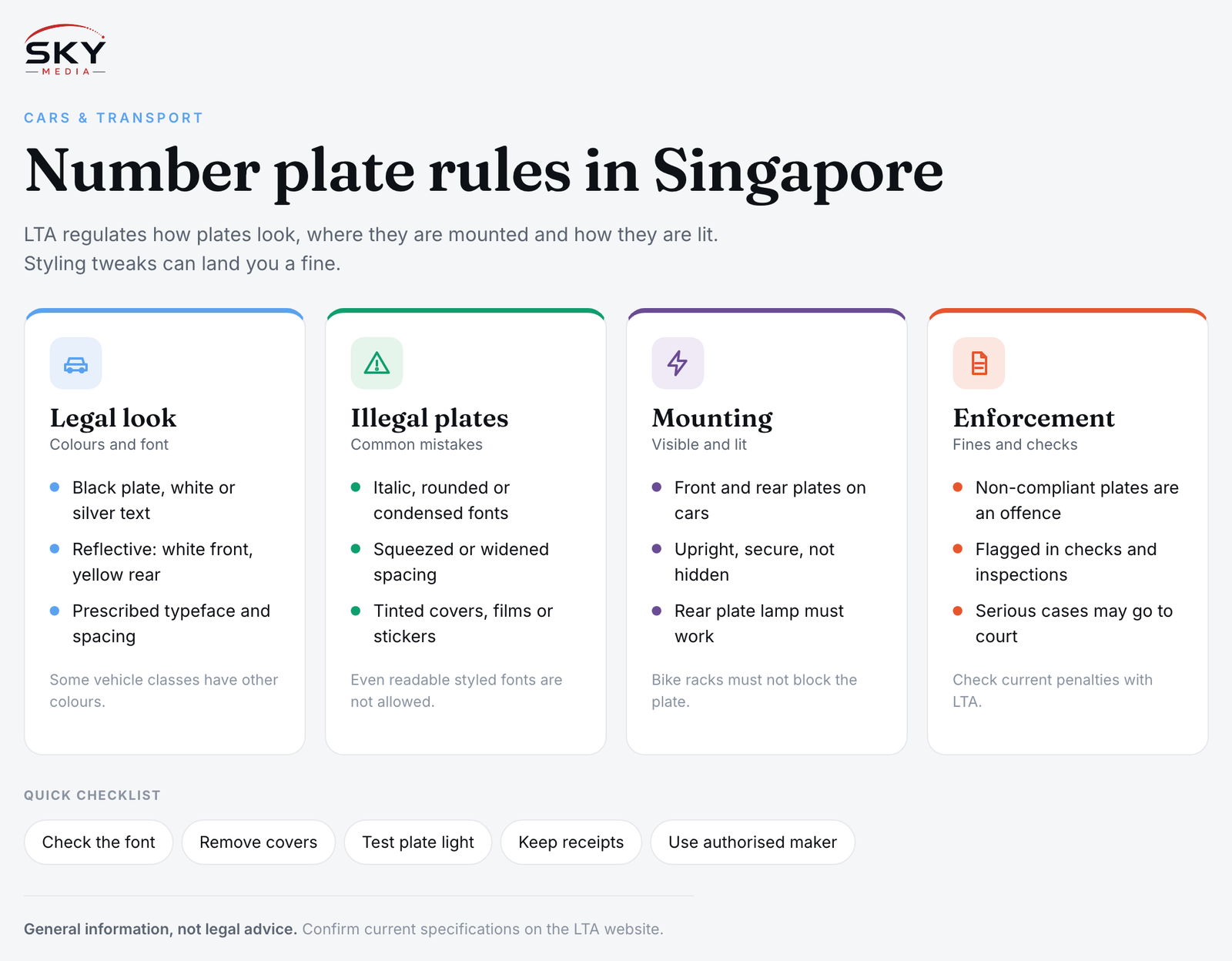
Why Plate Rules Are So Strict
Number plates are the main way a vehicle is identified by enforcement cameras, Electronic Road Pricing gantries, car park systems and members of the public reporting accidents. A plate that is hard to read, even slightly, weakens all of these. That is why the rules cover not just what the characters say but how they are drawn: font, height, width, stroke thickness, spacing, colour and reflectivity.
The vehicle number itself is assigned when the vehicle is registered. If you want a different number, there are proper channels for that, such as bidding for or retaining a number. See our guides on how to change your vehicle number plate and how to retain a car plate number. This article is about the physical plate: what it must look like once you have your number.
What a Legal Plate Looks Like
LTA’s specifications are detailed, but the key features are easy to check.
Colours and background
Singapore allows two main styles for private vehicles:
- Black plates with white or silver characters.
- Reflective plates, with black characters on a white background at the front and on a yellow background at the rear.
Certain vehicle classes, such as taxis, vehicles under special schemes and some commercial or off-peak vehicles, have different colour requirements set by LTA. If your vehicle falls into one of these classes, follow the requirements for that class.
Font and characters
The characters must follow the prescribed typeface and proportions. This is where many illegal plates go wrong. Italic or slanted lettering, rounded “designer” fonts, extra-bold or extra-thin strokes and condensed characters are not allowed, even if the number still reads correctly to the human eye. Characters should be evenly spaced, in a straight line and not squeezed together or spread apart for effect.
Size and layout
LTA prescribes the dimensions of the characters and the margins around them, and permits specific layouts, such as a single-line plate or a two-line plate, depending on the space on your vehicle. Do not invent your own layout, trim a plate to fit a bumper or stack characters in an unapproved way. Authorised plate makers work to these specifications, which is the simplest way to stay compliant.
Placement, Lighting and Covers
Getting the plate right is only half the job. How it is mounted matters too.
- Front and rear plates. Cars generally need plates at both the front and the rear. Motorcycles generally display a plate at the rear. Check LTA’s requirements for your vehicle type, including any specific rules for bicycle racks or tow bars that may block the rear plate.
- Visible and upright. Plates must be fixed securely and positioned so that they can be read clearly. Do not mount them at a sharp angle, tuck them into a recess or hide them behind accessories.
- Lighting. The rear plate must be illuminated so it can be read at night. A blown plate lamp is an easy fault to miss, so check it when you check your other lights.
- No covers or films. Tinted, smoked or anti-camera covers, glossy films and stickers over the plate are not allowed. Neither are frames or borders that cover any part of the characters.
- Keep it clean and intact. A cracked, faded, peeling or very dirty plate can count as illegible. Replace it rather than patching it up.
Legal Versus Illegal: A Quick Comparison
| Feature | Legal | Likely to be illegal |
|---|---|---|
| Font | Prescribed typeface with standard proportions | Italic, rounded, decorative or condensed lettering |
| Spacing | Even, standard spacing on an approved layout | Squeezed or widened gaps, characters arranged to spell words |
| Colour | Approved combinations for your vehicle class | Coloured characters, mismatched backgrounds, chrome or holographic finishes |
| Surface | Clean, flat plate with no covering | Tinted covers, glossy films, stickers or anti-camera sprays |
| Mounting | Secure, upright, clearly visible and lit at the rear | Hidden by bike racks, angled away, or with a broken plate lamp |
If you are unsure about any feature, the safest option is a plate made by an authorised maker to LTA’s specifications.
Fines and Enforcement
Displaying a non-compliant plate is an offence under Singapore’s road traffic rules. LTA and the Traffic Police conduct enforcement checks, and modified plates can also be flagged during vehicle inspections. Penalties can include a fine, and you will need to replace the plate with a compliant one. Serious or repeat offences, and cases where a plate is deliberately obscured or falsified, can be prosecuted in court and attract heavier penalties.
The exact fine amounts and composition sums are set by law and can be revised, so this guide does not quote figures. Check the current position with LTA. If you receive a notice, read it carefully for the offence description and payment or appeal options, and respond by the stated deadline.
Newcomers sometimes assume plate styles allowed in their home country are fine here. They are not. Our guide on adjusting to Singapore’s rules and fines as a newcomer covers other everyday rules worth knowing early.
Practical Checklist for Car Owners
Run through this list when you buy a car, after an accident repair or before an inspection:
- Check the font. Compare your plate with a standard plate on a recently registered car. If your characters look slanted, rounder or thinner, ask an authorised maker.
- Look at the colours. Make sure the combination matches what is allowed for your vehicle class.
- Remove covers and films. Take off any tinted cover, sticker or frame that touches the characters.
- Test the plate light. Switch on your lights at dusk and look at the rear plate from a few metres away.
- Check accessories. If you fit a bicycle rack or tow bar, confirm that the rear plate remains visible, or follow LTA’s rules on displaying an additional plate.
- Ask the workshop. After bodywork, ask the workshop to refit the original legal plates or supply compliant replacements.
- Keep receipts. When you replace a plate, keep the receipt from the plate maker in case you need to show compliance.
Buying a Used Car or Importing One
Used cars sometimes come with plates that a previous owner customised. When you buy, look at the plates as carefully as the tyres. If anything looks non-standard, ask the seller to replace them with compliant plates before handover, or budget to do it yourself. Plates swapped during accident repairs are another common source of problems.
If you import a vehicle, it will need Singapore plates made to LTA’s specifications once it is registered. Foreign plates and styles do not carry over.
Keeping It Simple
The easiest way to stay within the number plate rules is to treat the plate as a functional part, not a styling accessory. Use an authorised plate maker, keep the plate clean and lit, and avoid anything that changes how the characters look. When in doubt, check LTA’s published specifications and ask the plate maker to confirm their plates meet them. A compliant plate costs little compared with the hassle of a fine and a forced replacement.
Frequently Asked Questions
Where can I get a new number plate made? Use an authorised plate maker, since they work to LTA’s specifications for font, size and spacing. This is the simplest way to avoid a non-compliant plate. Check the current list of approved makers on the LTA website, and keep the receipt in case you need to show compliance.
What should I do if my number plate falls off or is damaged? Do not drive with a missing or unreadable plate for longer than necessary. Arrange a replacement through an authorised plate maker, and report a lost or stolen plate to the Traffic Police. LTA can advise on what is needed in your situation, so check its guidance.
Do motorcycles follow the same number plate rules as cars? The principles are the same: a clear, correctly formed and properly mounted plate. The details differ, because motorcycles generally display a plate at the rear and have their own size and layout specifications. Check LTA’s requirements for your vehicle type before ordering.
Can I use a stylish custom plate for photos or car meets? Only if it stays off public roads. Once a vehicle is driven or parked on a public road, its registered plate must follow LTA’s rules. A decorative plate for display at a private event is a different matter, but check with LTA if you are unsure.
Is it safe to buy a number plate online from overseas? It is risky, because plates sold abroad often follow other countries’ fonts, sizes and colours, which are not allowed here. A plate that does not match LTA’s specifications can lead to a fine and a forced replacement. Stick with an authorised local maker.
Official sources: OneMotoring
Further reading: Modifying Your Car Legally in Singapore