

If your condominium has signed a collective sale agreement and you are not one of the owners who agreed, you still have a voice. Singapore law lets minority owners object to en bloc sale applications at the Strata Titles Board (STB), and the Board must consider those objections before it can order the sale. This guide walks through how that objection process works in practice: who can object, what grounds actually count, how mediation and hearings run, and how to prepare. It is general information, not legal advice.
If you are still getting your head around the basics, start with En Bloc Sales Explained and What En Bloc Means for Owners, then come back here when the application stage arrives.
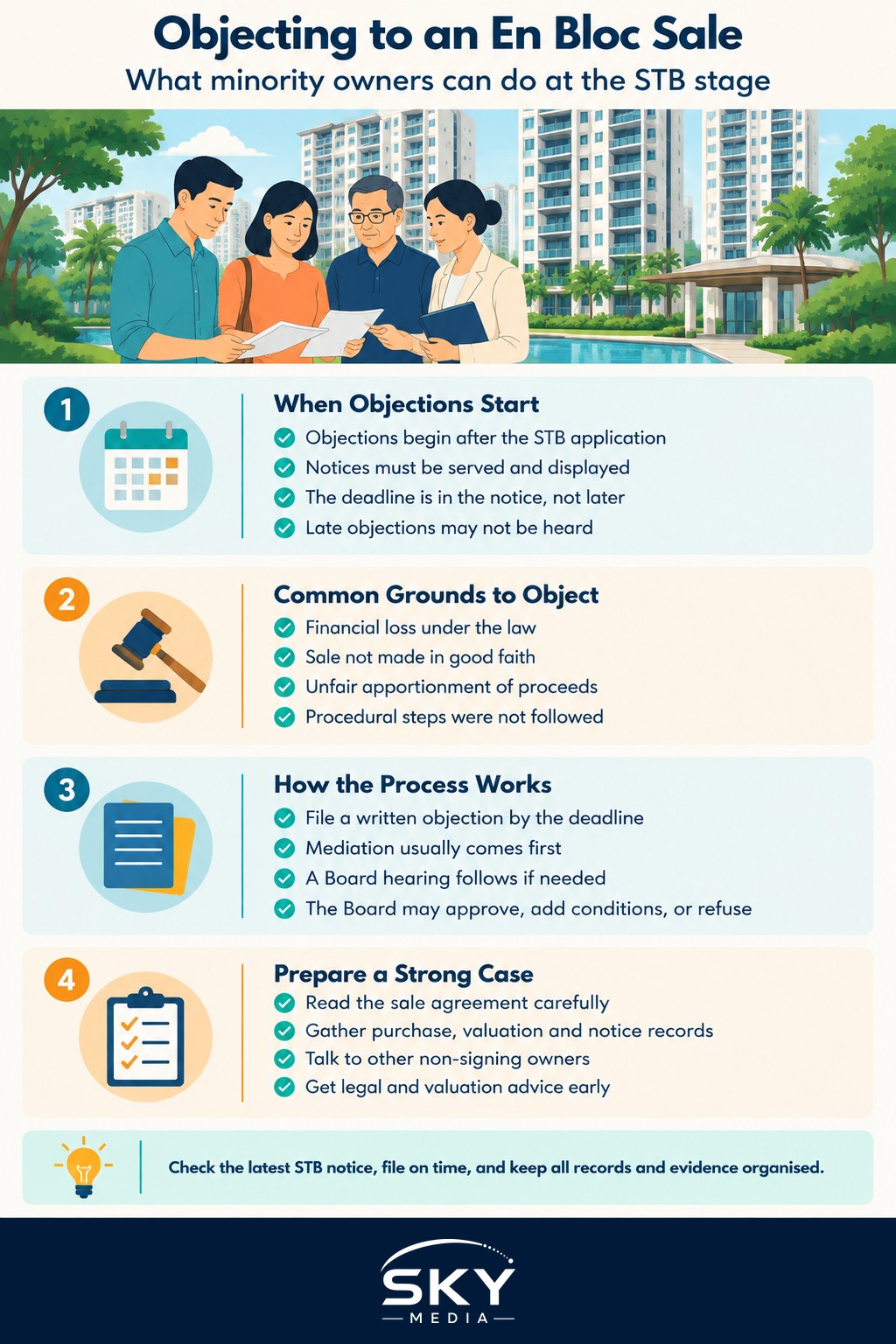
Where Objections Fit in the Collective Sale Timeline
A collective sale (the formal name for an en bloc sale) moves through several stages under the Land Titles (Strata) Act. Owners form a collective sale committee, sign a collective sale agreement, appoint a marketing agent, and look for a buyer. Once owners holding the required majority of share value and strata area have signed, and a buyer has been found, the committee can apply to the STB for an order that binds the owners who did not sign.
That application stage is where your formal objection lives. Before it, you can raise concerns at general meetings, ask questions in writing, and decline to sign. After the application is filed, the law requires the committee to serve notices on all owners, publish notices, and put up notices at the development. Those notices tell you the deadline to file an objection with the STB.
Key points to understand about timing:
- The objection window is short. It runs from the date stated in the notice, not from when you happen to read it. Check the notice and the STB website the same week you receive it.
- Late objections may not be heard. Do not assume you can file once you have gathered all your evidence. File on time, then build your case.
- Mortgagees and other interested parties can object too. If you have a bank loan, your bank receives notice as well, and its interests are not always the same as yours.
Valid Grounds to Object to En Bloc Sale Terms
The STB does not decide whether an en bloc sale is a good idea in general. It looks at specific statutory questions. Feeling attached to your home, or preferring not to move, is understandable but is not by itself a ground the Board can act on. Broadly, objections tend to fall into these categories.
Financial loss. An owner can argue they will suffer a financial loss from the sale. The law sets out how this is assessed, and it typically involves comparing what you would receive from the sale with what you paid for your unit, taking into account certain factors. Recent buyers are the owners most often in this situation. Gather your purchase documents early.
Not a transaction in good faith. The STB must be satisfied that the sale is in good faith, considering factors such as the sale price, the method of distributing the proceeds, and the relationship between the buyer and any owner or committee member. If you believe the property was undersold, or the process was not run properly, this is usually where the argument sits.
Unfair apportionment of proceeds. Sale proceeds are generally shared by share value, strata area, or a combination. If you believe the method chosen is unfair to units like yours, such as ground floor units with private gardens or penthouses with extra space, you can object on that basis.
Procedural non-compliance. The Act and its schedules set out steps the committee must follow, from how meetings are called to how the agreement is signed and how notices are served. Failures can be raised in an objection.
Valuation concerns. Committees obtain valuation reports. If you think the reserve price or sale price does not reflect fair market value, an independent valuation can support a good-faith argument. Understanding how plot ratio affects en bloc potential helps you judge whether a buyer’s offer reflects what the land can actually be redeveloped into.
| Ground for objection | What you generally need to show | Useful evidence to gather |
|---|---|---|
| Financial loss | The sale leaves you worse off in the way the law defines | Purchase price records, loan documents, sale apportionment for your unit |
| Not in good faith | Price, process or relationships suggest the sale was not fair | Independent valuation, meeting minutes, tender records, disclosures |
| Unfair apportionment | The distribution method disadvantages your type of unit | Share value and strata area figures, comparisons with similar sales |
| Procedural breach | Required steps under the Act were not followed | Notices received, dates, meeting records, signed agreement copies |
How to File and What Happens Next
The STB’s website explains its forms and filing requirements, and these can change, so use the current version rather than a template from a neighbour. In general terms, the process looks like this.
- File your written objection within the deadline. State clearly who you are, which unit you own, and the grounds you are relying on. Keep it factual.
- Attend mediation. The STB typically refers collective sale applications with objections to mediation first. Mediation is a structured conversation, often with a mediator, between objectors and the committee. Sometimes issues are resolved here, for example by clarifying figures or adjusting how proceeds are handled.
- Proceed to a hearing if mediation does not resolve things. A Board panel hears the application and the objections. Both sides present evidence, and witnesses such as valuers may be involved.
- Receive the decision. The Board may approve the application, approve it with conditions, or decline it. Further appeal routes, typically on points of law, exist through the courts, and a lawyer can advise on whether that is realistic in your case.
Throughout, keep copies of every document and a simple log of dates. Hearings turn on evidence.
Practical Steps to Strengthen Your Objection
Minority owners often feel outnumbered, but a focused, well-documented objection is taken seriously. Some practical habits help.
- Read the collective sale agreement closely. It sets out the reserve price, the apportionment method, and the committee’s powers. Highlight anything you do not understand and ask in writing.
- Talk to other non-signing owners. You may share grounds and can coordinate, though each owner’s objection should still reflect their own position.
- Get professional advice early. A lawyer familiar with strata and collective sale matters can tell you which grounds are strong and which are not. An independent valuer can test the price. Ask about fees upfront.
- Separate emotion from evidence. It is fine to say this is your family home. The Board will still focus on financial loss, good faith, apportionment and procedure.
- Think about outcomes, not just winning. Sometimes the realistic goal is a fairer apportionment or a clearer explanation, rather than stopping the sale entirely.
- Plan your housing either way. Whatever the result, map out what you would do if the sale goes through, including timelines for moving and financing your next home.
Common Mistakes Minority Owners Make
A few patterns come up again and again.
- Missing the deadline because the notice was set aside or went to an old address. Update your mailing address with the managing agent.
- Relying on informal complaints at meetings without filing a formal objection with the STB.
- Objecting on grounds the Board cannot act on, such as general dislike of developers.
- Not keeping their own records and assuming the committee will provide everything later.
Where to Get Official Information
The Strata Titles Board publishes guidance on collective sale applications, objections, mediation and hearings. The Ministry of Law and the Singapore Land Authority also publish information on collective sale rules. Because thresholds, forms and procedures can be updated, always check the current details directly with the STB before you file, and speak to a qualified lawyer about your specific situation.
Frequently Asked Questions
Does disliking the move count as a ground to object to an en bloc? No. Feeling attached to your home or preferring not to move is understandable, but it is not by itself a ground the Strata Titles Board can act on. Grounds focus on financial loss, good faith, apportionment of proceeds and procedure.
What if I miss the objection deadline stated in the notice? Late objections may not be heard, and the window runs from the date in the notice, not from when you read it. File on time and build your case afterwards. Update your mailing address with the managing agent so notices are not missed.
Can my bank object to the collective sale as well? Yes, mortgagees and other interested parties can object too. Your bank receives notice, but its interests are not always the same as yours. Tell your bank about the sale, and check the loan implications with a lawyer.
Do all objections end up at a full hearing? Not always. The Board typically refers applications with objections to mediation first, where issues are sometimes resolved by clarifying figures or adjusting how proceeds are handled. If mediation does not resolve things, a Board panel hears the case.
Should I hire a lawyer or valuer to object? Early professional advice helps. A lawyer familiar with strata and collective sale matters can say which grounds are strong, and an independent valuer can test the price. Ask about fees upfront, and keep every document and a log of dates.
Official sources: Ministry of Law