
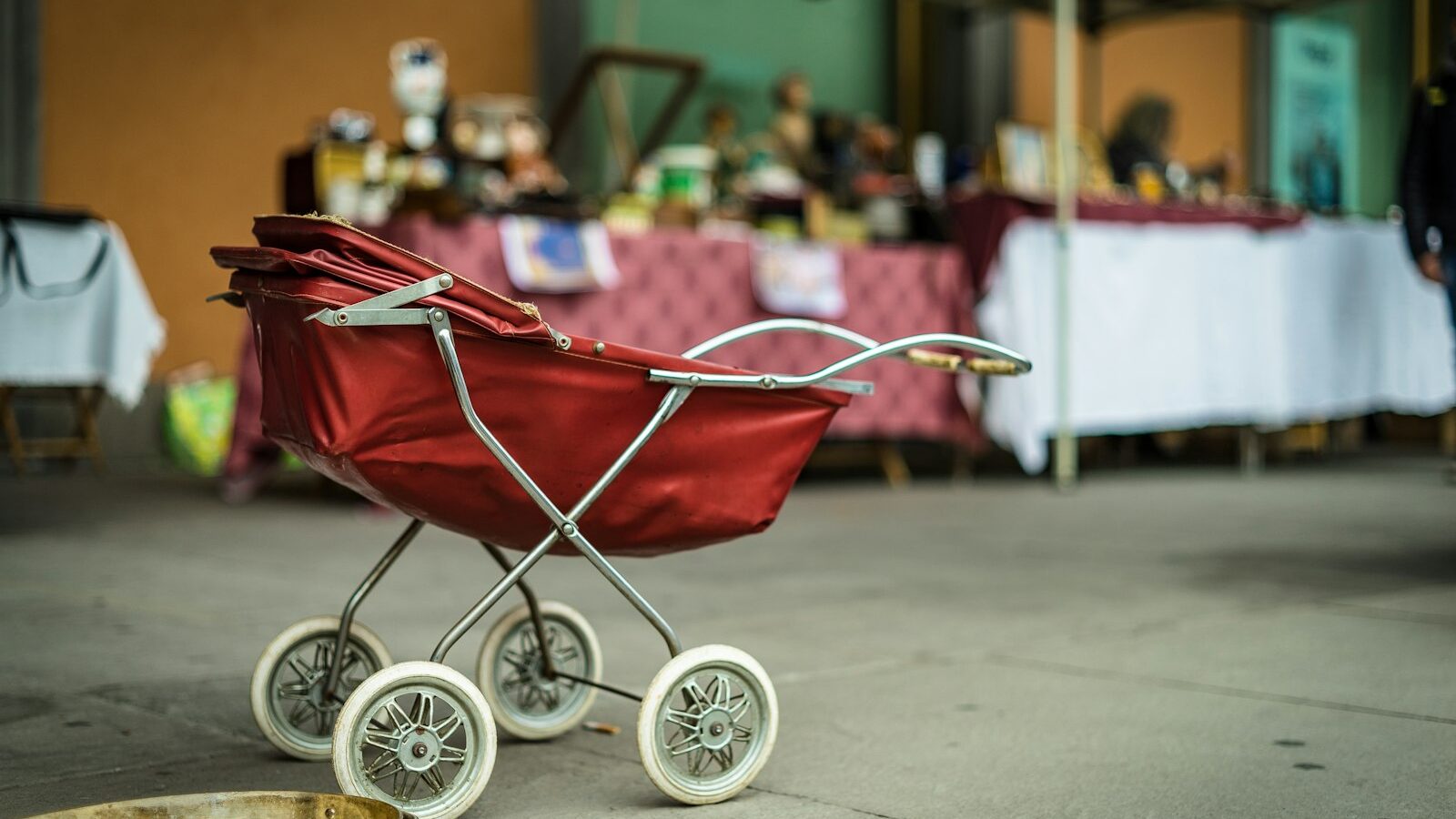
Children outgrow baby gear fast, and in a Singapore flat there is rarely room to keep a bulky pram or a car seat “just in case”. When the time comes to dispose of an old stroller or car seat, the greenest choice is not always the same for both. A sturdy stroller can often have a second life with another family. A car seat is different: once it is expired or has been in a crash, passing it on can put a child at risk.
This guide helps parents sort out which option fits each item, how to resell or donate responsibly, and how to get rid of what cannot be reused.
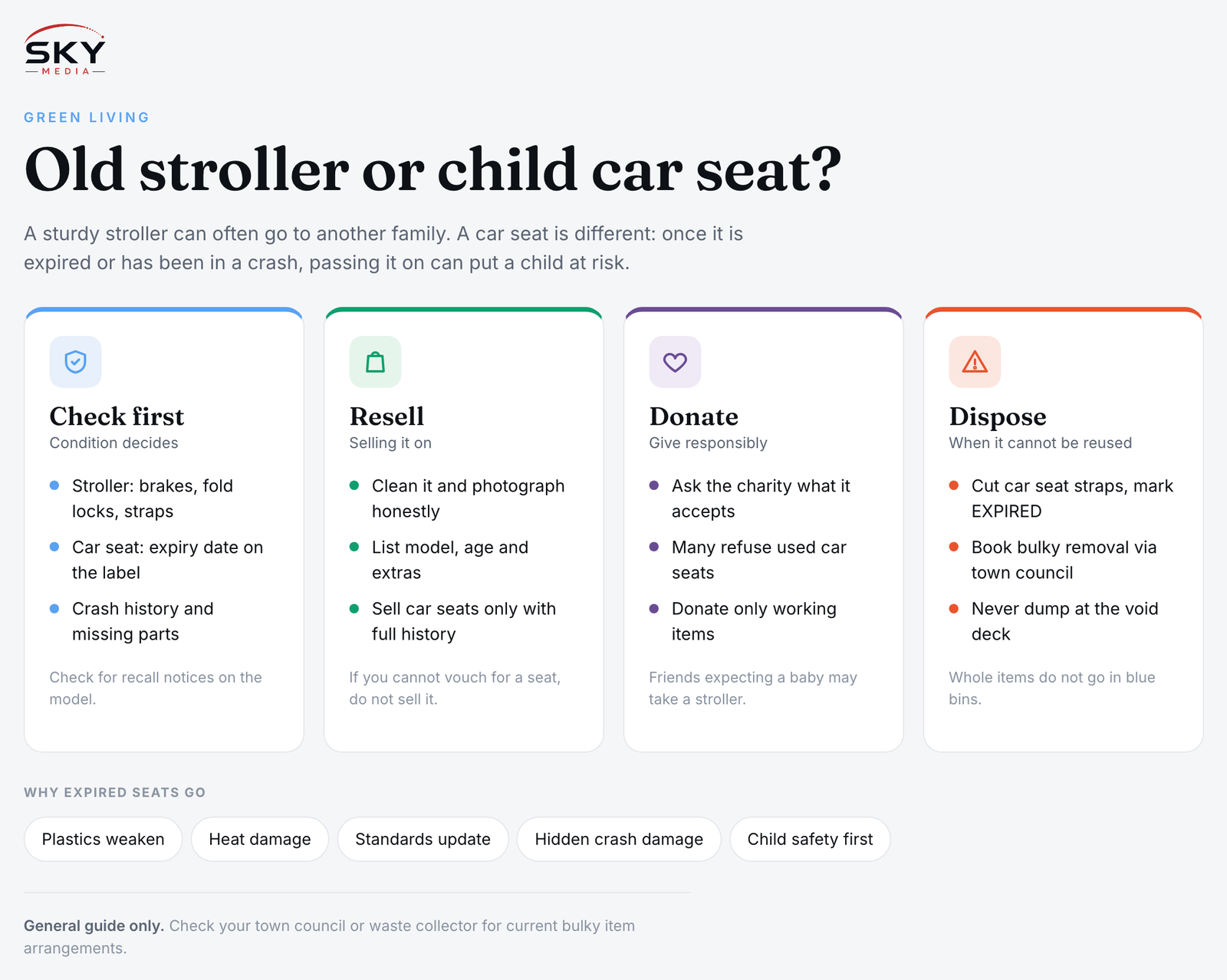
Start by Checking the Condition
Before you list anything for sale or drop it at a donation point, give each item an honest check.
For strollers and prams, look at:
- Brakes, which should lock firmly and release smoothly.
- The folding mechanism and locks, which should click securely in place.
- Harness straps and buckles, which should not be frayed or cracked.
- Wheels, frame and canopy for cracks, rust, bent parts or missing pieces.
- Any recall notices for the model. Check the manufacturer’s website, and see Singapore’s Consumer Product Safety Office (part of Enterprise Singapore) for product safety alerts.
For child car seats, look at:
- The expiry date. Most car seats have a manufacture date and a “do not use after” date or a stated lifespan, printed on a label or moulded into the plastic shell. Check the manual if you cannot find it.
- Crash history. Many manufacturers advise replacing a seat after a crash, even if it looks fine. Check what your seat’s manual says.
- Missing parts or labels, such as instructions, the base, or the safety approval label.
- Cracks, stress marks or frayed straps.
This check decides the route. Our guide to car seat safety for children explains why these details matter.
Choosing the Right Route for Each Item
| Item and condition | Best route | Why |
|---|---|---|
| Stroller in good working order | Resell or donate | Plenty of life left, saves another family money and waste |
| Stroller broken beyond simple repair | Strip reusable parts, then bulky waste removal | Unsafe to pass on, but some parts may still be useful |
| Car seat within date, no crash, complete | Pass on to someone you know, with its full history | Safe to reuse only if the new owner can trust its history |
| Car seat expired, crashed or incomplete | Disable it, then dispose as bulky waste | Should not be reused, as it may not protect a child |
Reselling a Stroller or Car Seat
Online marketplaces and parent groups on social media are busy with second-hand baby gear, so a good stroller often sells quickly.
Tips for a smooth sale:
- Clean it well. Wipe down the frame, vacuum crumbs from the seat and wash removable fabric according to the label.
- Photograph it honestly, including any wear or scuffs.
- List the model, age and what is included, such as the rain cover, cup holder or adaptors.
- Include the manual if you still have it, or link to the manufacturer’s online version.
- Meet safely in a public place, or at your void deck, and avoid sharing more personal details than needed.
For car seats, be especially careful. Only sell or give away a seat if it is within its expiry date, has never been in a crash, and has all its parts and labels. Tell the buyer its full history and the expiry date in writing in your listing. If you cannot vouch for its history, do not sell it.
Donating Baby Gear Responsibly
Donation is a lovely way to help families who need it, but check before you drop items off.
- Ask first. Contact the charity, family service centre, community group or second-hand shop and ask what they accept. Many have clear lists, and needs change.
- Expect car seats to be refused. Many organisations do not accept used car seats at all, because they cannot verify the seat’s history. This is a safety policy, not a judgement on your seat.
- Donate only working items. A stroller with broken brakes is a burden to the charity, which then has to dispose of it.
- Bundle useful extras, such as a rain cover or stroller hooks, with the main item.
- Consider your own network. Friends, relatives, neighbours and colleagues expecting a baby may be happy to take a stroller, and with a car seat, you can give them its complete history.
Community sharing groups and “free to a good home” listings can also find a taker quickly, especially for well-known stroller brands.
Why Expired Car Seats Should Not Be Passed On
It can feel wasteful to throw away a car seat that looks perfect. But car seats are safety equipment, and their materials do not last forever.
- Plastics can weaken over time, especially in Singapore’s heat and when a seat has been left in a hot car for years.
- Safety standards are updated, and older seats may not meet current requirements.
- Damage from a crash is not always visible.
Using an expired or damaged seat for a child is not something to risk. If a seat is past its date, it has reached the end of its useful life for carrying children. For information on choosing a replacement, see our guide to choosing a child car seat.
How to Dispose of a Car Seat or Broken Stroller
When an item cannot be reused, make sure nobody picks it up and uses it by mistake, then dispose of it properly.
Disable an expired car seat before disposal:
- Cut the harness straps.
- Remove the fabric cover and padding.
- Write “EXPIRED, DO NOT USE” clearly on the shell with a permanent marker.
- If you can, separate metal parts and remove the base.
Arrange bulky waste removal:
- HDB residents: contact your town council. Town councils generally offer bulky item removal for residents, often free within a set number of collections. Check your town council’s website or call them for the current arrangement and booking method.
- Private estates and landed homes: contact the public waste collector for your area, appointed by NEA, or your condo’s management office (the MCST, or Management Corporation Strata Title) for its arrangements.
- Do not leave items at the void deck or common corridor. Leaving bulky items in common areas without arrangement can be treated as illegal dumping and is a fire and obstruction risk.
Recycle what you can:
- Clean, sorted metal parts, such as a stroller frame stripped of fabric, may be accepted by recycling services that take scrap metal. Check with the collector first.
- Do not put a whole car seat or stroller in the blue recycling bin. Blue bins are for smaller, clean recyclables, and bulky mixed-material items can contaminate a whole load. NEA’s recycling guidance lists what goes into blue bins.
- Washable fabric covers in good condition can sometimes be reused as cleaning cloths or given to textile collection points, if the collector accepts them.
Keep, Store or Let Go
If you plan to have another child soon, storing gear may make sense, as long as the car seat will still be within date when you need it. Our guide on how to store child car seats when not in use covers storing safely. If not, letting go sooner frees up space and lets a stroller help another family while it is still in good shape.
A little planning turns a cluttered storeroom into a small win for your wallet, another family and the environment. Check the condition, choose the right route, and send expired car seats to the end of the line safely.
Official sources: National Environment Agency (NEA)