
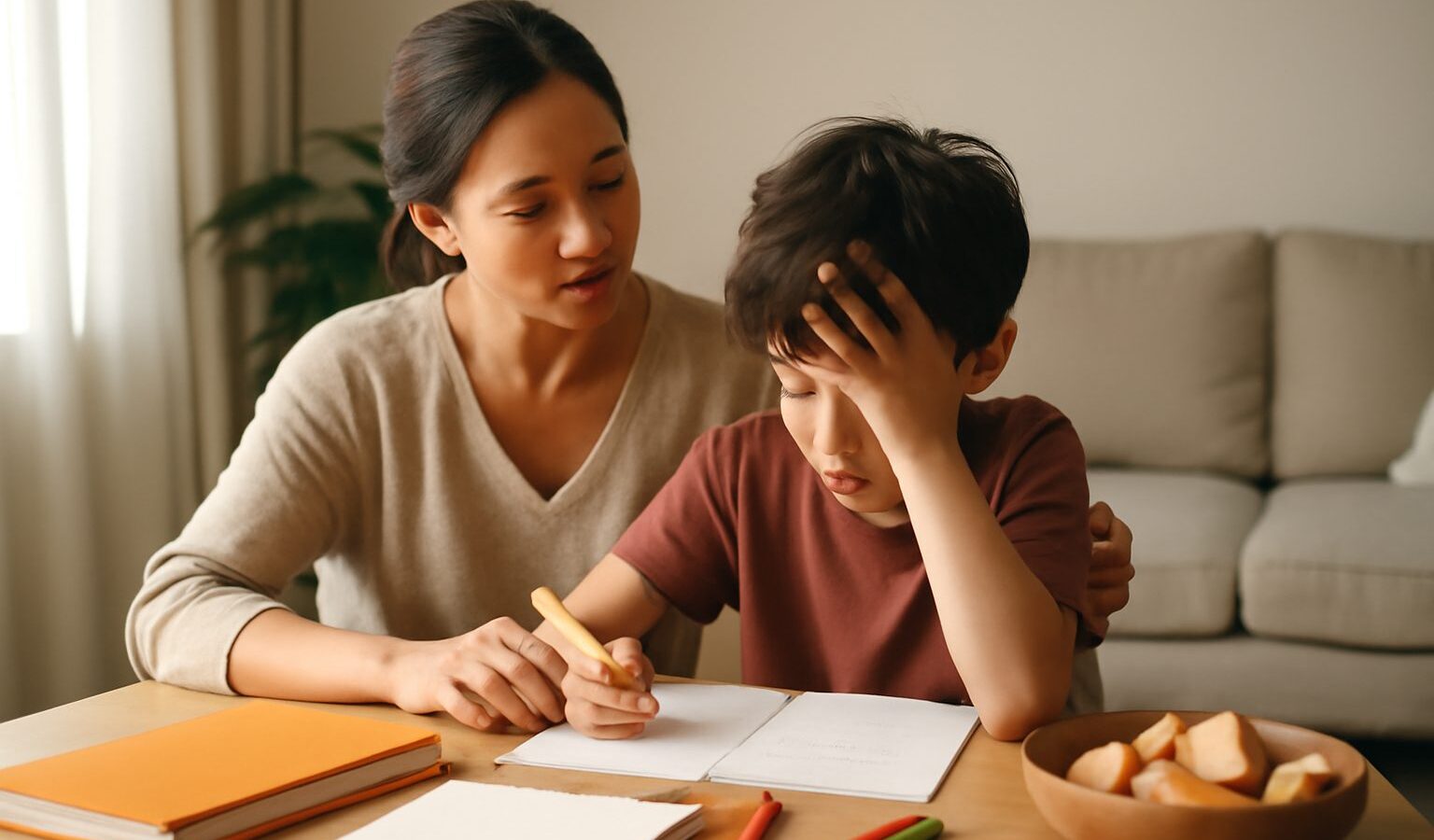
If you are raising a child with ADHD, some days can feel like you are running a house on hard mode. Getting out the door for school, sitting through dinner, finishing homework without three reminders and a wobble: these ordinary moments can take real energy for the whole family. You are not doing it wrong, and your child is not being difficult on purpose. ADHD, or attention deficit hyperactivity disorder, is a difference in how the brain manages attention, impulses and activity. With the right structure and a good dose of patience, home can become the calmest, most understanding place in your child’s day.
This is general information for Singapore families, not medical advice. Every child is different, and a child with ADHD deserves proper assessment and guidance from a paediatrician or child psychologist. Use what follows as a starting point, and always defer to the professionals who know your child.
Understanding What ADHD Actually Is
ADHD is not a matter of laziness, poor discipline or too much sugar. It is a recognised neurodevelopmental difference that affects how a child regulates attention, movement and impulses. Some children are mainly inattentive: they drift off, lose things and struggle to start tasks. Others are more hyperactive and impulsive: always on the go, blurting out answers, finding it hard to wait. Many are a mix of both.
It helps to remember that your child is not giving you a hard time. They are having a hard time. A child with ADHD often wants very much to please you and to do well. Their brain simply needs more support to bridge the gap between knowing what to do and actually doing it. When you see the behaviour as a skills gap rather than a willpower gap, everything softens, including your own reactions.
In Singapore, a formal assessment is usually done by a paediatrician, a child psychologist or a team at KKH or NUH. If you have concerns, speak to your GP, polyclinic doctor or your child’s school. Early support through the Early Childhood Development Agency (ECDA) and school learning support can make a real difference, and getting a clear picture is the first step.
Building Routines That Do the Remembering
Children with ADHD thrive on structure, because a predictable day means their brain has to hold less in mind at once. The goal is to build routines so familiar that they run almost on their own, leaving less room for friction.
- Keep the day visual. A simple chart or whiteboard by the door showing the morning steps (wake, wash, dress, eat, bag, shoes) does the reminding so you do not have to nag. Pictures work well for younger children.
- Break tasks into small pieces. “Tidy your room” is overwhelming. “Put the books on the shelf” is doable. One instruction at a time, then the next.
- Anchor to fixed points. Homework right after a snack, shower after dinner, screens off at the same time each night. Regular rhythms reduce daily negotiation.
- Use timers, not lectures. A visual timer for how long until we leave, or how long a task should take, turns an abstract idea into something a child can see.
- Protect sleep. Tiredness makes attention and self-control much harder. A calm, consistent wind-down routine helps more than most parents expect, especially in our warm evenings when settling can be tricky.
Consistency between caregivers matters too. If you share care with grandparents or a helper, walk them through the routines so your child gets the same steady signals wherever they are. It is worth revisiting our guide on working with a helper to care for your child so everyone pulls in the same direction.
Responding to Meltdowns Without Making Them Worse
Meltdowns and big emotions are common when a child’s brain is overloaded, and how you respond shapes what happens next. The aim is not to win the moment but to help your child come back to calm.
The table below contrasts reactions that tend to fuel a meltdown with ones that help settle it. None of this is about being permissive; it is about staying regulated yourself so your child can borrow your calm.
| In the heat of the moment | Try this instead | Why it helps |
|---|---|---|
| Raising your voice to match theirs | Lower your voice and slow down | A calm adult signals safety and helps the nervous system settle |
| Piling on instructions and questions | Say less, use short phrases | An overloaded brain cannot process long explanations |
| Demanding they explain themselves now | Wait until they are calm, then talk | Reasoning only lands once emotions have passed |
| Threatening big punishments | Hold the boundary quietly and kindly | Fear escalates; steady limits reassure |
Once the storm has passed, reconnect before you correct. A short cuddle or a quiet moment rebuilds trust, and then you can gently talk through what happened and what to try next time. Praise the recovery, not just the good behaviour.
Supporting Focus, Homework and School
Sitting still and concentrating is genuinely hard work for a child with ADHD, so set the environment up to help. Create a tidy, low-distraction homework spot, away from the television and, where possible, from siblings. Short bursts of work with movement breaks in between usually beat one long, painful session. Many children focus better after they have run around, so let them burn energy first.
Work with your child’s school rather than in parallel to it. Singapore schools have learning support staff, and teachers can often make small adjustments, such as seating your child near the front or breaking instructions down. Keep a friendly, open line with the form teacher, and share what works at home. If homework becomes a nightly battle, it is fine to ask the school how to make it more manageable rather than pushing through tears.
Above all, protect your child’s sense of themselves. Children with ADHD hear a lot of correction in a day, so be deliberate about catching them getting things right. Notice effort, kindness, humour and the many strengths that often come with an ADHD mind: creativity, energy, curiosity and the ability to hyperfocus on things they love. Helping them build on interests, as we cover in supporting your child’s hobbies and interests, does wonders for confidence.
Looking After Yourself and the Whole Family
Parenting a child with ADHD is demanding, and you cannot pour from an empty cup. Guilt, frustration and exhaustion are all normal, and feeling them does not make you a bad parent. Share the load with your partner or family where you can, and give yourself the same patience you are trying to show your child.
Watch for the strain on everyone, including siblings, who may feel that the child with ADHD gets more attention. Small pockets of one-on-one time with each child help. If change or stress is adding to things, our guide on helping your child cope with change may be useful.
Finally, look after your own wellbeing. If you feel persistently low, anxious or overwhelmed, please reach out for support. You can call mindline at 1771 or SOS at 1767 if you are struggling, and speak to your doctor. Supporting a child with ADHD is a long game, and a steady, well-rested parent is the single most helpful thing in the whole plan.
Every child with ADHD is different, and this article is general guidance only. For assessment, diagnosis and a plan tailored to your child, please consult your paediatrician, a child psychologist or your child’s school, and lean on ECDA and Singapore’s professional services where relevant.
Related across Sky Media: Supporting a Child With ADHD in Learning