

If you are a Singaporean planning to marry someone from overseas, or a foreign partner (for example from mainland China) planning to marry a Singaporean, one question often sits quietly in the background: after the wedding, will the foreign spouse be allowed to live in Singapore? The pre marriage LTVP assessment exists to answer that question earlier. It lets couples find out, before they register their marriage, whether the foreign partner is likely to be eligible for a Long-Term Visit Pass (LTVP) as a spouse.
This article explains what the assessment is, who it is for, how to prepare and what the result means. It is general information, not legal or immigration advice. The Immigration & Checkpoints Authority (ICA) runs the scheme and sets its rules, so always confirm the current requirements on the ICA website before you apply.
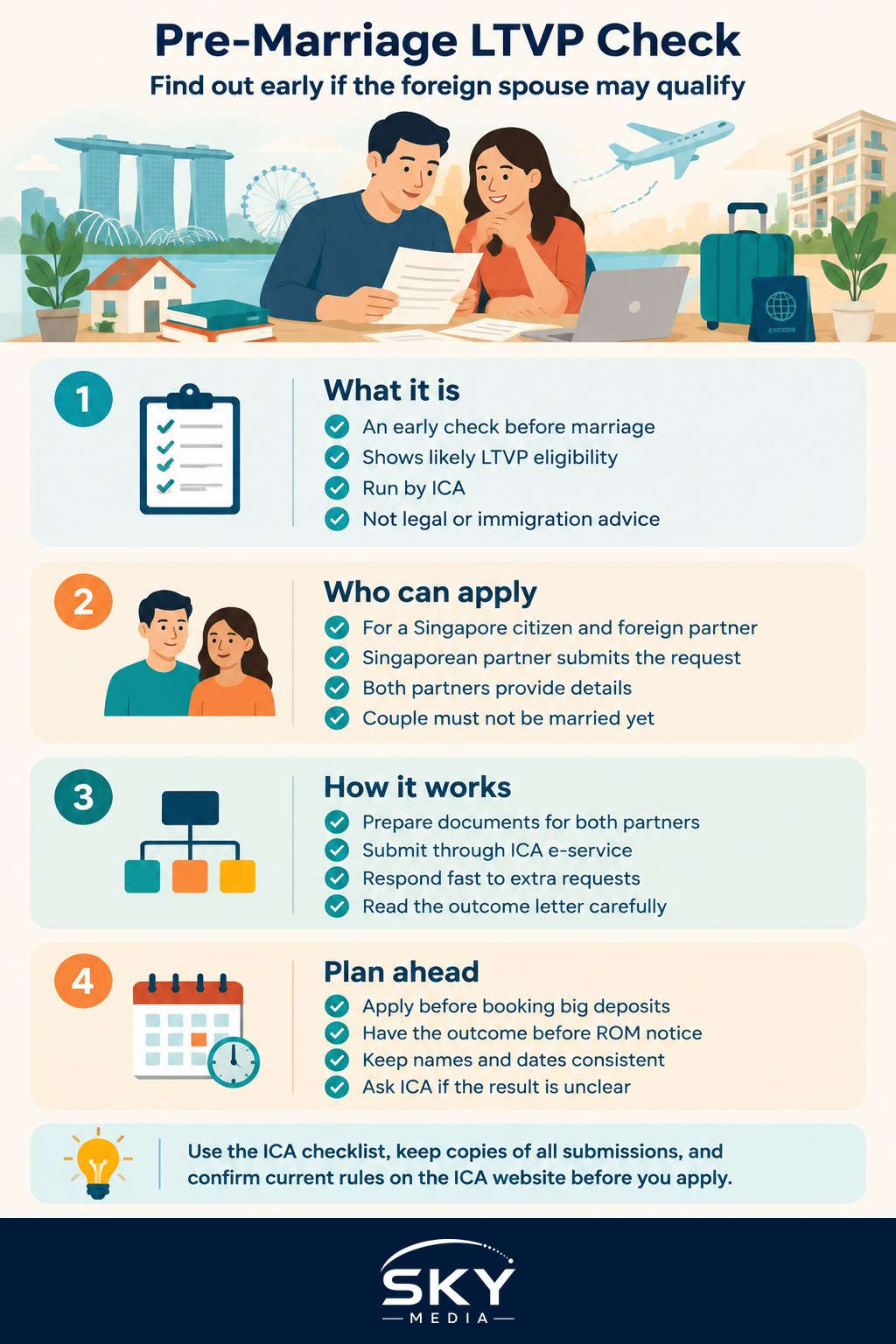
What the LTVP Is, and Why an Early Check Helps
The Long-Term Visit Pass is issued by ICA. For couples, it is the pass that commonly allows the foreign spouse of a Singapore citizen to stay in Singapore for an extended period. Our explainer on the Long-Term Visit Pass (LTVP) covers how the pass works after marriage, including the enhanced LTVP+ version for some foreign spouses.
The problem with applying only after the wedding is timing. A couple might marry, make plans, sign a lease or arrange a job move, and only then discover the pass application is not approved. That can be painful for a new family. The Pre-Marriage Long-Term Visit Pass Assessment, often shortened to PMLA, gives couples an indication of eligibility while they still have time to plan.
For readers from mainland China, a simple comparison may help. In China, household registration (户口) shapes where you can live and access services. In Singapore, a foreign spouse’s right to stay is decided pass by pass, by the relevant authority, based on the couple’s circumstances. The PMLA is a way to ask ICA for its view in advance, rather than waiting until after the marriage is registered.
Who Can Apply for the Assessment
The PMLA is designed for couples in which a Singapore citizen intends to marry a foreign national. In general:
- The Singaporean partner submits the request, as the intended sponsor of the future LTVP.
- Both partners must provide personal details and supporting documents.
- The couple must not yet be married to each other. Once you are married, you apply for the LTVP itself instead.
If the Singaporean partner is a permanent resident rather than a citizen, or if either partner has previously been married, divorced or widowed, the process and documents may differ. Check the ICA website for the current eligibility rules that apply to your situation, rather than assuming they match a friend’s experience.
How the Assessment Works, Step by Step
The exact process is set by ICA and can change, so treat the outline below as a general picture.
| Stage | What you do | What happens |
|---|---|---|
| Prepare | Gather identity, education, employment and income documents for both partners | You find out early if any documents need translating or certifying |
| Submit | The Singaporean partner submits the request through ICA’s official e-service, usually logging in with Singpass | ICA receives the application and may ask for more information |
| Assessment | Respond quickly to any request for extra documents | ICA reviews the couple’s circumstances as a whole |
| Outcome | Read the outcome letter carefully, including any validity period | You learn whether the foreign partner is likely to be eligible for an LTVP after marriage |
| After marriage | Register the marriage, then apply for the LTVP itself | The actual pass application is assessed again at that time |
ICA does not publish a simple checklist that guarantees approval. It considers each case in the round. Factors that are commonly understood to matter include the sponsor’s ability to support the family financially, the background of both partners, and whether the information provided is complete and truthful. Do not rely on online forums claiming a fixed income figure or a “formula”. Read the official guidance instead.
Documents and Preparation Tips
Your list will depend on your circumstances, so use the ICA checklist as your starting point. Couples are often asked for documents along these lines:
- Passports and identity documents for both partners.
- Proof of education and employment, and income documents for the sponsor.
- Documents about marital history, such as a divorce certificate or a spouse’s death certificate if either partner was previously married.
- For mainland Chinese partners, documents issued in China may need to be officially translated into English and notarised or certified. The requirements for this, including which body should certify them, are set by ICA and can change, so confirm before you pay for translations.
A few practical tips:
- Be completely honest. Inaccurate or incomplete information can lead to rejection and may affect future applications.
- Keep copies of everything you submit, along with the submission date and reference number.
- Start early. Getting documents from overseas, especially certified ones, can take longer than expected.
- Check the names match. Make sure the spelling of names and dates of birth are consistent across all documents, including Chinese names in pinyin.
Understanding the Outcome
The outcome letter is an assessment, not the pass itself. Keep these points in mind:
- A favourable outcome is an indication, not a guarantee. After marriage, you still need to apply for the LTVP, and ICA will assess the application based on circumstances at that time. If something material changes, such as the sponsor’s employment, the result may differ.
- The outcome usually has a validity period. Check the letter for how long it applies and plan your Registry of Marriages (ROM) appointment accordingly.
- An unfavourable outcome is not always the end of the road. Ask ICA whether there are ways to strengthen a future application, and what options exist. Some couples choose to reassess their plans, such as where they will live, after receiving the result.
If you are unsure what the letter means, contact ICA directly through its official channels. For complex cases, some couples also seek advice from a lawyer familiar with family and immigration matters.
Fitting the Assessment Into Your Wedding Plans
Couples often find it helps to place the PMLA early in the wedding timeline:
- Before booking venues or paying large deposits, do the assessment so you know where you stand.
- Before giving notice of marriage at ROM, have your outcome letter in hand.
- Consider a marriage preparation programme. The Ministry of Social and Family Development supports marriage preparation programmes, and ICA has encouraged Singaporean and foreign couples to attend one. Check whether attendance is required or recommended in your case on the official websites.
- Talk through practical life questions together, such as where you will live, how you will manage money and how you will handle family expectations on both sides. Our list of questions every couple should ask before marriage is a good starting point, and these conversations matter even more when partners come from different countries.
Planning Beyond the Pass
The LTVP is just one part of building a life together in Singapore. The foreign spouse may later wish to work, and work permissions depend on Ministry of Manpower rules for their specific pass, so check with MOM before starting any job. If you are weighing different routes, for example because a friend in a similar situation holds an Employment Pass rather than citizenship and sponsored a spouse differently, our comparison of Dependant’s Pass vs LTVP explains the differences.
The pre marriage LTVP assessment cannot remove all uncertainty, but it gives couples a clearer picture before making one of life’s biggest commitments. Treat it as an early, honest check, prepare your documents carefully, and rely on ICA’s official guidance for the details.
Frequently Asked Questions
Can my partner stay on a visit pass while we wait for the assessment? Foreign partners commonly enter on a short-term visit pass, but its length and renewal depend on ICA’s rules and your nationality. A visit pass does not allow work. Check ICA for the current conditions, and avoid overstaying while the assessment or later LTVP application is pending.
Do we need a lawyer or agent to apply for the pre-marriage assessment? No, the Singaporean partner submits the request through ICA’s official e-service, and a lawyer or agent is optional. Be careful with anyone promising approval, since ICA assesses each case itself. A lawyer can help with complex histories such as previous marriages.
Can the foreign spouse work in Singapore on an LTVP? Do not assume so. Work permissions depend on Ministry of Manpower rules for the specific pass the spouse holds, and the requirements can change. Check with MOM before starting any job, and confirm whether your spouse needs separate work approval first.
Is the LTVP+ different from the ordinary LTVP? Yes, LTVP+ is an enhanced version of the pass that ICA offers to certain foreign spouses of Singapore citizens, with extra benefits. Eligibility and the benefits are set by ICA, so check the current criteria before assuming it applies to you.
What happens to the spouse’s pass if the marriage ends? A spouse’s long-term pass is linked to the marriage, so a divorce or separation can affect the foreign partner’s right to stay. ICA reviews each case individually, and the outcome depends on the circumstances. Seek advice from a lawyer and speak to ICA before making decisions.
Further reading: Converting to Islam for Marriage in Singapore: What Couples Should Know