

Many children know their Science content well, yet still lose marks in the written section of the paper. The reason is usually technique, not knowledge. PSLE Science open ended questions ask pupils to explain, predict and justify in their own words, and markers look for specific ideas expressed precisely. This guide focuses on how to answer those questions well, with practical habits parents can reinforce at home.
The exact paper format and marking are set by the Singapore Examinations and Assessment Board (SEAB). Check SEAB’s website and your child’s school for the current format, as details can be updated.
How Open-Ended Questions Differ From Multiple Choice
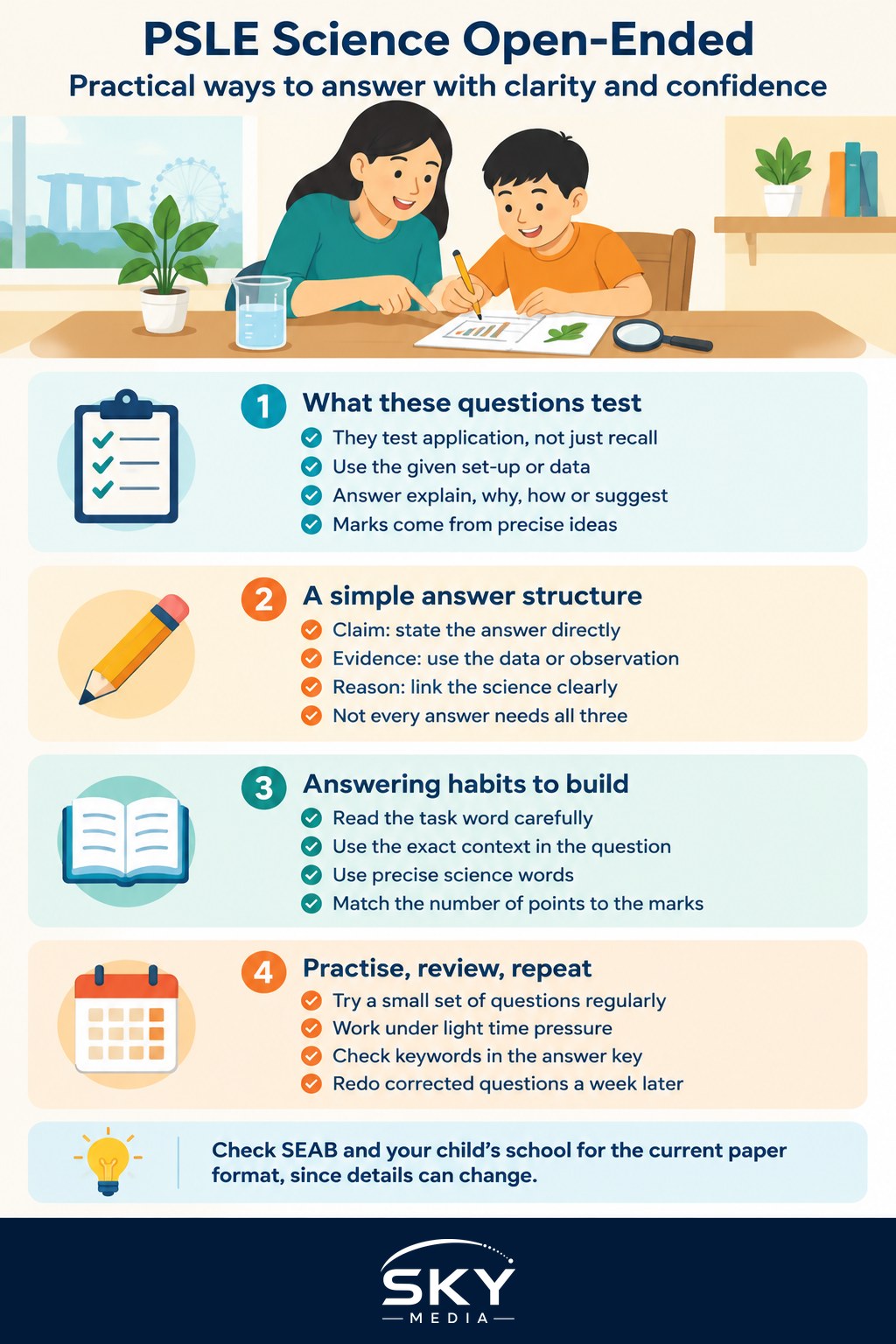
In PSLE Science, multiple-choice questions test whether a child can recognise the right idea. Open-ended questions, found in the written booklet, test whether the child can produce and apply that idea in an unfamiliar context. They typically involve:
- An experiment set-up, diagram, table or graph the child has never seen before
- Several short parts, each worth a small number of marks
- Questions that begin with words like “explain”, “why”, “how”, “suggest” or “what would happen if”
The common mistake is treating these as recall questions. A child might write a correct textbook fact that does not actually answer what was asked. Marks are given for linking the relevant concept to the specific situation in the question.
If you want a broader picture of the exam itself, our guide to the PSLE explained covers subjects, scoring and timelines.
A Simple Answer Structure: Claim, Evidence, Reason
A reliable way to answer “explain” questions is to build each answer in three parts:
- Claim. State the answer directly. For example, “Plant A grew taller than Plant B.”
- Evidence. Point to the data or observation in the question. “From the graph, Plant A received more light.”
- Reason. Explain the science that links them. “More light allowed Plant A to make more food through photosynthesis, so it could grow more.”
Not every question needs all three, but thinking this way stops children writing only half an answer. For “why” questions in particular, the reason is usually where most marks sit.
Answering Habits That Earn the Marks
Teach these habits through regular practice until they become automatic:
- Read the whole question, then underline the task word. “Describe” is not the same as “explain”. “State” usually needs a short, direct answer.
- Use the context. Refer to the specific plant, animal, object or set-up in the question rather than writing in general terms. “The ice in Beaker X” scores better than “ice”.
- Use precise scientific vocabulary. “Gains heat” rather than “gets hot”, “water vapour condenses” rather than “it turns wet”, “the force of friction” rather than “it is harder to move”.
- Be careful with comparisons. If the question compares two set-ups, mention both. “Set-up A lost heat faster than Set-up B” is clearer than “it lost heat fast”.
- Avoid vague words. Words like “it”, “thing” and “stuff” can make answers ambiguous. Name what you mean.
- Match the marks. A question worth more marks usually needs more than one point. A short answer to a multi-mark question often loses marks.
- Do not contradict yourself. Extra points that conflict with the correct answer can cost marks. Write what you are sure of, clearly.
Common Question Types and How to Approach Them
| Question type | What it asks | Answering technique |
|---|---|---|
| Fair test or experiment design | Why a variable is kept the same, or how to improve the set-up | Identify the variable changed, the variable measured and those kept constant, then explain how that makes the results reliable |
| Graph or table interpretation | Describe a trend or draw a conclusion | Describe the relationship in words, for example “as X increases, Y decreases”, and quote figures from the data where helpful |
| Prediction | What would happen if a condition changed | State the result clearly, then give the scientific reason, linked to the new condition |
| Explaining an observation | Why something happened in the set-up | Use claim, evidence and reason, naming the relevant concept such as heat transfer or photosynthesis |
| Applying a concept to real life | How a design or adaptation helps | Link the feature to its function and then to the benefit, for example a structure that reduces water loss in a dry habitat |
Getting fair test questions right
Experiment questions appear often and are a common source of lost marks. Train your child to ask three questions every time:
- What is being changed on purpose? (the changed variable)
- What is being measured or observed? (the measured variable)
- What must stay the same so the test is fair? (the constant variables)
When asked why a factor is kept constant, a strong answer explains that it ensures the change in results is caused only by the changed variable. When asked how to make results more reliable, repeating the experiment and taking an average is a common sound answer, though the best answer always depends on the set-up shown.
Reading graphs carefully
Children often lose marks by misreading axes or units. Encourage them to check what each axis represents, note the units, and describe the overall trend before mentioning any exceptions. If a question asks for a conclusion, it should be based on the data shown, not on outside assumptions.
Building a Practice Routine at Home
Short, focused practice tends to work better than long sessions. A simple weekly routine might look like this:
- Choose a small set of open-ended questions from school worksheets or past-year papers available through official or school channels.
- Let your child attempt them under light time pressure, writing full sentences.
- Compare with the answer key together. Look at which keywords and ideas earned marks, not just whether the answer was “right”.
- Keep a keyword notebook. Note phrases that markers expected, organised by topic, such as heat, light, electricity, life cycles and adaptations.
- Redo corrected questions a week later to check the technique has stuck.
Ask your child to explain answers out loud. If they cannot explain it clearly in speech, they usually cannot write it clearly either. A visit to Science Centre Singapore can also help concepts click by seeing them in action.
Supporting Your Child Without Adding Pressure
Open-ended questions can feel daunting because there is no list of options to choose from. Keep encouragement focused on progress, such as clearer wording or using the data more often, rather than on marks alone. Praise effort when your child rewrites an answer more precisely.
If your child seems anxious or overwhelmed, talk to their Science teacher, who knows what the class is working on, or the school counsellor if stress is affecting their wellbeing. Our guide on supporting your child through the PSLE years has more ideas for keeping the period calm.
With a clear answer structure, precise vocabulary and steady practice, PSLE Science open-ended questions become a chance for your child to show what they understand, rather than a section they dread.
Official sources: Ministry of Education (MOE)
Further reading: How to Revise Science Effectively for Singapore Exams · Tackling Data Response and Source Questions in Singapore